



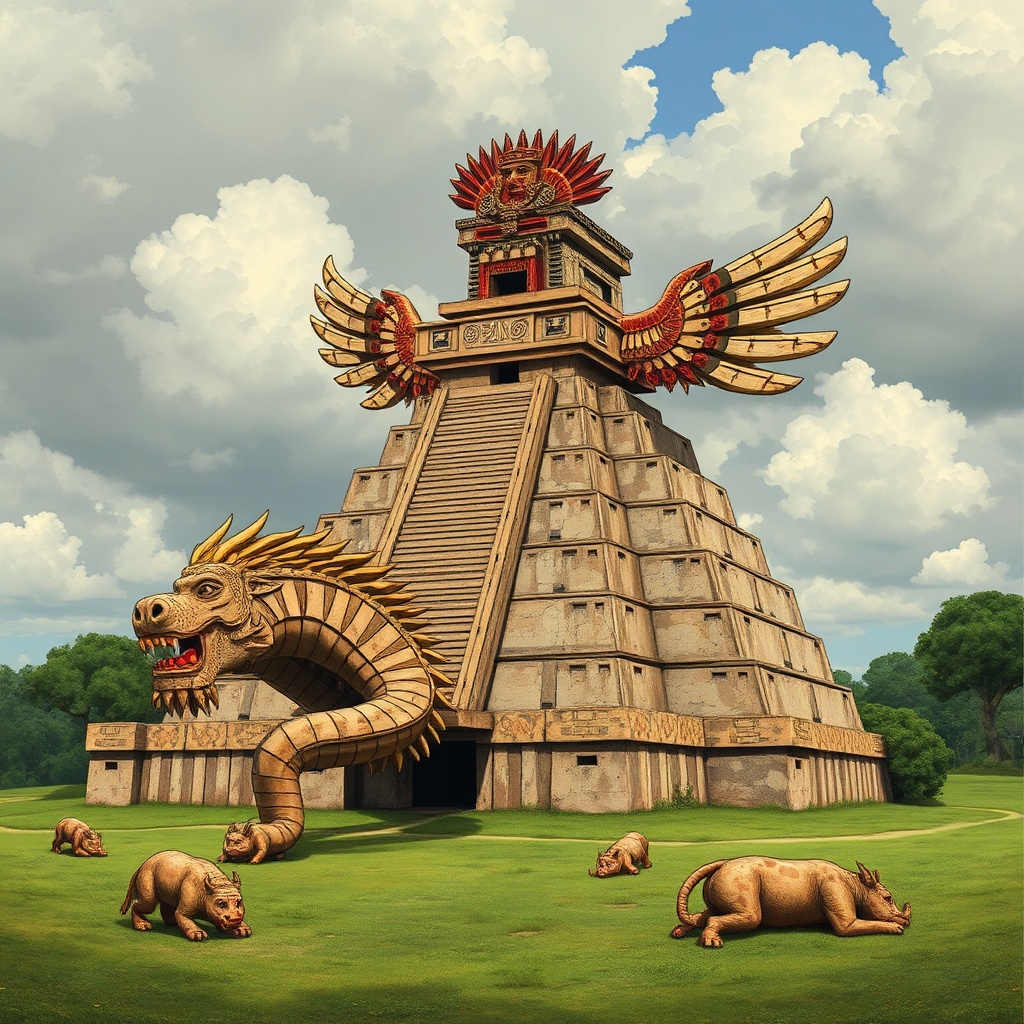
Aztec/Mayan Mythology, frequently referenced in contemporary reconstructions, encompasses a complex system of beliefs, rituals, and cosmological narratives that shaped the lives of pre-Columbian Mesoamerican civilizations. Far from being mere historical artifacts, these traditions find echoes in modern spiritual movements that seek to revive and adapt ancient practices and cosmologies to the current context, raising discussions about religious syncretism, cultural appropriation, and the very nature of religiosity in a globalized world.
Aztec/Mayan Mythology: Contemporary Reconstructions in the Context of the Humanities
1. Sociological and Theological Definition
From a sociological perspective, "Aztec/Mayan Mythology" in its contemporary reconstructions can be defined as a set of practices and belief systems that appropriate, reinterpret, and seek to revive elements of the worldviews of the ancient Aztec (Mexica) and Mayan peoples. These movements often manifest as neopaganism, contemporary indigenous spiritualities, or syncretic paths, seeking a connection with ancestry and with the natural and divine forces described in Mesoamerican traditions. Theologically, these reconstructions aim to understand and, at times, emulate the complex theogony, cosmology, and soteriology that characterized the original religions. They involve the worship of a pantheon of deities associated with elements of nature (sun, rain, corn), abstract concepts (justice, wisdom), and aspects of human life (war, fertility), as well as rituals that seek to maintain cosmic balance and harmony between the human and divine worlds.
2. Historical Origin, Founders, and Geographic/Cultural Context of Emergence
The historical origin of the beliefs that today compose "Aztec/Mayan Mythology" dates back thousands of years, with the civilizations that flourished in Mesoamerica, particularly in the regions that today correspond to central Mexico (Aztecs) and the Yucatán Peninsula and adjacent areas (Mayans). The Aztecs, whose empire reached its peak in the 15th and early 16th centuries, centered in Tenochtitlán, developed a complex religious system influenced by earlier cultures such as the Toltec and Olmec. Their central deities included Huitzilopochtli (god of the sun and war), Tlaloc (god of rain), and Quetzalcóatl (feathered serpent, associated with knowledge and wind). The Mayans, whose city-states reached their zenith in the Classic period (c. 250–900 AD), possessed an equally rich cosmology, with deities such as Itzamná (creator god), Kukulkán (equivalent to Quetzalcóatl), and Chaac (god of rain). The cultural context was marked by a deep relationship with agriculture (especially corn), astronomy, mathematics, and monumental architecture. The Spanish colonization in the 16th century imposed Catholicism, leading to a forced decline and religious syncretism, where many indigenous practices and beliefs were suppressed but not entirely eradicated, surviving in rural communities and in veiled forms. Contemporary reconstructions do not have single "founders" in the sense of a central figure as in many Western religions. Instead, they emerge from the efforts of researchers, cultural activists, and practitioners who seek to rescue and revitalize these traditions, often based on ethnohistorical and archaeological sources and knowledge transmitted orally by descendants of the original peoples. Figures such as Miguel León-Portilla, a prominent scholar of Nahua culture, played a crucial role in the preservation and dissemination of Aztec knowledge, influencing generations of scholars and practitioners. However, it is important to note that contemporary reconstructions are interpretations and adaptations, not an exact replication of ancient practices, as the cultural and social context has changed drastically.
3. Main Beliefs, Dogmas, Rites, and Practices
The fundamental beliefs of Aztec and Mayan cosmologies revolve around duality, the interconnection of all beings, and the belief in cosmic cycles of creation and destruction. The concept of Ometeotl (in the Nahua tradition) as a dual and primordial deity, the source of all creation, is central. The gods were seen as active forces in the universe, whose interaction shaped reality. Sacrifice, including human sacrifice in some circumstances for the Aztecs, was practiced as a means to nourish the gods and maintain cosmic order. Agriculture, especially the cultivation of corn, was intrinsically linked to fertility rituals and thanksgiving to the deities. Astronomy was fundamental, with complex calendars (such as the sacred Mayan Tzolkin calendar and the 260-day Aztec ritual calendar, in addition to 365-day solar calendars) used to determine auspicious moments for rituals, agriculture, and war. Rites of passage, healing ceremonies, harvest celebrations, and festivals dedicated to specific deities were common. In contemporary reconstructions, practices may include meditation, the use of sacred plants (with respect for local laws and ethics), ceremonies of gratitude to nature, study of ancestral texts, ritual dances, and the revitalization of knowledge regarding traditional medicine. Rigid and unified dogmas are less common in contemporary reconstructions than in organized religions. The emphasis is placed more on personal experience, connection to the earth, and the ethics of reciprocity with the natural and spiritual world.
4. Organizational Structure and Leadership Profile
In ancient civilizations, the religious structure was hierarchical and intrinsically linked to political and social power. High priests held great authority, acting as intermediaries between the people and the gods, responsible for interpreting omens, conducting the most important rituals, and administering the temples. There was also a vast network of priests, scribes, healers, and other religious specialists. In contemporary reconstructions, the organizational structure is often decentralized and diverse. There are groups that follow academic research lines more strictly, with leadership composed of scholars and experienced practitioners who guide learning. Other movements are more fluid, with leaders who emerge through charisma, empirical knowledge, or by being considered guardians of ancestral lineages. In some indigenous communities that keep ancestral traditions alive, leadership may be exercised by respected elders, community leaders, or traditional healers (called Shamans in some traditions). The leadership profile varies widely, from academics with deep historical and anthropological knowledge to practitioners who have developed a strong spiritual and intuitive connection with the teachings. Transparency and authenticity are crucial aspects, but the lack of a centralized structure can sometimes lead to divergences in interpretation and practice.
5. [WARNING/CONTROVERSIES] Factual Analysis of Potential Controversies and Deviations
When addressing contemporary reconstructions of Aztec/Mayan Mythology, it is fundamental to distinguish between respectful, academic practice and potential deviations. Original Mesoamerican religions and cosmologies, although they involved practices such as human sacrifice in certain historical contexts, should not be equated with modern "destructive cults." The historical and cultural context and the motivations behind such practices were profoundly different from those of contemporary groups that explore or manipulate religious beliefs for nefarious ends. However, as in any religious or spiritual movement that seeks to revitalize ancient traditions, controversies may arise:
- Cultural Appropriation and Commercialization: One of the most significant challenges is cultural appropriation by individuals or companies that use Aztec/Mayan symbols, rituals, and narratives in a superficial, decontextualized manner, and often for purely commercial purposes, without deep respect or knowledge of the original traditions and their descendants. This can lead to the trivialization and distortion of sacred meaning.
- Pseudoscience and Unsubstantiated Claims: Some groups may make pseudoscientific or esoteric claims without a solid historical or anthropological basis, mixing elements from different traditions in a syncretic and indiscriminate way.
- Ethical Deviations in Small Groups: Although not a systemic characteristic of Aztec/Mayan mythology reconstructions as a whole, very small and isolated groups, especially those with charismatic leadership and little external oversight, may present dynamics of control or exploitation. However, there are no widespread and proven reports of "destructive cults" with characteristics of widespread abuse, extreme social isolation, or systemic crimes specifically associated with "Aztec/Mayan Mythology" in its contemporary reconstructions, compared to other religious or esoteric movements that have been the targets of criminal investigations and public denunciations. The vast majority of practitioners and scholars seek to preserve and honor these traditions in an ethical and responsible manner.
- Divergent Interpretations: The diversity of interpretations and practices among the different groups that draw inspiration from Aztec and Mayan traditions can lead to internal debates about "what is authentic" or "what is correct," but this reflects the organic and evolutionary nature of spirituality.
It is crucial that practitioners and interested parties seek reliable sources, recognize the historical and cultural complexity, and be attentive to any signs of exploitation, manipulation, or unethical behavior. Comparisons with "destructive cults" that exploit individual vulnerabilities for personal gain or control must be made based on factual evidence and documented investigations, not on hasty generalizations.
6. Social, Cultural Impact, and Contemporary Relevance
The social and cultural impact of contemporary reconstructions of Aztec/Mayan Mythology is multifaceted. For many descendants of the original peoples, these movements represent a path to reconnection with their cultural and ancestral identity, strengthening the sense of belonging in a globalized world that often marginalizes their heritage. For others, they offer spiritual and philosophical alternatives to traditional religions, attracting people in search of a sense of purpose, connection with nature, and ancestral wisdom. Culturally, these reconstructions contribute to religious and spiritual diversity, enriching the landscape of existing practices and beliefs. They also drive academic research and public interest in the rich Mesoamerican civilizations, promoting greater understanding and respect for these cultures. Contemporary relevance lies in the ability of these ancient wisdoms to offer perspectives on modern challenges, such as the environmental crisis (through cosmologies that emphasize interdependence and respect for nature), the search for authenticity, and the need to rebuild communities. By revisiting and reinterpreting these traditions, contemporary society can find inspiration to develop more sustainable, ethical, and spiritually meaningful approaches to life.
References and Research Sources
- León-Portilla, Miguel. *The Broken Spears: The Aztec Account of the Conquest of Mexico*. Beacon Press, 2006.
- Coe, Michael D., and Stephen Houston. *The Maya*. Thames & Hudson, 2015.
- Townsend, Camilla. *Malintzin's Choices: An Indian Woman in the Conquest of Mexico*. UNM Press, 2006.
- Miller, Mary Ellen. *Maya Art and Architecture*. Thames & Hudson, 2017.
- Read, Kay A. *Corn and the Creation of the Americas: Indigenous and Colonial Narratives of the American Southwest*. Berghahn Books, 2018.
- Smith, Michael E. *The Aztecs*. Blackwell Publishing, 2009.
- Castañeda, Carlos. *The Teachings of Don Juan: A Yaqui Way of Knowledge*. University of California Press, 1968. (Note: Although Carlos Castañeda is a controversial figure and his works are widely considered fictional by many scholars, his works had a significant impact on the popularization of shamanic and spiritual themes in non-traditional contexts, influencing the landscape of new spiritualities. It is essential to approach him with critical discernment.)
- Richardson, James T. *Regulating Religion: Case Studies in the Twenty-First Century*. Springer, 2016. (Addresses the complex task of defining and regulating religious groups and the controversies surrounding "cults").
- Velasco, R. E., & Martínez, E. G. (2018). *Revitalization of indigenous traditions in Mexico: Challenges and perspectives*. *Revista de Antropología Social*, 27(2), 351-372.
- Carrasco, Davíd. *Cosmic Canvas: Creation Myths of the Indigenous Americas*. Bear & Company, 2017.





