



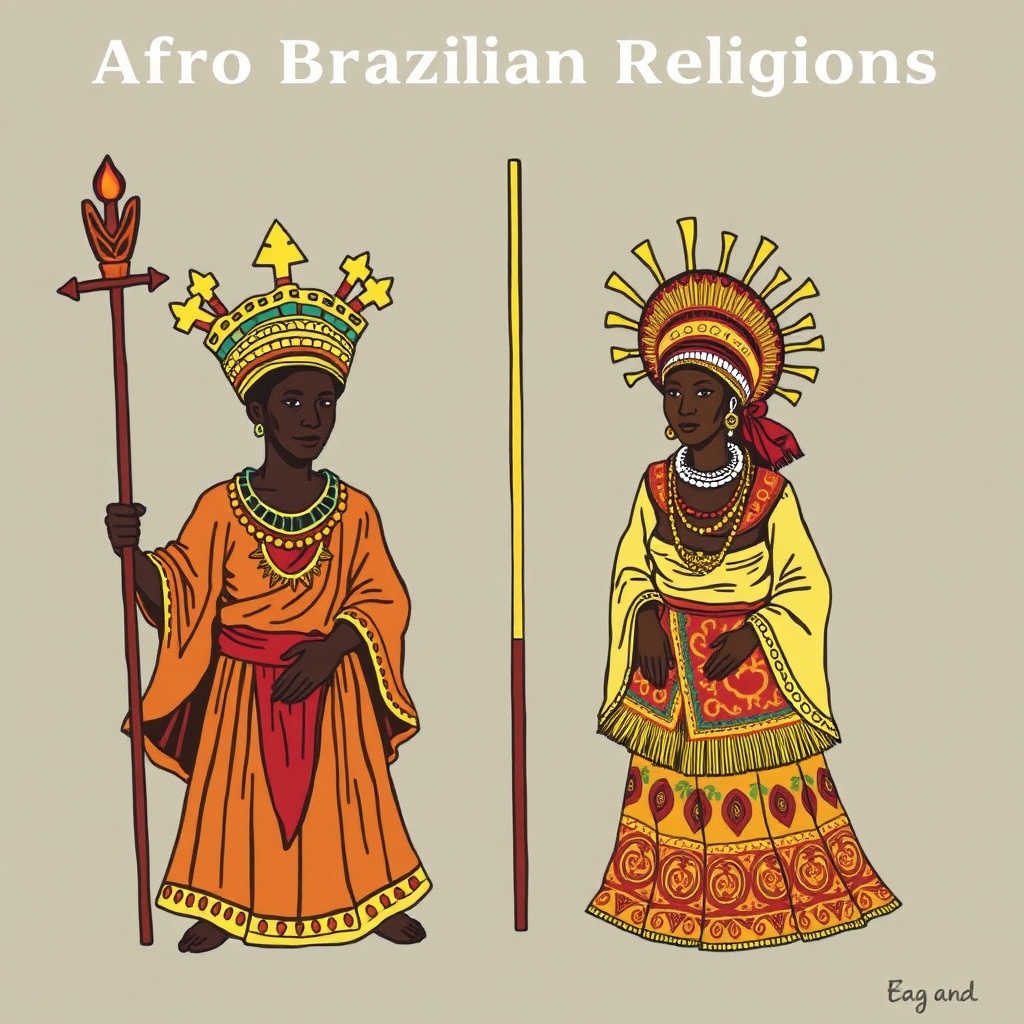
Afro-Brazilian religions, encompassing traditions such as Candomblé and Umbanda, represent a complex mosaic of religious beliefs and practices that emerged in Brazil following the African diaspora. These religions, marked by syncretism with Catholic and indigenous elements, are fundamental to understanding Brazilian cultural and spiritual identity, yet they also face historical and contemporary challenges and prejudices.
Afro-Brazilian Religions: Candomblé and Umbanda through the Lens of Human Sciences
This article proposes an in-depth analysis of Afro-Brazilian religions, with a special focus on Candomblé and Umbanda, from sociological, historical, and educational perspectives. It seeks to demystify concepts, present the richness of their traditions, and, at the same time, address in a responsible and factual manner any controversies or allegations that may arise regarding specific groups that call themselves practitioners of these religions, always guided by academic rigor, respect, and impartiality.
1. Sociological and Theological Definition
Afro-Brazilian religions are, in their essence, systems of beliefs and practices that originated from the fusion of worldviews, mythologies, rituals, and social structures brought by enslaved Africans to Brazil, which over the centuries merged with elements of indigenous and European (mainly Catholic) cultures. Sociologically, they represent not only a set of religious practices but also an important factor of social cohesion, ethnic identity, and cultural resistance for Afro-descendant populations and other communities that adopt them.
Theologically, both share the concept of a supreme God (Olorum in Candomblé, Olorum or Tupã in Umbanda) and a hierarchy of intermediate deities: the Orixás in Candomblé (associated with forces of nature and human archetypes) and the Spiritual Guides (caboclos, pretos velhos, children, among others) in Umbanda, who act as intermediaries between the material and spiritual worlds. The relationship with ancestors is also central to both, with specific cults and reverences.
Candomblé is generally considered closer to the original African traditions, with a strong emphasis on ancestry, initiation rituals, and the veneration of Orixás. Its theology is complex, with myths that explain the creation of the universe and the origin of each Orixá and their domains. The practice involves chants, dances, offerings, and sacrifices (of animals, in many cases, to feed the energy of the Orixás and please them).
Umbanda, which emerged in Brazil in the early 20th century, is a syncretic religion that incorporates elements of Candomblé, Kardecist Spiritism, Catholicism, and indigenous beliefs. Its theology is more accessible and focused on charity and spiritual healing, with a focus on mediumship and communication with Spiritual Guides, who work to assist the living and the dead on their journeys.
2. Historical Origin, Founders, and Geographic/Cultural Context
The genesis of Afro-Brazilian religions is intrinsically linked to the slave trade and slavery in Brazil, which lasted for over three centuries (from the 16th to the 19th century). Millions of Africans of diverse ethnicities (Yoruba, Jeje, Bantu, among others) were forcibly brought to the country, carrying with them their rich cultural and religious heritages. Faced with the prohibition of their practices by Portuguese colonizers, who imposed Catholicism, Africans developed strategies of resistance and spiritual survival.
One of the main strategies was syncretism, where Orixás and African deities were associated with Catholic saints, allowing the continuation of the cult under disguise. For example, Iemanjá was associated with the Virgin Mary and Ogum with Saint George. This practice, while resilient, also generated a fusion that shaped the Afro-Brazilian religions as we know them today.
Candomblé consolidated itself into various "nations" (ethnic and cultural groups) in Brazil, such as Candomblé Ketu (of Yoruba origin), Candomblé Jeje (of Fon-Ewe origin), and Candomblé Angola (of Bantu origin). The first recognized public Candomblé Ketu terreiro was that of Maria Escolástica da Conceição Nazareth, known as Maria Neném, in Salvador, Bahia, founded in the mid-19th century. Other important figures were Luíza Mahin (mother of one of the leaders of the Malê revolt, who was said to be an important religious figure) and Mãe Aninha (of the Ilê Axé Opô Afonjá terreiro, also in Salvador).
Umbanda, in turn, is considered a genuinely Brazilian religion, having emerged in Rio de Janeiro in the early 20th century. Its official founder is Zélio Fernandino de Moraes, who, according to reports, founded the first Umbanda house in 1908, known as the Tenda Espírita Nossa Senhora da Piedade. Another fundamental name is Chico Xavier, who, although he did not found Umbanda, was one of the greatest promoters of Spiritism in Brazil and had a strong influence on currents of Umbanda, especially in its more spiritualist and Kardecist branch.
The geographic context of emergence is crucial: Bahia, with a strong African presence, and Rio de Janeiro, as the capital of the Empire and later the Republic, were centers of consolidation and dissemination of these religions.
3. Main Beliefs, Dogmas, Rites, and Practices
Candomblé:
- Deities: Belief in a supreme God (Olorum) and a vast pantheon of Orixás (Oxalá, Iemanjá, Ogum, Xangô, Yansã, Oxóssi, etc.), each with specific characteristics, domains, colors, axés (vital forces), and offerings.
- Ancestry: Reverence for ancestors (Egungun), considered sources of wisdom and protection.
- Reincarnation: Belief in the continuity of life after death, with the spirit returning to learn and evolve.
- Axé: A central concept representing the vital force, the sacred energy that permeates all things.
- Rites: Complex ceremonies that include chants in African languages (Yoruba, Fon), dances, drumming, offerings of food, fruits, flowers, and, in some nations, animal sacrifices (chickens, goats, etc.), which are seen as a way to feed and strengthen the Orixás and the axé.
- Initiation: A rigorous and long process to become an initiate, involving seclusion, learning, and transformation rituals.
- Attire: Use of white clothing on feast days and rituals, and specific attire with the colors of the Orixás on other occasions.
Umbanda:
- Supreme God: Belief in a single, creator God (Olorum or Zambi).
- Spiritual Guides: Belief in communication with spirits of light who work in charity, such as caboclos (spirits of indigenous people), pretos velhos (spirits of elderly slaves), children (erês or ibeji), sailors, baianos, among others.
- Mediumship: The capacity for mediumship is fundamental for the incorporation of Spiritual Guides and for performing spiritual aid work.
- Charity and Spiritual Evolution: The main focus is the practice of charity, helping the needy (living and dead), and the spiritual evolution of all beings.
- Rites: Cults are generally simpler than Candomblé, with chants in Portuguese, incense, energy healing (passes), consecration of herbs, and offerings of flowers, fruits, candles, and drinks (water, wine, etc.), generally without animal sacrifice.
- Syncretism: Incorporates elements of Catholicism (saints associated with Orixás or Guides), Kardecist Spiritism (doctrine of reincarnation and the law of cause and effect), and indigenous beliefs.
- Work Lines: Organization of spiritual work by lines, each with its own characteristics and specific Guides.
4. Organizational Structure and Leadership Profile
The organizational structure of Afro-Brazilian religions is predominantly hierarchical and based on the figure of the religious leader, who holds deep knowledge of traditions, rituals, and deities.
Candomblé:
- Terreiro/Ilê: The religious temple is the center of the community, where rituals are performed and religious life takes place.
- Babalaô/Ialorixá: These are the highest leaders, fathers or mothers of saint, who hold the spiritual and administrative authority of the terreiro. They are initiated through a long and complex process and are responsible for conducting rituals, initiating new members, and maintaining the tradition.
- Ekedis/Egouns: Women who assist the Babalaô/Ialorixá, responsible for organizing rituals and caring for the Orixás.
- Ogan/Agê: Men who assist in organizing and conducting rituals, often responsible for the drums or the security of the terreiro.
- Initiates (Filhos de Santo): Members who have gone through the initiation process and dedicate their lives to the worship of the Orixás.
Umbanda:
- Terreiro/Tenda: Place of worship and spiritual work.
- Pai/Mãe de Santo: Spiritual leaders who have developed mediumship and knowledge of rituals and work lines. They are responsible for conducting the work, guiding the mediums, and performing charity.
- Mediums: Individuals who develop the ability to incorporate Spiritual Guides to assist people.
- Directors: Responsible for the administrative organization of the terreiro and the guidance of the mediums.
- Congregants: Members who attend the terreiro and participate in the work.
In both religions, leadership is generally charismatic and based on spiritual experience and knowledge passed down through generations. The figure of the leader is central to maintaining the doctrine and guiding the community.
5. [WARNING/CONTROVERSIES] Factual Analysis of Legal Controversies, Ethical Deviations, or "Destructive Cult" Characteristics
It is essential to address this topic with the utmost seriousness and responsibility. Traditional Afro-Brazilian religions, such as Candomblé and Umbanda in their consolidated and historically recognized manifestations, are not, in their essence, "destructive cults." They possess organizational and doctrinal structures aimed at spiritual development, community cohesion, and the practice of charity, with a history of cultural resistance and the fight against intolerance.
However, as in any large-scale religious or spiritual manifestation, it is possible for groups or individuals who call themselves practitioners of these religions to deviate from their ethical and moral principles, adopting abusive, exploitative, or harmful conduct. These cases, when they occur, must be analyzed factually, based on proven complaints, police investigations, and judicial proceedings, and should not be generalized to the entire religious community.
What characterizes a "destructive cult" (or destructive sect)? According to sociological and psychological literature, such groups generally present:
- Social Isolation: Encouragement to break family and social ties with the outside world.
- Financial Exploitation: Demand for large sums of money, assets, or unpaid labor in exchange for spiritual benefits or promises.
- Mind Control and Coercion: Psychological manipulation to induce blind obedience, suppress critical thinking, and create dependency on the leader.
- Abuse of Authority: The leader exercises absolute power, often with sexual connotations or the exploitation of vulnerable people.
- Harm to Third Parties: Practices that physically, emotionally, or financially harm members or society in general (including animal mistreatment when the practice is not ritualistic and is provenly abusive).
- Glorification of the Leader: The leader is seen as infallible, with divine powers or powers superior to those of the deity itself.
Research and Sources: When seeking information about possible deviations, it is crucial to consult reliable and independent sources:
- Human Rights Organization Reports: Institutions that monitor cases of religious intolerance and human rights violations.
- Serious Media Outlets: Investigative reports that present evidence and testimonies.
- Judicial Proceedings: Court decisions that prove crimes or abuses.
- Academic Studies: Sociological and anthropological research that critically analyzes specific groups.
Examples of Controversies (General and Potential):
- Religious Intolerance: Unfortunately, Afro-Brazilian religions are constant targets of intolerance, vandalism of temples, and verbal and physical aggression. This does not make them destructive, but rather victims of prejudice.
- Accusations of Fraud and Exploitation: In some isolated cases, unscrupulous leaders may take advantage of others' faith for financial gain. This is an ethical deviation and does not represent the totality of the practices. It is important to differentiate charging fees for temple and ritual maintenance (common in many religions) from predatory exploitation.
- Animal Sacrifice: In some branches of Candomblé, animal sacrifice is a ritualistic practice. Although it may cause discomfort to people of other faiths, within the theological context of these religions, it is seen as a sacred act to feed the vital energy of the Orixás. However, reports of animal mistreatment in specific rituals, when proven, must be investigated by the competent authorities, as they constitute crimes. Brazilian legislation protects animals but provides exceptions for religious rituals of a cultural and traditional nature.
- Esoteric Groups and Ambiguous Syncretisms: The flexibility and capacity for syncretism of Afro-Brazilian religions can, in some cases, give rise to interpretations and practices that distance themselves from the original traditions, leading to the formation of groups with more "esoteric" characteristics or control dynamics that may be questionable. The analysis here must be case-by-case, based on evidence.
Clear Warning: If a group that calls itself Candomblé or Umbanda is provenly investigated for crimes such as sexual exploitation, predatory financial exploitation, torture, murder, human trafficking, or if it consistently demonstrates the characteristics of mind control and social isolation typical of destructive cults, the competent authorities must act. Civil society and the academic community have a duty to denounce and combat such practices, without, however, stigmatizing the religions in their entirety. Academic research, in this sense, should be an instrument of clarification and protection, separating the wheat from the chaff.
For an in-depth analysis of the topic of destructive cults and the distinction between religion and sect, it is recommended to consult works by sociologists of religion such as Eileen Barker, Massimo Introvigne, and Robert Jay Lifton.
6. Social Impact, Cultural Relevance, and Contemporary Significance
Afro-Brazilian religions exert an immeasurable social and cultural impact in Brazil and other parts of the world where they have spread. They are:
- Pillar of Afro-Brazilian Identity: For millions of Afro-descendants, these religions are a fundamental link to their African roots, a space for identity affirmation and resistance against structural racism.
- Engine of Cultural Resistance: Throughout history, they have been spaces for the preservation and transmission of African languages, music, dances, cuisine, and customs, which have enriched Brazilian culture.
- Factor of Social Cohesion: Terreiros and tendas function as community centers, offering social, emotional, and spiritual support to their members.
- Artistic and Cultural Expression: The music, dance, visual art, and cuisine of Afro-Brazilian religions are recognized and admired worldwide, influencing contemporary artistic production.
- Contribution to Health and Well-being: Through their practices of spiritual healing, counseling, and community support, they contribute to the well-being of their adherents.
- Contemporary Challenges: Despite their growing visibility and recognition, Afro-Brazilian religions still face the challenge of religious intolerance, prejudice, and the need for demystification. The fight for equal rights and the fight against discrimination are constant agendas.
- Global Relevance: The African diaspora has taken these religions to other countries, where they continue to develop and influence new communities.
The contemporary relevance of Afro-Brazilian religions lies not only in their deep historical and cultural heritage but also in their capacity for adaptation, resilience, and their continuous contribution to the diversity and richness of the Brazilian spiritual and cultural landscape. Academic understanding and respect for these traditions are essential for building a more just and pluralistic society.
References and Research Sources
- PRANDI, Reginaldo. Mitologia dos Orixás. São Paulo: Companhia das Letras, 2001.
- CAPONE, Alessandro. Candomblé: Uma Religião em Busca de Liberdade. São Paulo: Editora Unesp, 2017.
- CAMARGO, Cássio. Umbanda: Breve Introdução à sua Filosofia e Prática. São Paulo: Editora Madras, 2006.
- FERRETTI, Sergio. Candomblé e Umbanda: Um Século de Religiões Afro-Brasileiras. São Paulo: Editora Vozes, 2003.
- BARKER, Eileen. The Making of a New Religious Movement: The Unification Church in America. New York: Oxford University Press, 1989. (Theoretical reference on sects and new religious movements).
- Academic articles on Afro-Brazilian religions available in databases such as SciELO, JSTOR, and Google Scholar.
- Investigative reports from serious media outlets (e.g., Folha de S.Paulo, O Globo, G1, UOL) on religious intolerance and cases of deviations in religious communities.
- Documentaries on Candomblé and Umbanda produced by research and media institutions.





