



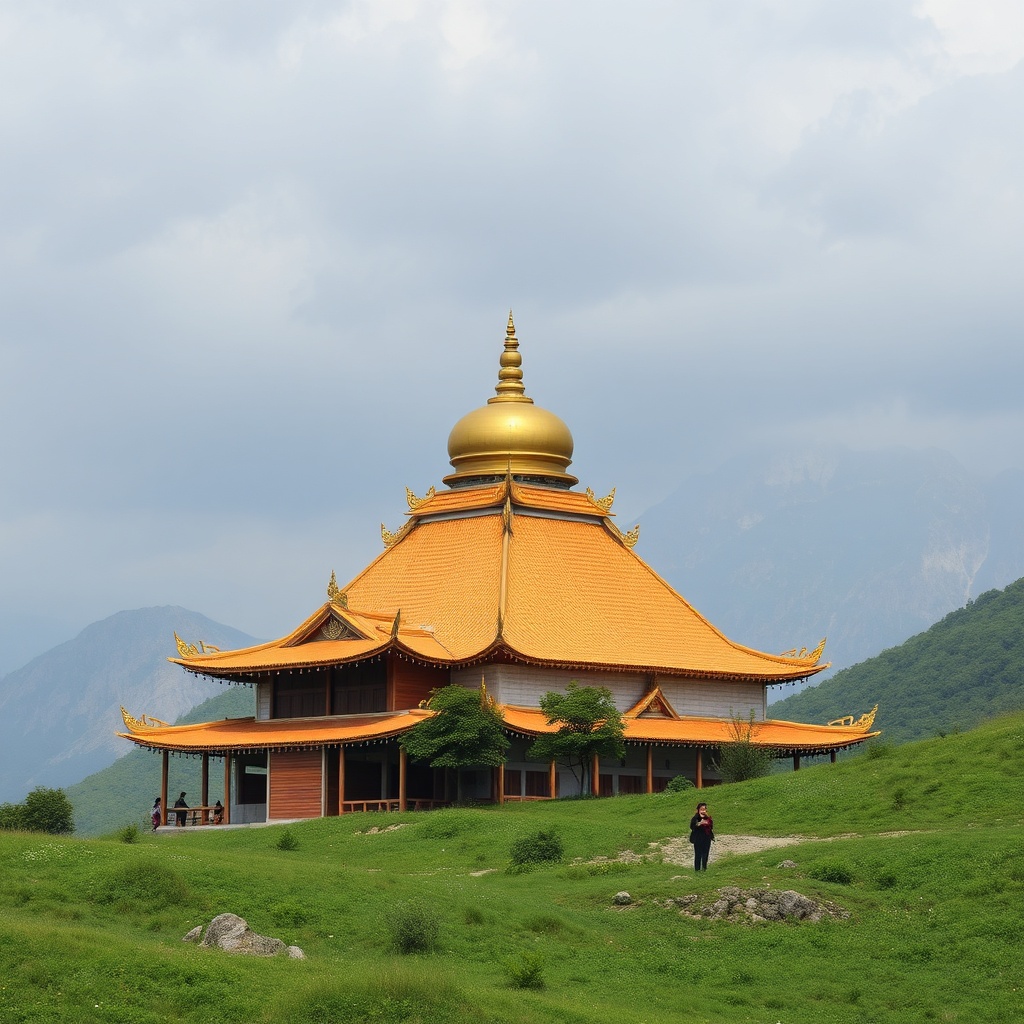
Tengrism is an ethno-nationalist religion and spirituality centered on the worship of the sky (Tengri) and shamanic practices, with deep roots in the religious traditions of Turkic, Mongol, and other ethnic groups in Central Asia and Siberia. Although its original form is ancient, the term "Tengrism" is a modern construct that encompasses a spectrum of beliefs and practices that have resurged strongly since the 20th century, often associated with cultural and identity revival movements.
Origin and Historical Foundation
Tengrism, as an organized religious system, has its origins in the animistic and shamanic beliefs of the nomadic peoples of Central Asia, dating back to prehistoric times. Its foundations are believed to trace back to the ancient religious traditions of the Xiongnu, Göktürks, and other empires and confederations that dominated the Eurasian steppes. The term "Tengri" refers to the supreme sky god in ancient Turkic and Mongol mythology, considered the creator and sustainer of the universe. Shamanism, with its practices of trance, healing, and mediation between the spiritual and material worlds, was central to these cultures. The geographical and cultural context of its emergence is vast, encompassing the expansive steppes of Mongolia, Siberia, Central Asia, and parts of China, regions where relationships with nature, celestial cycles, and ancestral spirits deeply shaped the worldview and religious practices.
The foundation of a formal "Tengrist religion" is a more contemporary phenomenon. There is no single historical founder in the sense of Abrahamic or Eastern religions. Instead, modern Tengrism is viewed as a revival and reinterpretation of ancient traditions. Resurgence movements gained strength in Mongolia after the fall of communism, seeking to revitalize the country's national and spiritual identity, separating it from foreign religious and ideological influences. Similarly, in other regions with Turkic populations, such as Tatarstan, Kazakhstan, and Siberia, Tengrism has been adopted by intellectuals and activists as a way to assert local cultural and historical identity.
Sociological and Theological Definition
Sociologically, Tengrism can be classified as an ethno-nationalist religion and a form of neo-paganism or religious revivalism. It is intrinsically linked to the ethnic and cultural identity of Turkic and Mongol peoples, serving as a pillar for the affirmation of their ancestral heritage. The practice of Tengrism often overlaps with nationalism, promoting the idea of a special destiny for these ethnicities and a mystical connection to their lands of origin. Tengrist theology is polytheistic, with a pantheon of deities and spirits that govern different aspects of nature and human life. At the top is Tengri, the supreme god of the blue sky, omniscient and omnipotent, but often viewed as distant. Below him, there are other deities such as Umay (goddess of fertility and protection), Erlik (god of the underworld), and a myriad of spirits of the earth, water, fire, and air. Shamanism plays a crucial role, with shamans (or "udagan" for women) acting as intermediaries between humans and the spiritual world, seeking healing, guidance, and balance.
In theological terms, Tengrism emphasizes harmony with nature, respect for ancestors, and the belief in a cosmic cycle. The concepts of "Ku" (vital energy) and "Süld" (ancestral spirit) are fundamental. They believe that life is a gift from the sky and that humans must live according to natural and spiritual laws. Destiny and luck are influenced by human actions and the will of the gods and spirits. Death is seen as a transition to the spirit world, and funeral rituals are important to ensure a safe passage and honor the ancestors, who continue to influence the living.
Main Beliefs, Dogmas, Rites, and Practices
The core beliefs of Tengrism revolve around the supreme deity Tengri, the "Eternal Blue Sky," which is the source of all existence. There is a strong respect for nature, viewed as sacred and inhabited by spirits. Fundamental beliefs include:
- Cosmology: The universe is generally divided into three worlds: the Sky (where Tengri and other celestial deities reside), the Earth (the world of humans and nature spirits), and the Underworld (the realm of Erlik Khan).
- Deities and Spirits: Besides Tengri, there is a hierarchy of celestial gods, earth spirits (such as Yer-su, Mother Earth), ancestral spirits, and nature spirits.
- Shamanism: The shaman is the link between the worlds, capable of traveling to the spirit world through trance induced by drums, chanting, and dancing. They perform rituals of healing, divination, exorcism, and mediation with spirits.
- Rites of Passage: Important rituals include birth (protection of the mother and newborn), marriage (union of families and clans), and death (ensuring a safe journey to the afterlife).
- Sacrifices and Offerings: Offerings to spirits and deities, such as food, drinks (kumis, tea), and symbolic items, are common to ask for blessings or appease entities. Animal sacrifices, although less common today, were performed in the past.
- Respect for Ancestors: The veneration of ancestors is fundamental, as it is believed they intercede for the living and maintain the lineage and identity of the clan.
- Ethics: Tengrist ethics emphasize honesty, courage, loyalty, respect for elders and nature, and the pursuit of harmony. It is believed that bad actions attract bad luck and imbalance.
Common practices include meditation, prayers in sacred places (mountains, rivers, ancient trees), shamanic healing ceremonies, and festivals that celebrate the cycles of nature and important historical events.
Organizational Structure and Leadership Profile
Modern Tengrism, in its various manifestations, does not have a centralized and hierarchical organizational structure like the major world religions. Its organization is more fluid and decentralized, varying according to the region and the practicing group. In many communities, leadership is exercised by shamans or local spiritual leaders, who are chosen based on their connection to the spiritual world, wisdom, and ability to guide the community. These individuals usually do not have a formal title of "priest" or "bishop," but are respected for their skills and knowledge of traditions.
In more organized revivalist movements, there may be associations or organizations that seek to promote the study and practice of Tengrism, hold congresses, and publish materials. In these cases, leadership may be more formalized, with presidents, boards, and active members. The leadership profile in modern Tengrism tends to be composed of individuals with a strong sense of cultural and historical identity, often intellectuals, cultural activists, or people who felt a spiritual calling to revitalize the ancient traditions of their peoples. There is an emphasis on authenticity and connection to roots, in contrast to the leadership of other more institutionalized religions.
[WARNING/CONTROVERSIES]
It is crucial to approach Tengrism with discernment, as the term can encompass everything from spiritual practices genuinely linked to the cultural heritage of Asian peoples to groups that appropriate the term for ideological or controversial purposes. The warnings and controversies associated with Tengrism do not derive from its intrinsic theology or traditional practices, but rather from its instrumentalization by certain groups, especially in political and nationalist contexts. The main point of attention lies in its fusion with extremist ideologies, particularly far-right nationalism in some regions of Eastern Europe and Central Asia.
In some strands, especially those that emerged or gained visibility in the 21st century, Tengrism has been associated with radical ethno-nationalist movements that promote the racial or ethnic superiority of Turkic and Mongol peoples. Reports and analyses from research institutes and human rights organizations point to the existence of groups that use Tengrist symbols and rhetoric to justify hate speech, xenophobia, and even violence against ethnic or religious minorities. These manifestations do not reflect Tengrism in its historical essence or the practice of the majority of its followers, but represent a dangerous deviation and ideological appropriation.
A notorious example is the association of Tengrism with certain far-right organizations and individuals in countries like Russia and Ukraine, where the religion can be co-opted to fuel narratives of "Aryan" or "Turkic" supremacy and justify conflicts or persecutions. Investigative documents and reports have already addressed how these extremist groups can distort ancestral teachings to promote radical political agendas, including the belief in a "superior race" and the need for ethnic cleansing. These strands may present characteristics of "destructive sects" in the sense of promoting social isolation, alienation, and radicalization of their adherents, although not in the classic sense of coercive mind control and financial exploitation by a centralized leadership as in other sects known globally. The damage is more directed at social cohesion, incitement to hatred, and potential violence against third parties.
It is fundamental to distinguish between the genuine cultural and spiritual rebirth of Tengrism, which seeks to preserve and honor ancestral traditions, and its manipulation by extremist ideologies. Shamanic practices and the veneration of nature, inherent to Tengrism, do not, in themselves, have destructive characteristics. The concern arises when these elements are distorted to serve radical political agendas that promote exclusion and conflict. Therefore, factual analysis requires a clear differentiation between the historical and religious tradition and contemporary appropriations by groups with malevolent intentions.
Social, Cultural Impact and Contemporary Relevance
Tengrism, both in its traditional forms and in its contemporary rebirths, exerts a significant social and cultural impact in the regions where it is practiced. In Mongolia, for example, the rebirth of Tengrism has been a crucial component in the reconstruction of post-Soviet national identity, revitalizing traditions, festivals, and the Mongolian language. It offers Mongolians a connection to their ancestral roots and a sense of historical continuity, contrasting with decades of religious and cultural suppression under the communist regime.
In other parts of Central Asia and Siberia, Tengrism serves as a reference point for Turkic and Siberian identity, helping to keep local traditions and spirituality alive in the face of globalization and the influence of exogenous religions. The appreciation of nature and environmental harmony inherent in Tengrism also makes it relevant in contemporary discussions about ecology and sustainability, promoting a worldview where humans are an integral part of the ecosystem, not its masters.
The contemporary relevance of Tengrism also lies in its ability to inspire movements of self-knowledge and spiritual seeking that do not fit into the major established religions. For many, Tengrism represents an authentic and ancestral alternative, offering a spiritual path that resonates with their cultural heritages and their connection to the land. However, continuous attention is necessary to monitor and criticize the undue and extremist appropriations of the term, ensuring that the cultural and spiritual legacy of Tengrism is understood in its complexity and respected in its diversity.
References and Research Sources
- Academic articles and reports on far-right nationalism in post-Soviet countries, focusing on the instrumentalization of symbols and religious beliefs. (Specific research would be required to cite exact articles).
- Publications from human rights and extremism monitoring organizations that document hate speech and xenophobia associated with neo-pagan or ethno-nationalist groups. (Specific research would be required to cite exact reports).
- Investigative reports and intelligence analyses on the influence of extremist groups that promote ideologies of racial or ethnic supremacy. (Specific research would be required to cite exact reports).
- Ethnographic and sociological studies on religious and cultural rebirth in post-communist Mongolia. (Specific research would be required to cite exact studies).





