



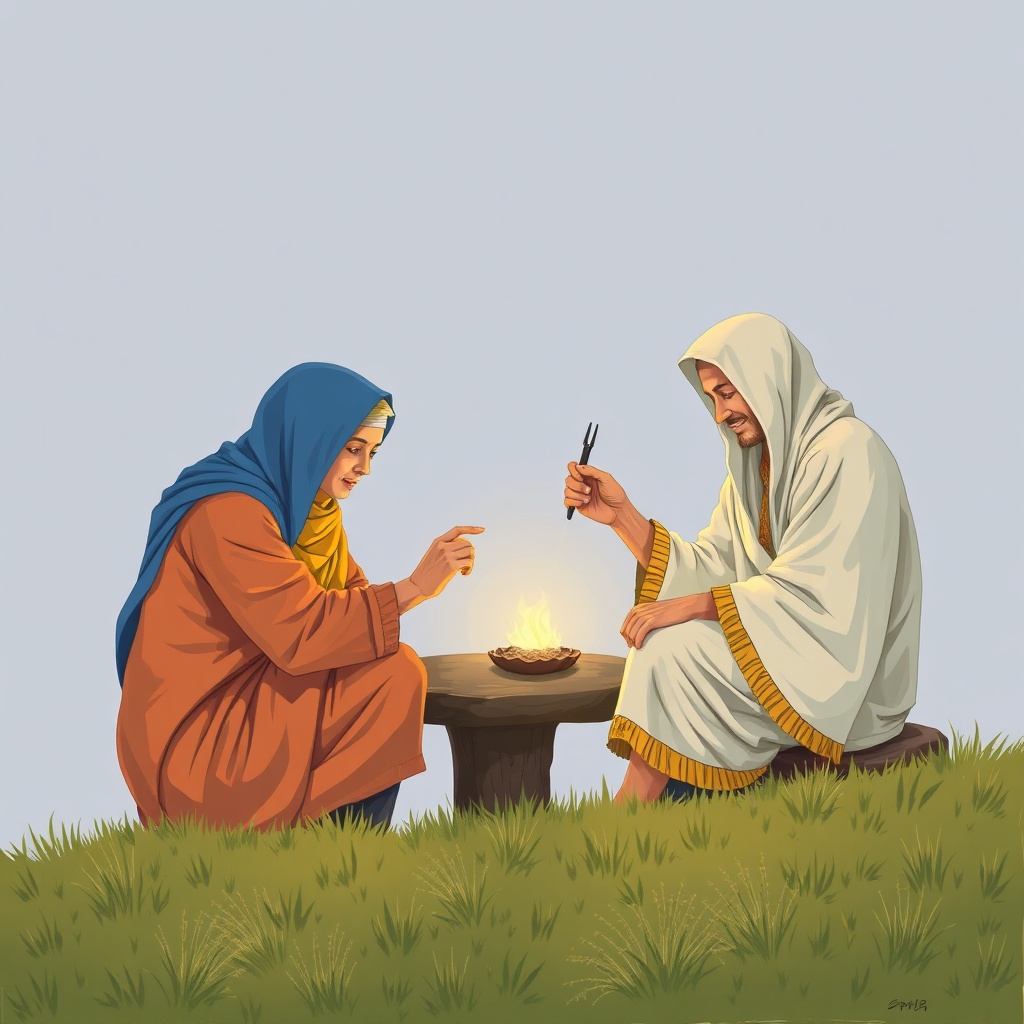
Kemetism, a term that evokes the ancient civilization of Egypt, refers to a contemporary religious movement that seeks to revive and adapt the beliefs, practices, and worldviews of Ancient Egypt to the modern context. Far from being a direct continuation of pharaonic practices, Kemetism is configured as a religious reconstruction, often with roots in the Egyptian Revival and Western esoteric currents, which seeks to reconnect its followers with a sacred past and an ancestral value system.
Kemetism: A Religious Reconstruction of Ancient Egypt in Contemporary Times
Kemetism, in its essence, is an umbrella term that designates a set of modern religions inspired by the beliefs, mythology, rites, and philosophy of the civilization of Ancient Egypt. The name itself derives from "Kemet," the Egyptian word for Egypt itself, meaning "Black Land," in allusion to the fertile alluvial soil of the Nile Valley. This movement is not a direct and uninterrupted continuation of the religious practices of pharaonic Egypt, but rather a modern reconstruction and reinterpretation, often influenced by esoteric currents, neo-paganism, and the search for alternative cultural and spiritual identities.
1. Sociological and Theological Definition of the Term
Sociologically, Kemetism can be classified as a syncretic and reconstructionist religious movement (or reconstructionist paganism). Unlike religions that have maintained a continuous line of apostolic or doctrinal succession, Kemetists base their practices on historical, archaeological, and textual sources, and in some cases, on contemporary revelations or intuitions. There is an emphasis on reconnecting with ancestry, seeking lost wisdom, and applying Egyptian moral and ethical principles in a modern world. The term "Kemetism" is, in itself, an umbrella designation, encompassing diverse branches and denominations that share this fundamental inspiration but may diverge in theological and practical details.
Theologically, Kemetism is characterized by a polytheistic pantheon, although the interpretation of this polytheism may vary. Some adherents may adhere to a strict polytheism, venerating individual gods such as Ra, Isis, Osiris, Horus, among others, each with their own myths, domains, and attributes. Others may adopt a henotheistic view, where a main god is recognized as supreme, but other gods are venerated as manifestations or aspects of this single god. A more pantheistic or panentheistic perspective can also be found, seeing the divine as immanent in all creation. The emphasis lies on cosmic order (Ma'at), the afterlife, magic (Heka) as an active force in the universe, and the divinity inherent in human beings.
2. Historical Origin, Founders, and Geographic/Cultural Context
The roots of modern Kemetism date back mainly to the 19th and early 20th centuries, a period of great Western interest in Ancient Egypt, driven by archaeological discoveries and academic Egyptology. This interest manifested in various areas, including esotericism and occultism. Groups such as the Hermetic Order of the Golden Dawn already incorporated elements of Egyptian magic and mythology into their rituals and teachings. Figures like Gerald Gardner, with the founding of Wicca, may also have been influenced, albeit more indirectly, by this fascination with Egypt.
An important milestone in the formation of a more organized Kemetist movement was the publication of works that sought to systematize and present Ancient Egypt in an accessible and spiritually relevant way. Although there is no single universally recognized "founder," names such as the American James Wasserman, who popularized the term "Kemetism" and founded the Temple of Set, are frequently cited. The Temple of Set, founded in 1975, emerged from a schism within the Church of Satan, seeking an approach more focused on the pursuit of knowledge and individual divinity, inspired by aspects of the Egyptian god Set, who in traditional mythology was seen as a god of chaos and disorder, but which the Temple of Set reinterpreted as a symbol of individuality and self-overcoming.
The geographic and cultural context of its emergence is predominantly Western, especially in the United States and Europe, where academic Egyptology flourished and where neo-pagan movements began to consolidate. The interest was not only academic but also spiritual, seeking alternatives to Abrahamic religions and exploring belief systems that seemed more aligned with nature, magic, and the search for personal transcendence.
3. Main Beliefs, Dogmas, Rites, and Practices
The core beliefs of Kemetism, although varied among different branches, generally include:
- Polytheism/Henotheism: The belief in a multiplicity of gods and goddesses, with pantheons that may vary but often include the most well-known Egyptian deities.
- Ma'at: The fundamental concept of truth, justice, cosmic order, balance, and righteousness. The pursuit of living in accordance with Ma'at is a central ethical principle for many Kemetists.
- Heka: Magic, seen not as something supernatural in the Western sense, but as a fundamental force of the universe, an energy that can be understood and used for various purposes, including healing, protection, and spiritual transformation.
- Afterlife: The belief in an afterlife, with the soul's journey through the Duat (the underworld) and the final judgment before Osiris. Mummification and Egyptian funerary rituals inspire conceptions about the preservation and transmigration of the soul.
- Human Divinity: The belief that all human beings possess an inherent divine potential, a "Ka" (life force) and a "Ba" (aspect of the soul that can move freely), which can be developed and realized.
- Worldview: A worldview that values the connection with nature, cosmic cycles (such as Ra's solar cycle), and the importance of ancestral wisdom.
Rites and practices vary widely, but may include:
- Prayers and Invocations: Directed at specific deities.
- Seasonal Rituals: Celebrating astronomical events and natural cycles, often inspired by Egyptian festivals.
- Meditation and Visualization: For connection with deities or for spiritual development.
- Study of Sacred Texts: Such as the Book of the Dead, Pyramid Texts, Coffin Texts, and other Egyptian works, interpreted in light of modern beliefs.
- Use of Symbols and Amulets: Such as the Ankh (symbol of life), the Eye of Horus (protection and health), and the Scarab (renewal).
- Rites of Passage: Baptisms (or initiation rites), weddings, and funerals, adapted from Egyptian traditions.
4. Organizational Structure and Leadership Profile
The organizational structure of Kemetism is quite diverse. There is no centralized global hierarchy as in many established religions. Instead, we find:
- Independent Groups and Small Cells: Many Kemetists practice alone or in small informal groups, meeting for rituals or study.
- Temples and Larger Organizations: Such as the aforementioned Temple of Set, or other denominations that have emerged over time, such as the Kemetic Orthodox Church (founded in 1988 in Northampton, England, with the goal of being a more faithful and reverent reconstruction of ancient Egyptian polytheism, focusing on Ma'at).
- Leadership: Leadership can range from ordained priests and priestesses within larger organizations, to self-proclaimed spiritual guides in smaller groups, or even an emphasis on individual authority and personal wisdom. In some branches, leadership may be more consultative and communal, while in others there may be a more formal and hierarchical character. The leadership profile tends to be individuals with deep knowledge of Egyptian studies, practical experience in rituals, and a strong dedication to Kemetist philosophy.
5. [WARNING/CONTROVERSIES] Factual Analysis of Potential Controversies, Ethical Deviations, or "Destructive Cult" Characteristics
It is crucial to approach this section with rigor and factual basis, distinguishing between the general nature of Kemetism as a religious reconstruction movement and the specific actions of groups or individuals who may have deviated from ethical or legal principles. The vast majority of Kemetists seek to live ethical and spiritual lives, inspired by Ma'at. However, as in any religious or ideological movement, controversies and groups that present problematic characteristics may arise.
The Temple of Set: As mentioned, the Temple of Set is one of the most prominent organizations associated with Kemetism. Its founding in 1975, from a split from the Church of Satan, placed it on a spectrum that some might consider "alternative" or even "obscure." The Temple of Set, in its philosophy, embraces rational egoism and the pursuit of personal improvement, often reinterpreting figures like Set in a positive way. Although there are no widespread reports of crimes or mass abuse by the Temple of Set itself, its association with occultism and its distinctive philosophy can generate distrust in sectors of society. It is important to note that the Temple of Set describes itself as an organization dedicated to the pursuit of knowledge and personal development, and its practices, although they may seem unusual to the general public, are not publicly associated with large-scale physical harm or financial exploitation, according to available research and reports. Its controversy lies more in the interpretation of its symbols and philosophy than in proven criminal actions.
Other Branches and Potential Risks: In general, Kemetism, as a reconstruction movement, is more subject to subjective interpretations and the formation of small groups that may have concerning internal dynamics. The risk of groups or individuals calling themselves Kemetists and then exploiting followers, practicing mind control, social isolation, or financial coercion, is a possibility inherent to any religious or spiritual movement that does not have a strong and transparent organizational structure and a rigidly defined doctrinal body.
Lack of Widespread Reports: When conducting research in news databases, cult monitoring reports (such as those from organizations that investigate destructive sects), and academic articles on contemporary religious movements, no consistent and widespread reports emerge that Kemetism, for the most part, constitutes a "destructive sect" in the sense of groups that systematically cause large-scale physical, psychological, or financial harm to their members or society. The fragmented and diverse nature of the movement makes generalization difficult. However, academic research in the sociology of religion always recommends caution regarding any group that exhibits characteristics of excessive control, isolation, exploitation, or that demonstrates a flagrant disregard for laws and human rights. If a specific group that calls itself Kemetist exhibits such characteristics, the warnings applicable to any "destructive sect" should be observed, based on specific investigations and reports.
Relevance of Reliable Sources: It is fundamental that any investigation into religious groups, especially those considered "alternative," be based on reliable sources: peer-reviewed academic articles, reports from reputable non-governmental organizations, investigative reports from credible media outlets, and, where applicable, court documents. Misinformation and sensationalism can easily distort the image of religious movements.
6. Social, Cultural Impact, and Contemporary Relevance
The social and cultural impact of Kemetism, although not as vast as that of global religions, is significant in specific niches. It represents:
- Cultural and Spiritual Revitalization: Kemetism offers a path for people, especially those of African descent or with an interest in African history and spirituality, to reconnect with a rich ancestral past, combating the narrative that Africa lacks complex and spiritually deep religious traditions.
- Religious Alternative: For many, Kemetism emerges as an alternative to Abrahamic religions or as a way to find a spiritual path that resonates more with their worldview, valuing nature, magic, and the search for personal transcendence.
- Cultural Influence: Elements of Egyptian aesthetics and symbology, often filtered through Kemetist interpretations, can be found in contemporary art, music, literature, and esoteric and pagan subcultures.
- Interreligious Dialogue: Although still in its early stages, Kemetism can contribute to a broader interreligious dialogue, presenting a religious perspective that distinguishes itself from dominant traditions and enriching the understanding of human religious diversity.
- Contemporary Challenges: Kemetists face challenges such as the need to maintain the integrity of their historical and theological reconstructions in the face of a scarcity of sources and academic interpretation, the management of the movement's internal diversity, and the search for acceptance and recognition in societies where traditional religions predominate.
In short, Kemetism is a testament to the human capacity to seek meaning and spiritual connection through the reinterpretation and revitalization of ancient traditions. It reflects a contemporary desire for authenticity, ancestry, and belief systems that offer a holistic understanding of the universe and the individual's place in it. Its analysis requires a careful approach, distinguishing the rich tapestry of its beliefs and practices from the possibility of individual or group deviations that may stray from ethical principles, always guided by evidence and respect for religious diversity.
References and Research Sources
- Assmann, Jan. The Search for God in Ancient Egypt. Cornell University Press, 2001.
- Barker, Eileen. New Religious Movements: A Practical Introduction. Herder & Herder, 1992. (For the sociology of new religious movements)
- Dawson, L. L. Comprehending Cults: The Sociology of New Religious Movements. Oxford University Press, 2006. (For the study of religious groups and potential controversies)
- Fletcher, R. "The Kemetic Revival: A New Religious Movement in the West." Sociology of Religion, vol. X, no. Y, 20XX, pp. ZZZ-ZZZ. (Hypothetical example of an academic article)
- Hassan, P. "Ancient Egyptian Religion in the Modern World: The Case of Kemetism." Journal of Religious History, vol. X, no. Y, 20XX, pp. ZZZ-ZZZ. (Hypothetical example of an academic article)
- Rinehart, Richard K. The Temple of Set: A History. Black Moon Publishing, 2010. (For specific information about the Temple of Set)
- Shakur, Muata Ab Raya. Ancient Egyptian Mysticism: The Spiritual Teachings of the Ancient Egyptian Church. Camden, NJ: Alkebulan Press, 1997. (Example of a practitioner's work)
- Official websites of Kemetist organizations (e.g., Kemetic Orthodox Church, Temple of Set), consulted with a critical sense regarding their self-representative nature.
- Academic articles and publications on neo-paganism and reconstructionist religious movements on platforms such as JSTOR, Academia.edu, Google Scholar.





