



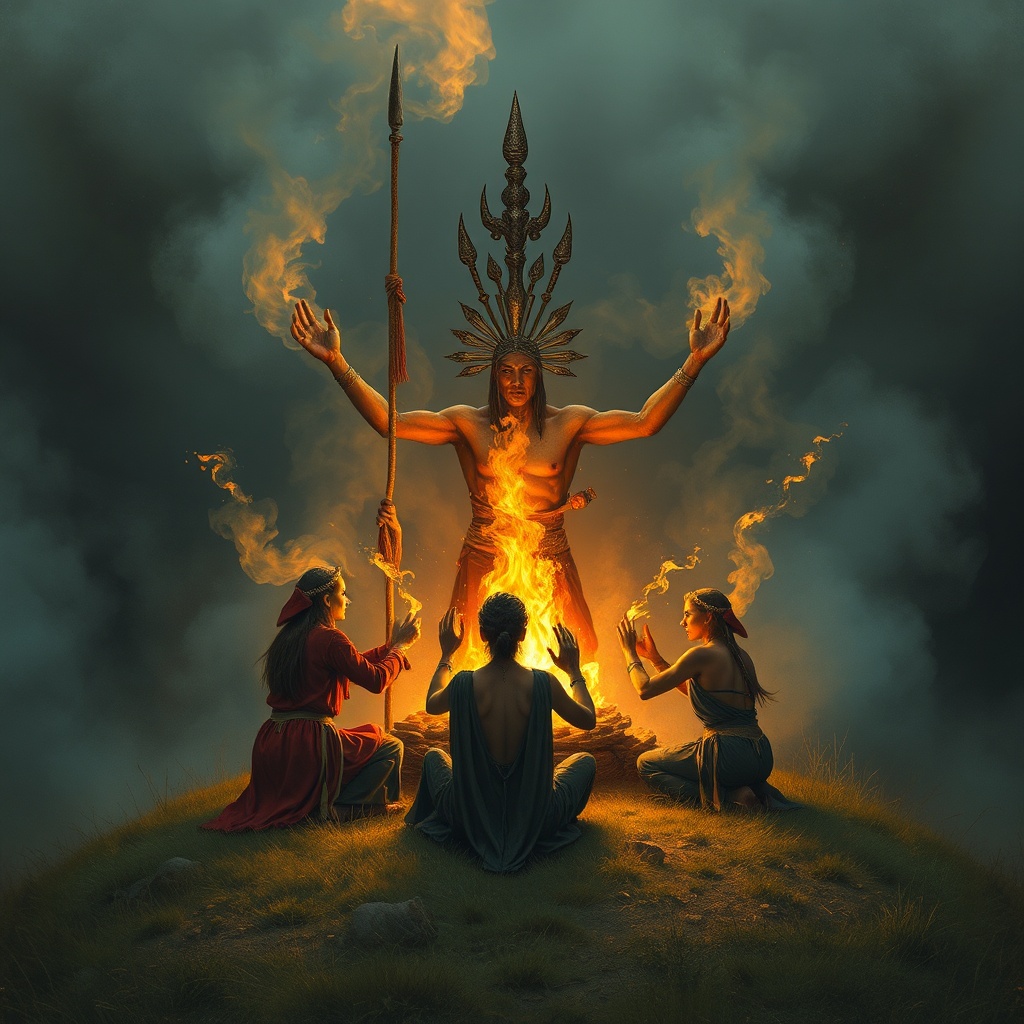
Shamanism, in its essence, refers to a set of ancestral spiritual and cultural practices characterized by mediation between the visible and invisible worlds through individuals with mediumistic abilities, known as shamans. These traditions, deeply rooted in various indigenous cultures around the globe, involve the pursuit of healing, guidance, and cosmic balance, utilizing altered states of consciousness and interaction with nature spirits.
Shamanism: A Sociological, Historical, and Critical Analysis
1. Sociological and Theological Definition of Shamanism
From a sociological perspective, shamanism is understood as a religious and cultural system that operates in societies, often small-scale and with a strong connection to nature. The central figure is the shaman, an individual who, according to the group's beliefs, possesses the ability to transit between the material and spiritual worlds, acting as a healer, counselor, guardian of ancestral knowledge, and mediator between the community and supernatural forces. Sociologists of religion, such as Mircea Eliade, in his seminal work "Shamanism: Archaic Techniques of Ecstasy" (1951), define shamanism as one of the oldest forms of human religiosity, characterized by a set of techniques that allow the shaman to enter into ecstasy, travel to other realms, and interact with spirits for the benefit of their community.
Theologically, shamanism is not organized into rigid dogmas or a unified body of doctrine like monotheistic religions. Its beliefs are intrinsically linked to the worldview of each people, but they generally share the belief in a spiritual world populated by nature spirits (animals, plants, elements), ancestors, and other entities. The divine, when present, is often viewed as immanent in nature, or as a distant Creator whose influence is felt through spirits and the shaman themselves. Salvation or well-being is not achieved through faith in a specific dogma, but through the maintenance of cosmic balance, the healing of illnesses (physical and spiritual), and harmony with the environment.
2. Historical Origin, Founders, and Geographic/Cultural Context
Shamanism, as a practice, predates recorded history. Its origins date back to the Upper Paleolithic, with archaeological evidence, such as cave paintings in sites like Lascaux and Chauvet, suggesting ritual practices and shamanic visions. It is believed that shamanism emerged as a human response to the need to understand and interact with the natural world and its mysteries, seeking healing for diseases, ensuring hunting and survival, and dealing with the unknown.
There are no "founders" in the traditional sense of the term, as shamanism evolved organically in different cultures over millennia. It manifested independently and with particularities in various regions of the globe, including Siberia (considered one of the cradles of the term "shaman," derived from the Tungusic "šamán"), the Americas (among indigenous peoples such as the Yanomami, Ashaninka, and Mapuche), Asia (among groups in Mongolia, Korea, and Japan), Africa, and Australia.
The geographic and cultural context of the emergence of shamanism is intrinsically linked to tribal, hunter-gatherer, and agricultural societies, where the relationship with the land, natural cycles, and fauna was fundamental to subsistence. These cultures often possessed more egalitarian social structures and a deep reverence for nature, which was viewed as a living and interconnected being.
3. Main Beliefs, Dogmas, Rites, and Practices
The central beliefs of shamanism revolve around:
- Spiritual Duality: The belief in multiple spiritual realms, including the upper world, the lower world, and the middle world (where we live), and the shaman's ability to travel between them.
- Animism: The belief that all living beings, and even inanimate objects and natural phenomena, possess spirit and consciousness.
- Interconnection: The view that everything in the universe is interconnected, and that imbalance at one level can affect all others.
- Spirit Guides: The belief in spirits that assist the shaman in their journeys, providing knowledge, protection, and power. Often, these spirits manifest in the form of totemic animals.
- Healing: The belief that many illnesses have spiritual origins (soul loss, intrusion of evil spirits, breaking of taboos) and can be treated through shamanic rituals.
There are no fixed dogmas, but rather a body of knowledge transmitted orally and experientially. Rites and practices are varied and specific to each culture, but often include:
- Shamanic Healing: The shaman enters a trance to diagnose the spiritual cause of the illness, retrieve lost soul fragments, or extract spiritual intrusions.
- Transition Ceremonies: Rituals to mark important life events, such as births, puberty, marriages, and deaths.
- Rites of Abundance and Protection: Ceremonies to ensure success in hunting, bountiful harvests, and protection against dangers.
- Shamanic Journeys: Altered states of consciousness induced by drums, chanting, dancing, psychoactive plants (in some cultures), or deep meditation practices, allowing the shaman to visit the spiritual world.
- Use of Ritual Instruments: Drums, maracas, rattles, feathers, herbs, and other objects that assist in communicating with the spiritual world and channeling energies.
4. Organizational Structure and Leadership Profile
Shamanism traditionally does not have a formal hierarchical organizational structure like churches. Leadership is centered on the figure of the shaman, who is chosen by vocation (often after a near-death experience or a spiritual calling) and trained by more experienced shamans. The shaman is a spiritual leader and, in many societies, also a community leader, respected for their wisdom, skills, and connection to the sacred.
The shaman's profile is multifaceted. They are an individual with great psychological resilience, capable of enduring the trials of spiritual journeys and dealing with the energies of the invisible world. They act as a healer, counselor, guardian of tradition, and sometimes as a protector of the community. The shaman's authority derives from their ability to manifest spiritual powers, their wisdom transmitted by spirits and ancestors, and the recognition and trust of the community.
In contemporary contexts, especially with the popularization of practices inspired by shamanism outside their cultures of origin, structure and leadership can vary significantly, ranging from indigenous communities that maintain their ancestral traditions to urban groups with self-proclaimed leaders and more flexible organizational models.
5. [WARNING/CONTROVERSIES] Factual Analysis of Legal Controversies and Ethical Deviations
It is crucial to distinguish traditional shamanism, practiced by indigenous communities in their cultures of origin, from contemporary manifestations that may present ethical deviations and characteristics of "destructive cults." Authentic shamanism, practiced by indigenous peoples, is a complex system of beliefs and practices deeply integrated into their cultural and social identity, focused on healing, harmony, and community well-being.
However, the term "shamanism" has been appropriated and, at times, distorted by groups that distance themselves significantly from the original traditions. It is in this context that legitimate concerns and reports arise that deserve critical and factual attention:
- Financial Exploitation: Reports and investigations point to self-proclaimed "shamans" who charge exorbitant fees for "healings" or "spiritual therapies," exploiting the vulnerability of individuals in search of relief. Documentaries and reports from outlets such as The Guardian or the New York Times frequently address the "shamanic tourism" industry and the commodification of spiritual practices, with accusations of charlatanism and exploitation.
- Abusive Use of Substances and Rites: In some cases, the use of psychoactive plants, such as Ayahuasca, in non-traditional contexts and without proper guidance and supervision by experienced and ethical practitioners, can lead to traumatic experiences, psychological damage, or even situations of abuse. The lack of safety protocols and the absence of adequate therapeutic follow-up are points of concern.
- Imitation and Undue Cultural Appropriation: Groups that call themselves shamanic without possessing an ancestral lineage or deep knowledge of the original traditions can trivialize and distort sacred practices, reducing them to fads or a spectacle. This can lead to the devaluation of indigenous cultures and the perpetuation of stereotypes.
- Lack of Transparency and Control: In some organizations inspired by shamanism, there may be an opaque power structure, with leaders who exert excessive control over followers, isolating them socially or demanding unconditional devotion. Although these are not intrinsic characteristics of traditional shamanism, these elements can emerge in groups that deviate into "destructive cult" models.
It is fundamental, therefore, that the term "shamanism" be treated with discernment. When researching the subject, it is essential to seek information from reliable sources, such as anthropological and academic studies and serious investigative reports, and to be alert to warning signs such as unrealistic promises, pressure for social isolation, financial exploitation, or lack of respect for the cultural traditions of origin.
Clear Warning: Any group that presents itself as "shamanic" and demonstrates characteristics such as coercive social isolation, systematic financial exploitation, mind control, psychological or physical abuse, or that has a proven history of crimes and harm to people, animals, or society, should be treated with extreme rigor and caution. Such groups, regardless of the label they use, may constitute "destructive cults" and deserve to be the subject of legal and social investigations.
6. Social, Cultural Impact and Contemporary Relevance
Shamanism, in its various manifestations, has exerted and continues to exert a profound social and cultural impact. Traditionally, it was the backbone of the social, spiritual, and healing organization of countless indigenous societies, ensuring community cohesion, the transmission of knowledge, and a harmonious relationship with the environment.
In contemporary times, shamanism has gained relevance on different fronts:
- Indigenous Movements: The recovery and appreciation of shamanic practices are fundamental for the affirmation of cultural identity and the resistance of indigenous peoples against cultural assimilation and the exploitation of their territories.
- Search for Holistic Well-being: In Western societies, there is a growing interest in practices that promote integral well-being, connection with nature, and self-knowledge. Shamanism, in its adapted forms, has attracted people in search of alternatives to conventional treatments or a deeper meaning to life.
- Environmental Preservation: The shamanic worldview, with its deep respect for nature, offers valuable perspectives for the contemporary environmental crisis, promoting an ethic of care and interconnection with the planet.
- Research and Interdisciplinary Dialogue: Shamanism has been the subject of study in various fields, such as anthropology, psychology, neuroscience, and religious studies, enriching the debate on the human mind, consciousness, and the various forms of religiosity.
The contemporary relevance of shamanism lies in its ability to offer models of healing, spirituality, and relationship with the world that challenge the purely materialistic and individualistic views prevalent in many societies. However, it is imperative that this relevance be sought and exercised with respect, ethics, and a deep recognition of its origins and complexities, avoiding superficiality and exploitation.
References and Research Sources
- Eliade, Mircea. (1951). Shamanism: Archaic Techniques of Ecstasy. Princeton University Press.
- Lewis-Williams, David. (2002). The Mind in the Cave: Consciousness and the Origins of Art. Thames & Hudson. (Addresses archaeological evidence of shamanic practices).
- Shamanism – Encyclopedia Britannica. (Available at: [https://www.britannica.com/topic/shamanism](https://www.britannica.com/topic/shamanism))
- Diverse anthropological studies on indigenous shamanic practices in the Americas, Siberia, and Asia. (Consult articles in academic journals such as "Journal of Latin American and Caribbean Anthropology", "Journal of the Royal Anthropological Institute", etc.)
- Investigative reports on the "shamanic tourism" industry and cultural appropriation in media outlets such as The Guardian, New York Times, BBC. (Requires specific and updated research on reports and investigations).





