



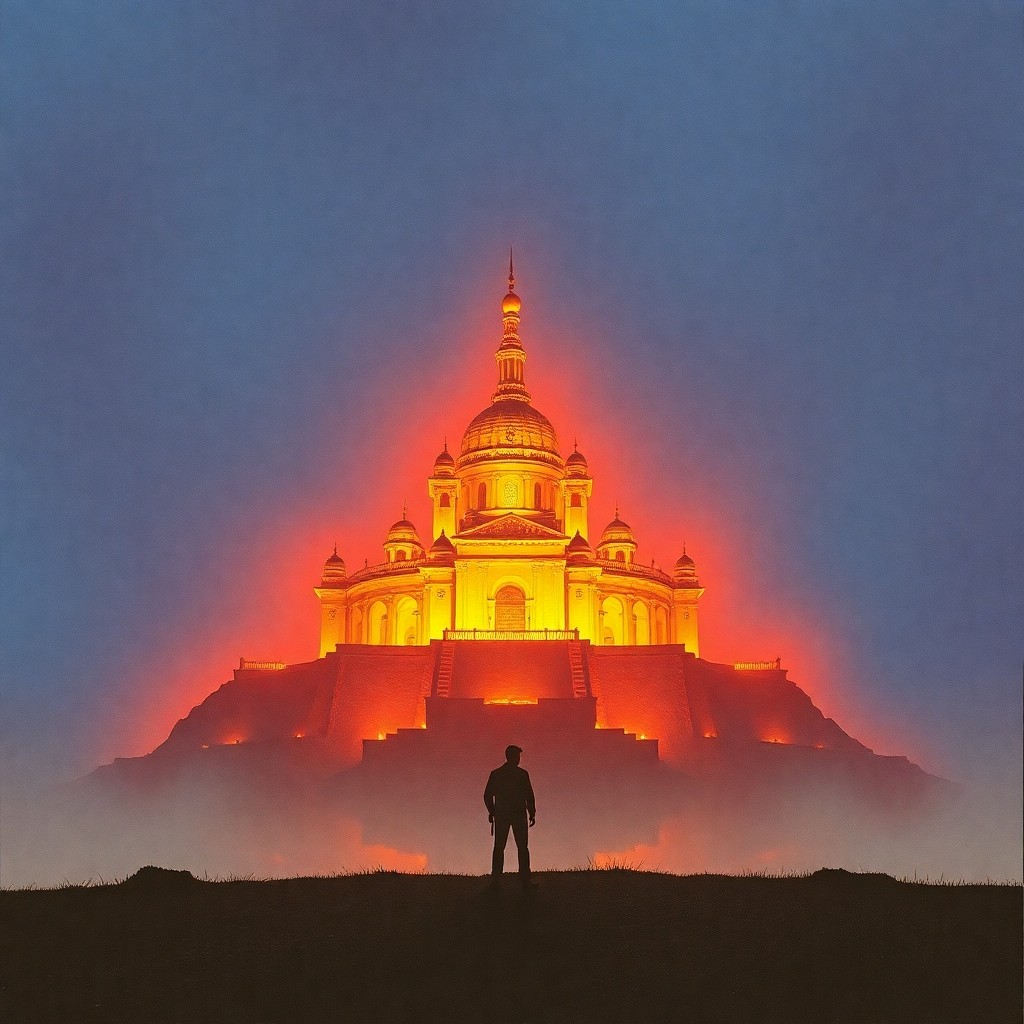
Winner of nine Academy Awards and directed by Italian master Bernardo Bertolucci, The Last Emperor (1987) is a biographical and dramatic masterpiece that chronicles the tragic and fascinating journey of Aisin-Gioro Puyi, the final ruler of the Qing dynasty in China. Through monumental production design and an intimate narrative, the feature film established itself as one of the greatest visual and historical landmarks of world cinema, examining the limits of sovereignty and the melancholy of lost identity amidst the political storms of the 20th century.
Analysis and Plot: Puyi's Golden Tragedy
The Last Emperor is not merely a conventional historical epic; it is an extraordinarily intimate character study operating within a machine of colossal scale. The film adopts a non-linear narrative structure, brilliantly alternating between two crucial periods of Puyi's life (played in adulthood by John Lone): his childhood and youth in the isolated opulence of the Forbidden City, and his subsequent humiliation and attempted rehabilitation at the Fushun War Criminals Management Center in 1950, under Mao Zedong's communist regime.
The story begins in 1908. At only three years old, Puyi is torn from his mother's arms and taken to the legendary Forbidden City in Beijing. He is crowned Emperor of China, surrounded by thousands of eunuchs and courtiers who bow to his every whim. However, this sovereignty is an existential farce. While Puyi reigns within the golden walls, the outside world undergoes drastic transformations: the Qing dynasty falls, the Republic of China is proclaimed, and the young emperor becomes a prisoner of luxury, a sovereign without an empire who cannot even cross the gates of his own residence.
As he grows, Puyi is shaped by external influences, most notably his British tutor, Reginald Johnston (Peter O'Toole), who introduces him to Western concepts, modern technology (such as bicycles and eyeglasses), and the burning desire to escape his golden cage. Marrying the beautiful Wanrong (Joan Chen) and taking Wenxiu (Vivian Wu) as a secondary consort, Puyi tries in vain to exert some control over his life. However, in 1924, he is summarily expelled from the Forbidden City by republican forces.
Exile begins the second phase of his downfall. Seduced by the glamour of the West and the promise of reclaiming his ancestral throne, Puyi commits the greatest mistake of his life: he allies himself with the Japanese invaders, who install him as the puppet ruler of Manchukuo (occupied Manchuria) in the 1930s. Under the manipulative influence of Amakasu (Ryuichi Sakamoto), Puyi becomes an unwitting accomplice to a brutal regime, while his wife Wanrong sinks into opium addiction and despair. With Japan's defeat in World War II, Puyi is captured by the Soviet army and subsequently handed over to the new Communist China, where he spends ten years in ideological re-education, forced to confront his crimes, his imperial ego, and his own practical uselessness.
The Ending Revealed: The Cricket, the Throne, and the Transition of Time
The finale of The Last Emperor is one of the most poetically devastating and symbolically rich sequences in cinema history. After receiving a pardon from the communist government and being released in 1959, Puyi spends his final years working humbly as a gardener in Beijing. He has finally become an ordinary citizen, stripped of all privilege, but paradoxically free for the first time in his life.
In 1967, during the tumult of the Chinese Cultural Revolution, an aged and ill Puyi visits the Forbidden City as a paying tourist. The palace that was once his entire world is now a public museum. He crosses the isolation ropes and climbs the steps to the Dragon Throne. There, he is approached by the son of one of the museum guards, a boy wearing the red scarf of the communist pioneers. To prove to the boy that he was indeed the emperor, Puyi smiles and retrieves from behind the throne an object hidden for over fifty years: the small bamboo cage he received from an elder on the day of his coronation, containing a cricket.
Puyi hands the cage to the boy. When the child opens the container, a green cricket emerges, perfectly alive and active. The boy looks up to speak to Puyi, but the old emperor has mysteriously vanished from the hall. The camera then cuts to a group of modern tourists entering the throne room under the voice of a tour guide who dryly announces that Puyi passed away in 1967, ending over two thousand years of imperial rule in China.
Hidden Meanings of the Ending
- The Cricket as a Metaphor for Puyi's Soul: The cricket, which remained trapped in the small cage for five decades, represents Puyi himself. Both were confined in artificial and exquisite structures (the bamboo cage and the Forbidden City), deprived of freedom in the name of tradition. The release of the cricket at the end symbolizes that, by accepting his common humanity and dying as a simple man, Puyi's soul finally freed itself from its historical chains.
- The Survival of the Human Spirit: The fact that the cricket is alive after so many years is an element of magical realism that defies biological logic, indicating that the essence of history and individual memories survives political regimes, whether they be dynastic, fascist, or communist.
- The Irony of History: By buying a ticket to enter his own childhood home, the film concludes its profound meditation on power. The man who was once considered the "Son of Heaven" and owner of a quarter of the world's population ends his journey possessing nothing but his memories, illustrating the impermanence of secular power.
Performances and the Weight of the Cast
The film's dramatic success rests heavily on the shoulders of its stellar cast. John Lone delivers the performance of his career portraying Puyi from youth to old age. Lone infuses the character with a unique melancholic vulnerability; he manages to portray the naive arrogance of a spoiled monarch and, simultaneously, the pain of a man aware of his own historical irrelevance. His physical nuances as he transitions from a haughty emperor to a hunched prisoner and, finally, to a serene gardener are movingly subtle.
Joan Chen shines intensely as Empress Wanrong. Her transformation from a cosmopolitan and hopeful young woman into a woman devastated by depression, Puyi's neglect, and opium addiction is one of the most painful trajectories in the film. The scene in which she chews opium flowers with tears in her eyes is one of the most iconic moments of the feature.
Peter O'Toole, with his aristocratic presence and unmistakable voice, brings warmth and humanity to the role of Reginald Johnston. He acts as Puyi's moral anchor and the emperor's only link to the reality of the outside world. The supporting cast also features notable contributions from Vivian Wu as the courageous consort Wenxiu, who demands a divorce (an unprecedented act in imperial history), and the legendary Japanese composer and actor Ryuichi Sakamoto, who plays the calculating official Amakasu with a threatening rigidity.
Behind the Scenes, Production, and Storaro's Color Theory
The production of The Last Emperor was an unprecedented logistical feat. It was the first Western feature film to receive full authorization from the government of the People's Republic of China to film within the royal walls of the Forbidden City in Beijing. Until then, the historical site had never opened its doors to a foreign film crew. The level of cooperation was so high that the Chinese army provided over 19,000 extras to recreate the grand coronation scenes and imperial assemblies.
One of the most celebrated aspects of the film is the cinematography by Italian master Vittorio Storaro. He used a complex and meticulous "Color Theory" to translate Puyi's psychological and chronological evolution:
- Red: Used in Puyi's childhood, it represents birth, blood, initial passion, and the walls of the Forbidden City that kept him isolated from the real world.
- Yellow: The exclusive imperial color. It represents Puyi's divine identity, his absolute monarchy, and the total isolation of his mythical power.
- Green: Introduced with the arrival of Reginald Johnston. It symbolizes knowledge, education, intellectual youth, and the desire to see what lies beyond the walls.
- Blue: Dominates the period in Manchukuo. It represents coldness, melancholy, loss of control, and the illusion of power that, in reality, belonged to the Japanese military.
- Grey: The color that dominates the communist prison. It represents the demystification of the emperor, raw reality, social equality, and the erasure of his mythical individuality for his rebirth as an ordinary citizen.
The original soundtrack, composed in an iconic collaboration between Ryuichi Sakamoto, David Byrne (leader of the band Talking Heads), and Chinese composer Cong Su, is a sublime blend of traditional Chinese sounds with synthesizers and Western orchestral arrangements, perfectly capturing the cultural clash and the country's temporal transition.
Controversies, Ideology, and Bertolucci's Vision
Despite its resounding critical success, The Last Emperor was not immune to intellectual debates and controversies. As Bernardo Bertolucci was a man of declared Marxist convictions, many historians and critics pointed out that the film adopts an excessively benevolent and sanitized perspective regarding the "re-education" process imposed by the Chinese Communist Party.
The director of the Fushun prison (played by Ying Ruocheng) is portrayed in an almost sanctified way, as an understanding and humanist therapist, rather than an agent of a totalitarian regime that used severe methods of brainwashing and psychological coercion. In historical reality, the re-education process was much more brutal and destructive for thousands of prisoners than the peaceful and enlightened transition suggested on screen.
Another point of divergence lies in the representation of Puyi himself. Historians point out that the film romanticized the emperor, omitting traits of his personality found in biographies and historical records, such as episodes of sadistic cruelty against his eunuchs in his youth, his severe emotional instability, and his complex abusive relationships with his wives. Bertolucci chose to focus on Puyi as a perpetual victim of historical circumstances—a leaf in the wind carried by geopolitical storms—diminishing his personal agency and moral responsibility in his political choices in Manchukuo.
Critical Reception, Box Office, and Historical Legacy
In the commercial circuit, The Last Emperor defied Hollywood's expectations for a nearly three-hour historical drama spoken partially in English and set in Asia. With an estimated budget of 25 million dollars, the film grossed over 44 million dollars in the North American box office alone, becoming an international financial success and broadening Western public interest in China's modern history.
Critical acclaim was almost unanimous. On the review aggregator site Rotten Tomatoes, the film maintains an extremely high approval rating, being praised by critics as an incomparable aesthetic achievement. At the 1988 Academy Awards, the film achieved one of the greatest "sweeps" in the history of the ceremony, winning in all nine categories for which it was nominated:
- Best Picture
- Best Director (Bernardo Bertolucci)
- Best Adapted Screenplay
- Best Cinematography
- Best Art Direction
- Best Costume Design
- Best Original Score
- Best Film Editing
- Best Sound Mixing
The legacy of The Last Emperor lies in its ability to fuse the visual grandeur of Hollywood's golden age with the artistic sensitivity and existential depth of European auteur cinema. By recording the transition from feudal China to modernity through the desolate gaze of its last monarch, Bertolucci delivered one of the greatest cinematic reflections on time, the loneliness of power, and the inevitability of change.
Sources Researched
- Roger Ebert Movie Reviews: rogerebert.com/reviews/the-last-emperor-1987
- The Academy of Motion Picture Arts and Sciences (Oscars Database): oscars.org
- American Cinematographer (Vittorio Storaro Analysis): ascmag.com
- Rotten Tomatoes (Critical Reception): rottentomatoes.com/m/last_emperor
- Box Office Mojo: boxofficemojo.com
- British Film Institute (BFI): bfi.org.uk





