



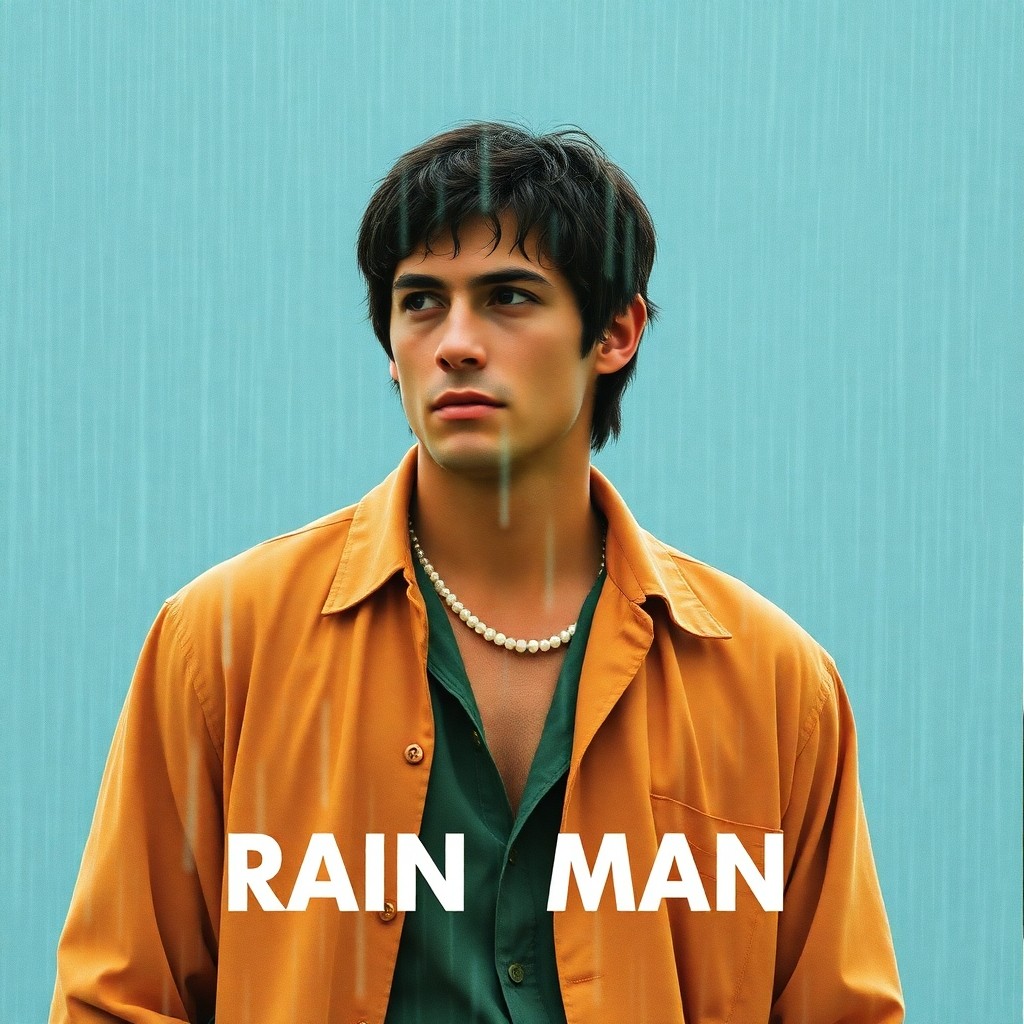
Released in 1988 and directed by Barry Levinson, Rain Man is a watershed moment in contemporary cinema, blending intimate drama and the road movie genre to explore the complex relationship between two long-estranged brothers. Starring Dustin Hoffman and Tom Cruise, the feature film not only dominated the awards season—winning four Oscars, including Best Picture—but also redefined the representation of autism in global pop culture, establishing itself as a cultural landmark that balances psychological sensitivity with the commercial appeal of 1980s Hollywood.
Analysis and Plot
At first glance, Rain Man presents itself as the redemption journey of a selfish man through contact with the purity and limitations of his brother. However, under the precise direction of Barry Levinson and the sharp screenplay by Ronald Bass and Barry Morrow, the film reveals itself as a psychological autopsy of late 1980s American materialism. The protagonist, Charlie Babbitt (Tom Cruise), is the embodiment of the greedy "yuppie," whose life is dictated by deadlines, debts, and an incessant search for control and status through the import of luxury sports cars.
The narrative is triggered by the death of Charlie's father, a man with whom he had cut ties in his adolescence. Upon returning to Cincinnati for the funeral and the reading of the will, Charlie discovers he has inherited only a collection of prize-winning rosebushes and a 1949 Buick Roadmaster, while a 3-million-dollar fortune has been left to a trust fund managed by a mental health institution, Wallbrook. While investigating the institution, Charlie discovers the existence of Raymond (Dustin Hoffman), his older brother diagnosed with autism and Savant syndrome, whose existence had been completely hidden from him his entire life.
Driven by greed and the frustration of being disinherited, Charlie "kidnaps" Raymond from the institution, planning to take him to Los Angeles to force a financial settlement with the fund's trustee, Dr. Gerald Bruner (Jerry Molen). What should have been a quick flight back to California turns into a cross-country odyssey, as Raymond's inflexible aversion to flying and busy highways forces Charlie to drive along the country's backroads.
During the trip, the dynamic between the brothers evolves from a relationship of irritated exploitation to a genuine connection of affection and mutual understanding. Charlie begins to decipher Raymond's rigid rituals—which involve watching the TV show The People's Court religiously, eating specific foods on exact days, and always sleeping before 11 PM—and discovers his brother's astonishing mnemonic and mathematical calculation abilities. It is at the dramatic climax in Las Vegas, where Charlie uses Raymond's skills to count cards at Blackjack and pay off his debts, that the commodification of Raymond reaches its peak and, paradoxically, initiates the definitive collapse of Charlie's emotional barriers.
The Conclusion: Hidden Meanings and the Deconstruction of the "Cure"
The ending of Rain Man is frequently praised for its refusal to give in to the easy clichés of Hollywood melodrama. In the final hearing that will determine Raymond's custody, mediated by a neutral psychiatrist, Charlie is confronted with the harsh reality that his newfound love for his brother is not enough to overcome Raymond's severe cognitive limitations and need for a structured routine. When the psychiatrist asks Raymond what he wants, the character is unable to make a complex long-term decision, evidencing that his mind operates under parameters of immediate safety, not existential autonomy.
By accepting that Raymond must return to the institutional safety of Wallbrook, Charlie Babbitt completes his transformation arc. The renunciation of custody—and, implicitly, the direct dispute for the 3 million dollars—represents the death of the "yuppie" Charlie and the birth of a man capable of altruism. The money, which initially motivated the entire journey, becomes irrelevant. Charlie's true prize is the discovery of his own humanity, symbolized by the moment he gently rests his forehead against Raymond's—a gesture of physical connection extremely rare for the autistic brother, who normally rejects any type of touch.
The hidden meaning of the ending lies in the acceptance of otherness. Rain Man does not offer a miraculous cure for Raymond's autism, nor does it propose that brotherly love can resolve all neurological barriers. Instead, the film argues that true growth lies in adapting to the other, rather than forcing the other to adapt to our world. Raymond's departure on the train, with Charlie promising to visit him in two weeks, is bittersweet but deeply honest: the brothers now inhabit worlds separated by geography and neurodiversity, but united by an indestructible emotional bridge.
Cast and Standout Performances
The artistic success of Rain Man rests almost entirely on the shoulders of its two leads, whose contrasting acting approaches created perfect cinematic chemistry.
- Dustin Hoffman (Raymond Babbitt): Winner of the Oscar for Best Actor for this role, Hoffman delivers a meticulous performance that avoided the trap of cheap sentimentality. The actor avoided eye contact with the camera and with Cruise for most of the filming, adopting a monotone voice and a rigid physical posture that perfectly conveyed Raymond's sensory isolation. His performance was the result of months of living with people on the autism spectrum and individuals with Savant syndrome, resulting in a characterization that, although analyzed today through new clinical lenses, was considered revolutionary at the time for its technical precision.
- Tom Cruise (Charlie Babbitt): Often eclipsed by Hoffman's transformative performance, Cruise's work in Rain Man is, from the perspective of modern criticism, the film's true dramatic engine. Cruise plays Charlie's transition with impressive subtlety. At the beginning, he uses his habitual charm in an aggressive and unsympathetic way; throughout the film, this shell of self-confidence peels away, giving way to a touching vulnerability. It is Charlie who changes; Raymond remains static in his condition. Cruise's ability to react to and anchor Hoffman's performance is what prevents the film from becoming a mere exercise in theatrical virtuosity by a single actor.
- Valeria Golino (Susanna): In the role of Charlie's Italian girlfriend, Golino serves as the moral compass of the film's first act. Her presence highlights the contrast between Charlie's initial inability to show empathy and the need for human connection. The elevator scene in Las Vegas, where Susanna teaches Raymond to dance and kisses him gently on the cheek, is of crucial delicacy for the development of Hoffman's character.
Behind-the-Scenes Trivia and Turbulent Production
The journey to bring Rain Man to the big screen was long and marked by an impressive turnover of directors and distrust from the production team itself.
Barry Morrow's original script passed through the hands of several legendary directors before reaching Barry Levinson. Martin Scorsese was considered to direct, but preferred to focus on The Last Temptation of Christ. Steven Spielberg even developed the project for almost half a year, collaborating on the script's structure, but had to abandon the production due to pre-existing contractual commitments with the Indiana Jones franchise (specifically, The Last Crusade). Sydney Pollack was also briefly associated with the direction, attempting to rewrite the narrative to focus more on the financial dispute, before finally giving up due to creative differences.
During filming, both Dustin Hoffman and Tom Cruise were convinced that the film would be a resounding box office failure. They jokingly nicknamed the production "Two Schmucks in a Car." At one point, overcome by frustration with the difficulty of finding the exact tone for Raymond, Hoffman told director Barry Levinson: "Hire another actor, Barry, because this is the worst work of my life." Fortunately, Levinson kept his cool and encouraged improvisation. The famous scene where Raymond passes gas inside a closed phone booth was entirely improvised by Hoffman and Cruise, with Cruise's reactions of disgust and laughter being genuine.
The greatest inspiration for the character of Raymond Babbitt was Kim Peek, a man diagnosed with macrocephaly and agenesis of the corpus callosum, gifted with an extraordinary eidetic memory. Peek could read two pages of a book simultaneously (one with each eye) and memorize about 98% of everything he read. Hoffman spent weeks with Peek, studying his mannerisms, his characteristic walk, and his way of interacting with the world, although Raymond was scripted as autistic, unlike Peek's actual neurological condition.
Controversies and Representation of Autism
Despite its enormous critical and commercial success, Rain Man is not exempt from debate and controversy, especially when analyzed from the contemporary perspective of neurodivergent rights.
The main controversy revolves around the so-called "Rain Man Effect." By directly associating autism with extraordinary mathematical and mnemonic abilities (Savant syndrome), the film created, in the popular imagination, the stereotype that every autistic person possesses a "hidden genius" or a superhuman ability. Activists and psychologists point out that this created unrealistic social pressure on individuals on the autism spectrum, obscuring the fact that Savant syndrome is extremely rare, occurring in only a small fraction of people diagnosed with autism spectrum disorder (ASD).
Furthermore, contemporary film critics debate the concept of "inspiration porn," arguing that the character of Raymond, by not possessing real agency over his own destiny, serves primarily as a "learning device" for the moral growth of the neurotypical protagonist (Charlie). Raymond is treated, in several passages, as a valuable object to be disputed or a tool to obtain money, and although Charlie learns to love him, the narrative structure still centers the emotional journey on the man without a disability.
Reception, Box Office, and Legacy
Against all the pessimistic expectations of the lead stars, Rain Man was an unprecedented commercial and critical triumph in 1988. Produced with an estimated budget of 25 million dollars, the feature film grossed a staggering 354.8 million dollars worldwide, becoming the highest-grossing film of 1988 in the United States and consolidating Tom Cruise's audience-drawing power and Dustin Hoffman's artistic stature.
Critical acclaim was almost unanimous. On the review aggregator site Rotten Tomatoes, the film maintains an extremely high approval rating, with reviews from the time praising Levinson's sensitive direction, which avoided tear-jerking melodrama in favor of subtle humor and a humanistic observation of the characters. Roger Ebert, the legendary film critic, highlighted in his review that the film's strength lies precisely in Raymond's refusal to change: "Raymond is not cured. He does not learn to love. He remains the same at the end, and it is Charlie who changes by realizing that he must accept Raymond exactly as he is."
At the 1989 Oscars, Rain Man consolidated its consecration by receiving eight nominations and winning in the four main categories:
- Best Picture (Mark Johnson, producer)
- Best Director (Barry Levinson)
- Best Actor (Dustin Hoffman)
- Best Original Screenplay (Ronald Bass and Barry Morrow)
The legacy of Rain Man transcends the movie screen. From a cultural standpoint, the film was responsible for introducing the term "autism" to the general public's vocabulary at a time when the diagnosis was widely misunderstood and stigmatized. Although the representation has its imperfections in light of modern science, the work opened crucial doors for research funding, public debate on inclusion, and the humanization of neurodivergent individuals in mass media. Thirty years later, the silhouette of Charlie and Raymond Babbitt walking side by side on the road remains one of the most iconic and emotionally resonant images in the history of American cinema.
Sources Researched
- IMDb - Rain Man (1988) - Trivia and Box Office: www.imdb.com/title/tt0095953/
- Rotten Tomatoes - Rain Man Reviews: www.rottentomatoes.com/m/rain_man
- The New York Times - Film Review: "Rain Man" by Janet Maslin (1988): www.nytimes.com
- Box Office Mojo - Rain Man (1988) Historical Data: www.boxofficemojo.com
- American Film Institute (AFI) - Catalog of Feature Films: catalog.afi.com





