



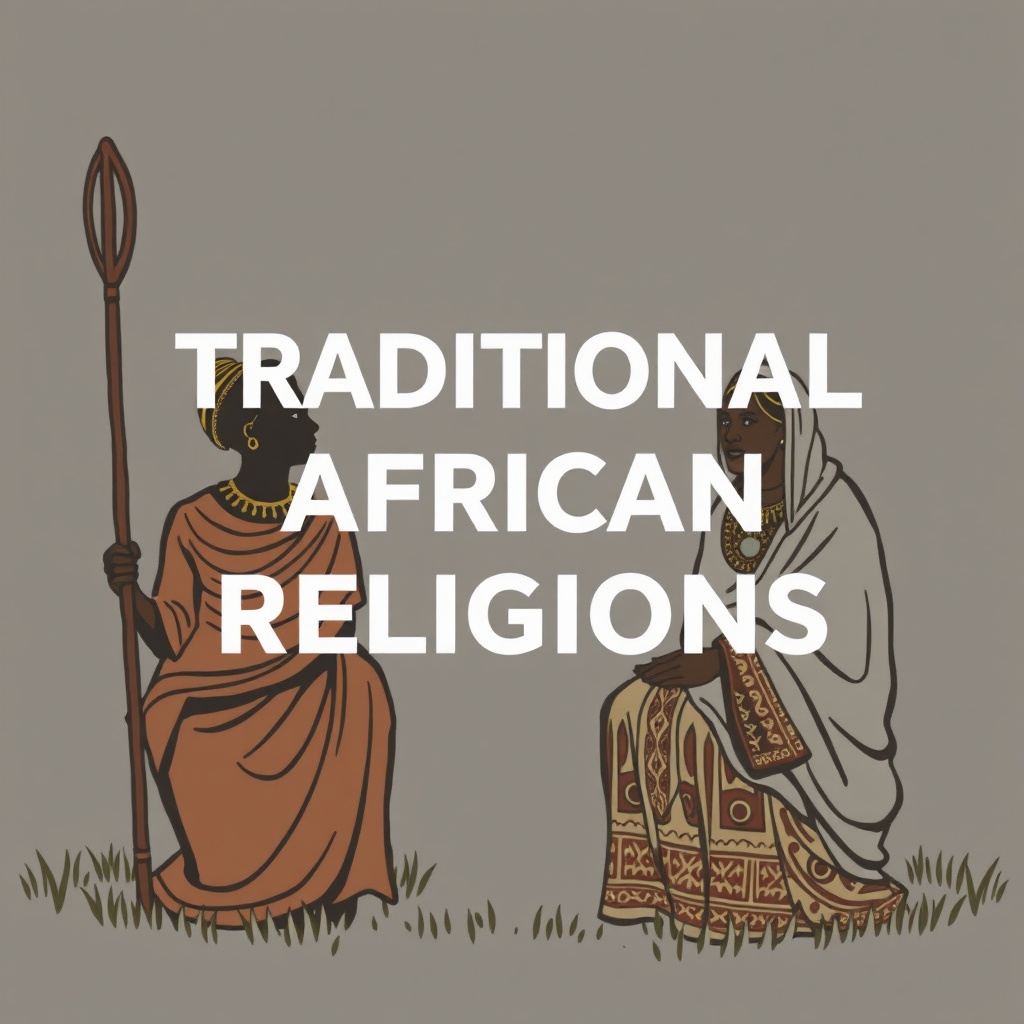
Traditional African Religions encompass a vast and diverse range of belief systems and spiritual practices originating from the African continent. Far from being a monolithic block, they represent a complex mosaic of worldviews, rituals, and social structures that have evolved over millennia within different ethnolinguistic and geographic contexts, profoundly shaping the identity and communal life of their adherents.
Traditional African Religions: A Sociological, Historical, and Critical Analysis
The term "Traditional African Religions" is, in itself, an academic construct that seeks to categorize a broad and multifaceted spectrum of belief systems and spiritual practices that have flourished and continue to exist on the African continent. It is essential to recognize from the outset that this denomination can lead to oversimplification, obscuring the richness and intrinsic diversity of these traditions. However, in an academic analysis context, the term serves as a starting point for understanding common characteristics and a shared historical genealogy, allowing for a deeper study of their specific manifestations.
1. Sociological and Theological Definition
Sociologically, Traditional African Religions are understood as systems of beliefs and practices that are intrinsically linked to the social, political, and economic life of the communities that profess them. They often do not clearly distinguish the sacred from the profane, integrating the spiritual into daily life in an organic way. Religion is often a unifying element of the community, providing a moral, social, and cosmological framework that guides the lives of individuals and the group.
Theologically, and with the caveat of diversity, it is possible to identify some recurring elements. The belief in a Supreme God, creator and transcendent, although not always directly worshipped, is common in many traditions. Below this Supreme God, there are intermediate deities (orishas, voduns, abosom, ncimbi, etc.), ancestral spirits (who maintain a relationship with the living and can intercede), and forces of nature. The relationship with the divine is often mediated by rituals, sacrifices, offerings, and the figure of the religious leader, who acts as an intermediary. Morality is frequently based on harmony with the community and the cosmos, with illness, misfortune, and natural disasters often interpreted as consequences of spiritual or moral imbalances.
2. Historical Origin, Founders, and Geographic/Cultural Context
Traditional African Religions do not have single founders or specific dates of emergence, as their origins date back to prehistoric times, developing organically from the first human societies on the continent. They are the result of millennia of cultural interactions, environmental adaptations, and reflections on human existence.
The geographic and cultural context is one of immense diversity. We can cite, for example, the religions of the Yoruba people in Nigeria and Benin (such as Ifá, which worships the orishas), the traditions of the Fon people in Benin (worship of voduns), the Ashanti beliefs in Ghana (worship of abosom), the traditions of the Bantu people in Southern and Eastern Africa (with their diverse forms of ancestor and spirit worship), and many others in regions such as West, Central, and East Africa.
Orality is a fundamental pillar in the transmission of these beliefs and practices. Myths, stories, songs, and dances are the primary vehicles of religious and cultural knowledge, passed down from generation to generation. European colonization, the expansion of Islam, and, more recently, the growth of Christianity have brought new challenges and influences, leading to syncretism, resistance, and, in some cases, the decline of the practice of original traditions, but also driving their revitalization and adaptation.
3. Main Beliefs, Dogmas, Rites, and Practices
Although diversity is the norm, some themes are recurring:
- Worldview: A vision of the world where the spiritual permeates all aspects of existence. Life is seen as a continuous cycle, with a strong emphasis on the interconnection between the visible and invisible worlds.
- Deities and Ancestors: Belief in a Supreme Being, intermediate deities who act as messengers or agents of the divine on earth, and the veneration of ancestors, who are seen as protectors and guides of the living.
- Rites of Passage: Important ceremonies to mark transitions in life, such as birth, initiation, marriage, and death, ensuring social and spiritual continuity and order.
- Rituals and Sacrifices: Practices such as offerings of food, drinks, animals, and other goods are common to appease deities and ancestors, ask for blessings, healing, or protection, and to restore balance.
- Divination: Methods such as Ifá (among the Yorubas), the reading of shells or bones, are used to interpret the divine will, obtain advice, and diagnose the cause of problems.
- Healing: Healing is often seen as a process that involves both the physical and spiritual dimensions, with healers and religious leaders playing crucial roles.
- Festivals: Community celebrations that reinforce social and religious ties, honoring deities, ancestors, and important events.
It is important to note that theology and practice can vary enormously. For example, the Ifá system, associated with Candomblé and Santería, is one of the most studied and systematized, with a complex pantheon of orishas and a sophisticated divination system. Other traditions may have a greater focus on ancestor worship or nature spirits.
4. Organizational Structure and Leadership Profile
The organizational structure of Traditional African Religions is predominantly decentralized and community-based. There is no unified global hierarchy as in some universal religions. Instead, the organization is generally local and familial.
- Community and Religious Leaders: Figures such as family heads, elders, priests (babalawo, iyalorisha, houngan, mambo, etc.), and healers hold spiritual and social authority. Their role is to mediate the relationship with the divine, interpret omens, lead rituals, and advise the community.
- Family and Bloodline: Family lineage and respect for ancestors are central. Rituals often revolve around the extended family and direct ancestors.
- Secret Societies and Associations: In some cultures, there are secret societies or associations of initiates that play specific roles in religious and social life, such as maintaining secret rites or protecting the community.
Leadership is often acquired through initiation, vocation, or inheritance, and is marked by wisdom, knowledge of rituals, and the ability to communicate with the spiritual world. Authority is often more charismatic and based on knowledge than on a formal bureaucratic structure.
5. [WARNING/CONTROVERSIES] Factual Analysis Regarding Potential Legal Controversies, Ethical Deviations, or "Destructive Cult" Characteristics
It is crucial to address with rigor and impartiality the question of whether the term "Traditional African Religions" can, in some contexts, be associated with groups that exhibit characteristics of "destructive cults." It is fundamental to separate the vast majority of genuine African traditions, which promote social cohesion, moral values, and community care, from isolated and perverse cases that exploit the faith of others.
Generalization and the Danger of Demonization:
The main danger is generalization. Traditional African Religions, in their essence, are deep and complex belief systems that were historically targeted by prejudice and demonization by Christian missionaries and colonizers, who labeled them as "pagan," "witchcraft," or "demonic cults." This ethnocentric and racist view obscured the richness of these traditions and contributed to the marginalization of their practitioners.
Specific Cases and Deviations:
However, as in any religious or ideological system, it is possible for individuals or groups to take advantage of the faith and vulnerability of people for illicit purposes. It is imperative to monitor and report such cases, based on concrete evidence and reliable sources.
Research and Reporting:
Academic research and reports from serious sources occasionally point to situations where practices that call themselves "traditional religions" may present concerning characteristics. Examples that may arise in investigations include:
- Financial Exploitation: Exorbitant charges for rituals, healings, or blessings, exploiting the faith and hopelessness of believers. Reports of "religious leaders" who enrich themselves at the expense of their followers are a warning sign.
- Coercion and Mind Control: Social isolation of members, control of their personal, financial, and relational lives, and the imposition of beliefs in a dogmatic way without room for questioning.
- Violence and Abuse: Although not inherent to the traditions, there are occasional and isolated reports of leaders who commit physical, sexual, or psychological abuse in the name of religion. The practice of violent "exorcisms" or "purifications," for example, can be an indicator of deviation.
- Harm to Third Parties: In rare and extreme cases, there may be reports of rituals that cause harm to animals (cruel sacrifices outside the traditional and ethical ritualistic context) or that incite hatred and violence against specific groups.
Clear Warning:
It is **crucial** to emphasize that the vast majority of Traditional African Religions do not fit into any of these destructive profiles. They are belief systems that, when practiced within their original cultural and ethical contexts, promote harmony, respect for ancestors and the community, and the pursuit of balance in life. However, any denomination or group that systematically exhibits the characteristics of social isolation, abusive financial exploitation, coercive mind control, or that promotes harm to people, animals, or society, must be treated with extreme skepticism and investigated rigorously. Academic research and serious investigative journalism are essential tools for discerning between genuine religious tradition and the abuse of power disguised as faith.
Research Sources for Controversial Cases:
When investigating allegations of deviations, it is imperative to seek information from:
- Reports from human rights organizations.
- Journalistic investigations from reliable media outlets (national and international).
- Court cases and police inquiries.
- Academic articles that critically analyze specific groups.
- Investigative documentaries from reputable sources.
It is fundamental that the analysis be based on facts, evidence, and verifiable testimonies, avoiding generalizations that perpetuate prejudice against African religions.
6. Social, Cultural Impact, and Contemporary Relevance
Traditional African Religions exert a profound social and cultural impact, shaping identities, value systems, health practices, social organization, and worldviews across much of the African continent and its diasporas.
- Identity and Social Cohesion: They provide a sense of belonging and historical continuity, strengthening community ties and cultural identity in a rapidly changing world.
- Health and Well-being: Traditional medicine, often intertwined with religious practices, continues to be a vital source of healthcare for many communities, addressing both the body and the spirit.
- Cultural Resistance: During periods of colonization and the imposition of foreign religions, African traditions served as an important point of cultural resistance and affirmation of identity.
- Syncretism and Hybridity: The interaction with Christianity and Islam resulted in complex processes of syncretism, giving rise to new religious forms that combine elements of different traditions (such as Candomblé and Santería in Brazil and the Caribbean, which combine African elements with Catholicism).
- Contemporary Relevance: Despite the expansion of monotheistic religions, Traditional African Religions continue to be vibrant and relevant. Many communities actively practice them, and there is growing academic and public interest in their richness and complexity. They offer unique perspectives on the relationship between humans, nature, and the cosmos, which can be valuable for the contemporary world, especially in discussions about ecology, spirituality, and community well-being.
References and Research Sources
- John Mbiti. African Religions and Philosophy. Heinemann, 1969.
- E. Bolaji Idowu. Olodumare: God in Yoruba Belief. Longman, 1962.
- Augustin Holl. The Forgotten Past: The Development of Indigenous African Religions. University of Pennsylvania Press, 2012.
- Kyle Harper. The Fate of Rome: Climate, Disease, and the End of an Empire. Princeton University Press, 2017. (Although focused on ancient Rome, it offers methodologies for understanding the intersection of environmental and social factors in ancient societies, applicable to historical analysis).
- Publications from African research institutes and centers for African religious studies (e.g., African Centre for Religious Studies, University of Ibadan).
- Academic articles in journals such as: Journal of Religion in Africa, African Arts, Africa: Journal of the International African Institute.
- Reports from international news agencies (Reuters, Associated Press, BBC News) and reference newspapers (The New York Times, The Guardian) that cover the African continent and its social and religious dynamics.
- Research and reports from human rights organizations that document abuses in the name of religion, always verifying the origin and credibility of the information.





