



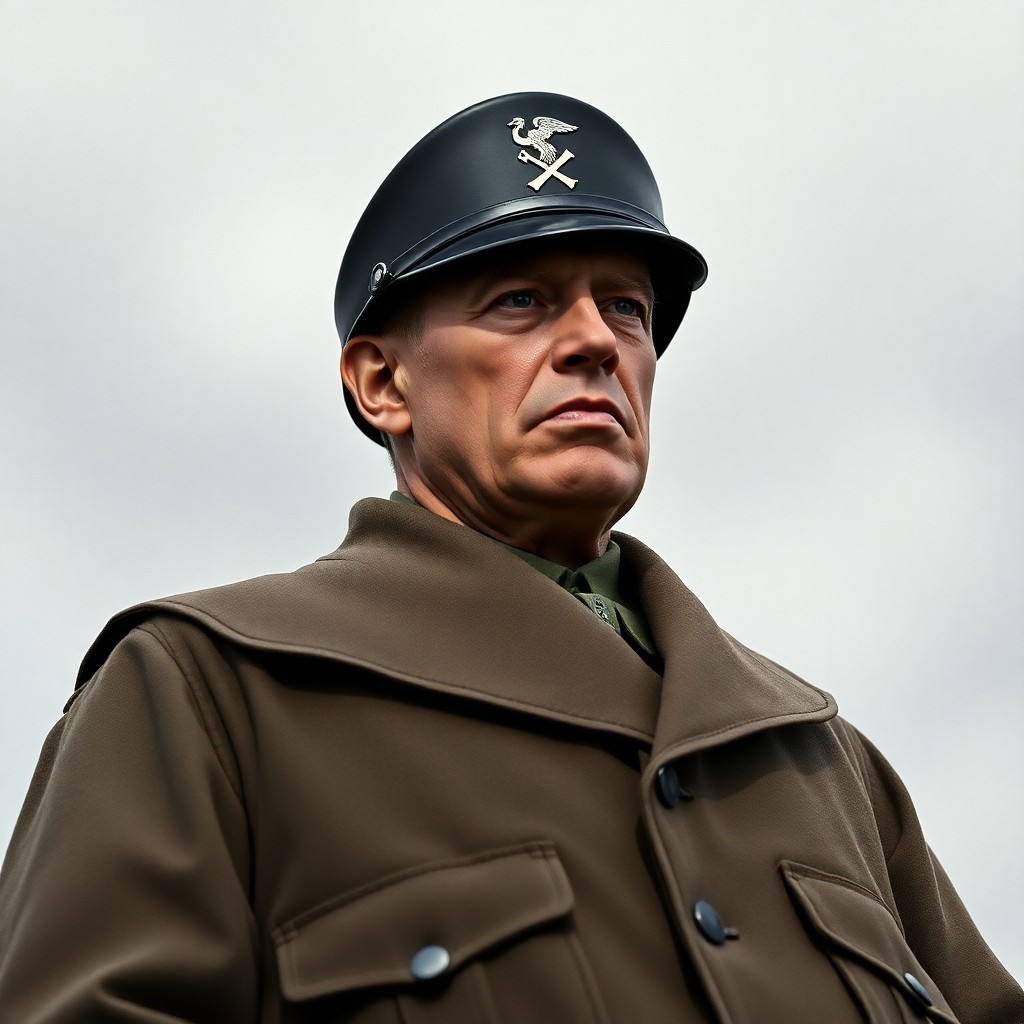
Released in 1970 under the masterful direction of Franklin J. Schaffner, Patton is a definitive biographical epic that transcends the boundaries of traditional war cinema. Starring an indomitable George C. Scott, the film surgically captures the complex and contradictory psyche of General George S. Patton Jr. during World War II. The work serves both as a profound psychological study of a man born out of his time and as a poignant reflection on militarism, glory, and the anachronism of the warrior in a rapidly modernizing world.
Analysis and Plot
Patton does not begin with the roar of cannons or the clamor of soldiers on the front, but rather with one of the most iconic, theatrical, and imitated openings in cinema history. Standing before a gigantic United States flag, General George S. Patton Jr. (played by George C. Scott) appears impeccably uniformed, decorated, and carrying his famous ivory-handled pistols. He delivers a nearly six-minute monologue that serves as a thesis on the American character, the philosophy of war, and the inevitability of conflict. This introduction immediately sets the tone of the film: a character study on a monumental scale, where the historical figure merges with the myth.
The narrative itself begins in 1943, in North Africa, shortly after the disastrous American defeat at the Battle of Kasserine Pass. The U.S. Army is demoralized, poorly trained, and tactically outmatched by Field Marshal Erwin Rommel's Afrika Korps. Patton is sent to take command of the U.S. II Corps and, with an iron fist, instills Spartan discipline. He demands that all soldiers wear ties and helmets at all times, restoring pride and military rigor. His brutalist approach works; he reorganizes the troops and wins a crucial victory over Axis forces at El Guettar.
The film follows Patton's trajectory through the invasion of Sicily, where his veiled rivalry with British General Bernard Montgomery (Michael Bates) reaches its peak. Patton is obsessed with capturing Messina before the British, pushing his men beyond normal physical limits to feed his own ego and sense of historical destiny. It is during this campaign that the infamous "slapping incident" occurs, in which Patton physically assaults two soldiers hospitalized for "battle fatigue" (post-traumatic stress), accusing them of cowardice. This act of brutality generates a massive political scandal, forcing General Dwight D. Eisenhower to remove him from active command.
Patton spends months in political and military ostracism, serving as a strategic distraction (a ghost army in England) to deceive the Germans before D-Day. He begs for a new chance and is rehabilitated to lead the Third Army after the invasion of Normandy. His march across Europe is lightning-fast, culminating in the spectacular rescue of American troops surrounded at the Battle of the Bulge (Bastogne), where he performs a brilliant tactical repositioning maneuver under adverse weather conditions, after publicly asking God for "good weather to kill Germans."
With the end of the war in Europe, Patton's true tragedy is revealed. Unable to adapt to the diplomacy of peace and the politics of coexistence with the Soviet Union—whom he openly views as the next inevitable enemy—Patton makes disastrous public statements comparing Nazi party membership to the political rivalry between Democrats and Republicans. Without a war to fight, he becomes a dangerous anachronism to the new world geopolitical order, resulting in his final removal from command of the Third Army.
The Ending and Its Hidden Meanings
The finale of Patton is one of overwhelming poetic melancholy, contrasting sharply with the triumphalism of its opening. We see Patton walking alone, without military uniform, wearing civilian clothes alongside his faithful dog, Willie, in a European rural landscape dominated by a windmill whose blades turn slowly against the gray sky.
The presence of the windmill is not a mere aesthetic choice. It is a direct allusion to Don Quixote, the anachronistic knight who fought windmills imagining them to be giants. Patton, like Quixote, is a man trapped in a code of medieval chivalry in a world that has industrialized and bureaucratized. Mechanized warfare and, subsequently, the atomic age rendered individual heroism and the pursuit of personal glory obsolete. He is a warrior without a battle, a living anachronism.
In a voice-over, we hear Patton narrate his famous reflection on the Roman triumph:
"For over a thousand years, Roman conquerors returning from the wars enjoyed the honor of a triumph... In the procession, a slave would stand behind the conqueror, holding a golden crown and whispering in his ear a warning: 'All glory is fleeting.'"
This line encapsulates the tragic core of the film. Patton believed in reincarnation and was convinced he had been a Greek soldier, a Roman legionnaire, and a Napoleonic cavalryman in past lives. The slave's warning serves as fate's verdict on Patton's own existence: no matter how brilliant his victories or how vast his military genius, time and social evolution erase the need for the pure warrior. Peace is the grave of men like Patton.
Cast and Notable Performances
It is virtually impossible to discuss the impact of Patton without surrendering to the titanic performance of George C. Scott. Scott did not play Patton; he embodied him with a volcanic intensity that redefined the concept of cinematic biographies. The actor adopted a raspy, harsh, and imposing voice (curiously deeper and more threatening than the real, considerably higher-pitched voice of General Patton himself) and a physical posture that exuded aristocratic and intimidating authority.
The brilliance of Scott's performance lies in his ability to humanize a man who could easily have been portrayed as a cartoonish villain or a one-dimensional hero. He transitions masterfully between relentless fury and moments of deep sensitivity, such as when he cries by the bedside of a dying soldier or when he demonstrates his erudition by reciting poetry and discussing military tactics of classical antiquity.
However, the greatness of Scott is perfectly balanced by the sober and pragmatic performance of Karl Malden as General Omar Bradley. Bradley functions as Patton's moral and rational counterpoint. While Patton seeks glory and divine confrontation, Bradley is concerned with logistics, the lives of his men, and diplomacy. The dynamic between the two actors gives the film its realistic ballast, demonstrating the collision between the romantic idealism of war and the cold efficiency of modern military management.
Behind-the-Scenes Trivia
- The Script Saved by Scott: The original script was written by a young Francis Ford Coppola in 1965. However, his vision—which included the iconic flag opening and a highly ambiguous portrait of Patton—was considered "eccentric" and rejected by 20th Century Fox. The studio hired Edmund H. North to rewrite it. Years later, when George C. Scott was cast in the lead role, he demanded to read Coppola's version and declared he would only do the film if the young writer's original script was restored. Fox relented, and the fusion of Coppola and North's work ended up winning the Oscar for Best Original Screenplay.
- The Refusal of Other Actors: Before Scott accepted the role, several Hollywood stars refused the opportunity to play the general for fear that the film would glorify war amidst the tensions of the Vietnam War. Among those who refused were Burt Lancaster, Robert Mitchum, Lee C. Marvin, and Rod Steiger. The latter later declared that turning down the role was the biggest mistake of his career.
- Locations in Franco's Spain: To recreate the various European and African battlefronts without breaking the budget, the production was filmed almost entirely in Spain, under the regime of dictator Francisco Franco. The Spanish army provided thousands of soldiers as extras, as well as tanks and historical World War II military equipment.
Controversies and Historical Context
The Refusal of the Oscar by George C. Scott
One of the greatest controversies in cinema history occurred at the 43rd Academy Awards in 1971. George C. Scott, nominated for Best Actor for his flawless performance, sent a telegram to the Academy of Motion Picture Arts and Sciences months before the ceremony, formally refusing the nomination. Scott referred to the ceremony as a derogatory "meat market" and stated that he did not want to be part of an artificial competition between actors.
Despite his refusal, the Academy kept his name on the list and Scott won the category. Producer Frank McCarthy accepted the statuette on his behalf during the television broadcast, but the trophy was returned to the Academy the following day. Scott spent the night of the awards at his farm, watching a hockey game.
The Political Rorschach Test: The Vietnam Context
Released in 1970, at the height of the protests against the Vietnam War and the polarization of American society, Patton became a kind of political "Rorschach test." The genius of Schaffner's direction and Coppola's script consisted of not taking an explicit side on the general's character. The film presents Patton in a raw way: an undeniable military genius, but also a dangerous egomaniac, insensitive to individual suffering and obsessed with violence.
As a result, the public interpreted the film in diametrically opposed ways:
- The Hawks (Conservatives/Pro-War): Saw the film as a patriotic tribute to an American hero misunderstood by Washington bureaucrats, a strong leader who did what was necessary to win. President Richard Nixon was notoriously obsessed with the film, watching it repeatedly at the White House before making crucial military decisions, such as the controversial invasion of Cambodia in 1970.
- The Doves (Liberals/Anti-War): Saw the work as a brilliant satire and a fierce denunciation of fanatical militarism. For this group, George C. Scott's Patton was a pathological portrait of the madness of war, an infantile man who found aesthetic pleasure in human destruction ("God help me, I do love it," Patton confesses while walking through a devastated battlefield).
Critical Reception and Legacy
Patton was a resounding success with both audiences and critics. It grossed over $61 million at the worldwide box office against an estimated budget of $12 million, an impressive feat for a biographical drama nearly three hours long.
In the 1971 awards season, the film dominated the Oscars, receiving 10 nominations and winning in 7 major categories:
- Best Picture
- Best Director (Franklin J. Schaffner)
- Best Actor (George C. Scott - refused)
- Best Original Screenplay (Francis Ford Coppola and Edmund H. North)
- Best Art Direction
- Best Film Editing
- Best Sound
Critics unanimously praised the film's audacity in avoiding the clichés of Hollywood war melodrama. In his original review, the celebrated critic Roger Ebert gave the film four stars, noting that "the film does not apologize for Patton, nor does it glorify him in a simplistic way; it simply places him on the screen in all his disconcerting complexity."
In 2003, Patton was selected for preservation in the United States Library of Congress's National Film Registry for being considered "culturally, historically, or aesthetically significant." The work remains the gold standard of cinematic biographies, proving that the best way to honor a historical figure is not to sanctify them, but to expose their fractures, their contradictions, and their tragic humanity.
Sources Researched
- Academy of Motion Picture Arts and Sciences (oscars.org) - Official records of the 43rd Academy Awards.
- American Film Institute (afi.com) - Feature Film Catalog and lists of the greatest films of all time.
- Box Office Mojo (boxofficemojo.com) - Consolidated historical box office data.
- IMDb (imdb.com) - Production details, cast, and behind-the-scenes trivia.
- Roger Ebert (rogerebert.com) - Original review and retrospective essays on the work.
- Rotten Tomatoes (rottentomatoes.com) - Contemporary and historical critical reception.





