



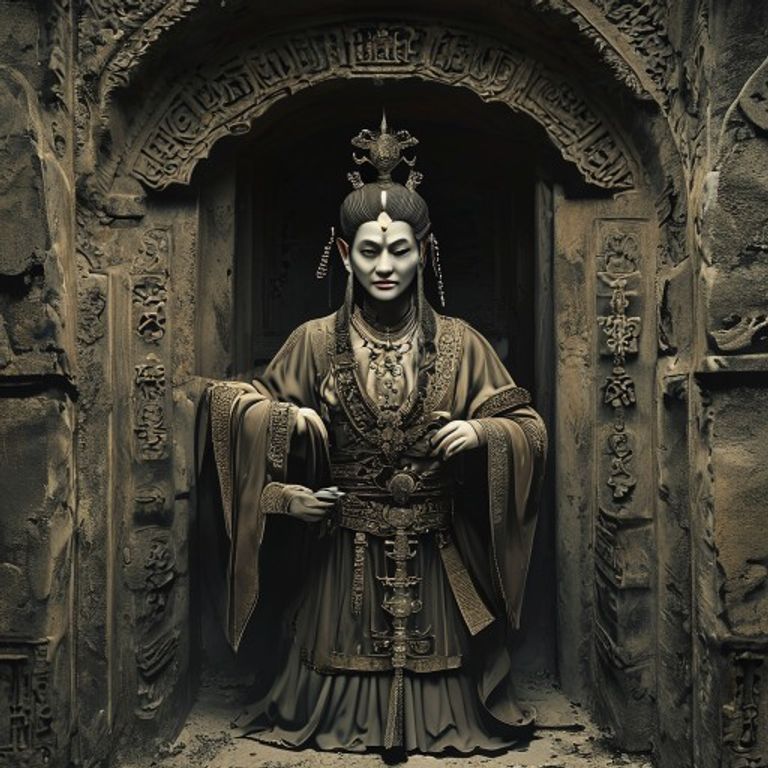
The mausoleum of China's first emperor, surrounded by terracotta soldiers, whose main chambers have never been opened due to fears regarding booby traps and mercury.
⚠️ Research prepared with the aid of Deep Research is subject to referential ambiguity.
🖥️ Clean HTML code using a proprietary tool.
👥 Research by Guilherme Felipe, Curation by Sílvio Lôbo
The Mystery of Qin Shi Huang's Tomb: The Sleeping Emperor and His Unviolated Secrets
More than two millennia ago, one of the most powerful men China has ever known, Qin Shi Huang, the first emperor of the Qin dynasty, ended his earthly life. However, his death did not mark the end of his presence; on the contrary, it inaugurated one of the greatest historical and archaeological mysteries of all time: that of his monumental tomb, which remains an impenetrable enigma to this day.
1. The Context and the Incident: Where, When, and How the Mystery Began
The mystery does not lie in a specific event of disappearance or crime, but rather in the very existence and content of the imperial tomb. Located in Xi'an, Shaanxi province, China, the tomb of Qin Shi Huang is an underground complex of epic proportions. Its construction, begun during the emperor's lifetime around 246 BC, involved the labor of hundreds of thousands of artisans and workers. The goal was clear: to replicate the universe for the emperor in the afterlife.
The "incident" that gives rise to the mystery is, in fact, the impenetrability of the main tomb. Despite its incidental discovery in 1974, when local farmers stumbled upon the Terracotta Army, the central burial chamber, where the emperor is believed to rest with his treasures, remains closed. The reluctance of Chinese authorities to open the tomb, citing concerns about artifact preservation and safety, has fueled global fascination and speculation.
2. Timeline of Events
- c. 246 BC: Construction of Qin Shi Huang's tomb begins.
- 210 BC: Death of Qin Shi Huang. It is believed his body was taken to the tomb.
- Subsequent Centuries: Historical accounts, such as those by the historian Sima Qian (c. 145 – c. 86 BC), describe the grandeur of the tomb and its contents, including the famous text about "rivers of mercury" and weapons that fired automatic arrows.
- 1974: Accidental discovery of the Terracotta Army by farmers near Xi'an, drawing worldwide attention to the funerary complex.
- Subsequent Decades: Extensive archaeological excavations and research reveal the vast complex, but the central chamber remains intact.
- Present: The main tomb remains closed, fueling mystery and speculation.
3. The Main Theories
The theories about what lies in Qin Shi Huang's burial chamber range from the factual to the fantastic, reflecting the magnitude of the enigma.
3.1. Scientific and Archaeological Theories (Based on Evidence and Reports)
- Content Described by Sima Qian: The most well-founded theory is that the tomb contains what was reported by Sima Qian. This would include a replica of the cosmos on the ceiling, rivers of mercury (indicating a water circulation system and, possibly, a preservation method), and a vast collection of precious artifacts, treasures, and even a model of the imperial palace. The presence of mercury has been corroborated by high mercury concentration readings in the area's soil, which indicate its possible use as a sealing system and even as a contaminant to discourage intruders.
- Impenetrable Preservation: One theory suggests that the chamber is protected by sophisticated mechanisms, described in ancient texts, such as booby traps and defense devices, making any attempt at invasion extremely dangerous. The advanced engineering for the time would be the main obstacle.
- Innovative Preservation Materials: The use of mercury and other substances, possibly unknown to modern science, may have been employed to preserve the emperor's body and the objects inside, making deterioration less of a problem than one would expect for such an ancient tomb.
3.2. Alternative, Conspiracy, or Paranormal Theories (Speculative)
- The Emperor Still "Lives": A more fanciful speculation suggests that Qin Shi Huang did not truly die, but used unknown methods to enter a state of suspended animation or even immortality, and that the tomb is his sanctuary of rest, possibly with mechanisms to maintain him. This theory is devoid of any scientific evidence but is fueled by the fascination with legends of immortality in ancient China.
- Extraterrestrial Technology: In more extreme lines of conspiracy theories, it is suggested that the complexity and scale of the tomb, as well as the technologies mentioned in ancient texts, could indicate influences or assistance from advanced civilizations, possibly extraterrestrial. This hypothesis lacks any empirical basis.
- The Blind Spot of History: A more sober, yet still speculative perspective is that the tomb may contain crucial information about the Qin period that modern archaeology does not yet fully understand, radically altering our view of Chinese history and even human development.
4. Controversies and Blind Spots
The biggest blind spot of the Mystery of Qin Shi Huang's Tomb is, without a doubt, the lack of direct access to the main burial chamber. The controversies revolve around the reasons for this inaccessibility and the implications of keeping one of the world's greatest historical treasures locked away.
- Preservation vs. Knowledge Concerns: The main justification for keeping the tomb closed is the need to preserve the artifacts and the emperor's body itself from deterioration caused by exposure to air, light, and temperature changes. However, critics argue that the development of excavation and conservation technologies should allow for safe exploration, and that the knowledge lost due to the lack of access is incalculable.
- The "Threat" of Mercury: Reports of high mercury concentrations in the area suggest that the tomb itself may be a toxic and dangerous environment, a natural and artificial barrier to intruders. Safe navigation and conservation in such an environment would be monumental challenges.
- The Ethics of Discovery: There is an ethical debate about the right to disturb the final rest of such an important historical figure and about the ownership of the knowledge that may be revealed.
- Restricted Official Reports: Although there are extensive archaeological reports on the complex, specific details about the central chamber and plans for its eventual opening remain largely inaccessible to the public and the international scientific community.
5. Curiosities and Legacy
The Mystery of Qin Shi Huang's Tomb has transcended the boundaries of archaeology to become a global cultural icon, inspiring countless works of fiction, documentaries, and speculation. Its legacy is intrinsically linked to the Terracotta Army, which, in itself, is already one of the most important archaeological discoveries of the 20th century.
- The Terracotta Army: The fortuitous discovery of thousands of terracotta warriors, horses, and chariots, each with unique facial features, demonstrated the scale and sophistication of the labor and art of the Qin dynasty.
- Cultural Impact: The mystery of the central tomb fuels the popular imagination, representing the last bastion of secrets of an emperor who unified China and established the foundations for its future greatness.
- Current Status: The main tomb of Qin Shi Huang remains closed and unexplored. Chinese authorities have stated that its opening will only occur when conservation technology is advanced enough to ensure the preservation of all artifacts. Until then, the emperor and his secrets continue to sleep in their underground fortress, a silent testament to a past that waits patiently to be revealed, or that perhaps should remain an enigma forever.





