



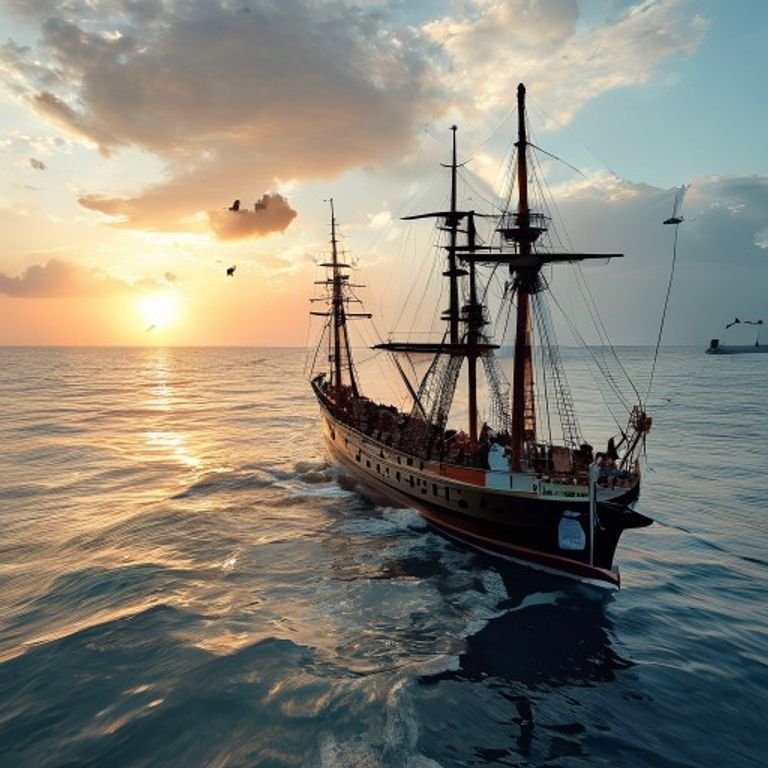
A sailing ship that was found drifting off the coast of Chile in 1913, twenty-three years after it had been declared lost, with the skeletons of the crew still at their duty stations.
⚠️ Research conducted with the aid of Deep Research is subject to referential ambiguity.
🖥️ Clean HTML code using a proprietary tool.
👥 Research by Guilherme Felipe, Curation by Sílvio Lôbo
The Silent Enigma of the Marlborough Ship: An Investigation in Murky Waters
The sea holds ancient secrets, and few are as stubborn and enigmatic as the disappearance of the ship Marlborough. Far from being just another maritime tragedy, this case has become a beacon of mystery, casting shadows over official investigations and fueling a range of theories from the scientific to the supernatural. As an investigative journalist, diving into the depths of this enigma means confronting the fragility of certainty and the persistence of the inexplicable.
1. The Context and the Incident: The Silenced Cry in the Atlantic
The British cargo ship Marlborough, operated by the Union Steam Ship Company of New Zealand, was a robust vessel built to cross oceans with its goods. Its final voyage, however, would take it into the unknown vastness of the South Atlantic. The starting point was the city of Liverpool, England, on February 14, 1911, bound for Wellington, New Zealand. The planned route included passages through the Atlantic and Indian Oceans, rounding Africa.
The mystery began to form when the Marlborough failed to arrive at its first port of call in Port Said, Egypt. Days turned into weeks, and the ship's silence became deafening. No communication, no distress signal, no sign of life. The vessel, with its 133 crew members on board, simply evaporated, leaving behind only a trail of uncertainty and anguish.
2. Timeline of Events: The Unraveled Tapestry of Time
Reconstructing the events surrounding the disappearance of the Marlborough is an exercise in patience and detail, where every date and every clue becomes crucial.
- February 14, 1911: The ship Marlborough departs from Liverpool, England, with its crew and cargo.
- March 1911: The ship does not appear in Port Said, Egypt, the first planned port of call. Concern begins to grow.
- April - May 1911: The official search is initiated. Warships and merchant vessels are sent to patrol expected routes and possible diversion areas.
- June 1911: Searches are intensified, but no trace of the Marlborough is found. The hope of finding survivors begins to diminish drastically.
- July 1911: The ship Marlborough is officially declared lost. The families of the crew are notified, and the case becomes a symbol of unexplained tragedy.
- Subsequent Years: Sporadic reports of sightings of wreckage or floating objects in the South Atlantic emerge, but without conclusive confirmation.
3. The Main Theories: Deciphering the Abyss Enigma
Over more than a century, the disappearance of the Marlborough has been the subject of intense speculation. The theories vary in complexity and plausibility, but all attempt to fill the void left by the absence of concrete facts.
3.1. Scientific and Police Hypotheses (the most likely):
- Extreme Weather Conditions: A sudden and violent storm, possibly a tropical cyclone or an unusual rogue wave, could have capsized or sunk the ship quickly, without time to issue a distress signal. The South Atlantic, especially at certain times of the year, can present treacherous maritime conditions.
- Navigation Accident: A collision with another ship in low visibility conditions, or a navigation miscalculation that led the ship into dangerous waters (such as hidden reefs or areas with strong currents), are possibilities. The era in which the ship disappeared lacked modern navigation and communication systems.
- Catastrophic Structural or Mechanical Failure: A serious and unexpected problem in the ship's structure or its machinery could have led to a rapid sinking. The cargo on board, if poorly distributed or unstable, could also have contributed to the loss of control.
- Piracy or Unexpected Attack: Although less likely in the context of 1911, the possibility of a pirate attack, especially on less patrolled routes, cannot be entirely ruled out. The lack of communication could indicate a sudden and total attack.
3.2. Alternative and Paranormal Theories (speculation):
- Disappearance in a Bermuda Triangle: Some theories, although more linked to folklore and fiction, attempt to associate the case with areas of mysterious disappearances, such as the Bermuda Triangle, despite the Marlborough having disappeared far from that region geographically. This theory reflects more of a fascination with mysteries than a factual analysis.
- Encounter with Anomalous Marine Phenomena: Rumors about giant sea creatures or natural phenomena not yet understood that could have swallowed the ship are recurring in maritime mystery narratives.
- Government or Military Conspiracy Theory: The idea that the ship was intentionally sunk for unknown political or military reasons, with the purpose of covering something up, is a common strand in conspiracy theories. However, there is a lack of evidence to support such a claim.
4. Controversies and Blind Spots: The Shadows in Official Investigations
The official investigation, conducted at the time, was limited by the resources and technologies available. However, even within that context, some points raise questions:
- Lack of Concrete Traces: The almost total absence of wreckage, lifeboats, or any other sign of the Marlborough is one of the biggest blind spots. Sunken ships, even at high speed, usually leave some trail.
- Conflicting or Scarce Testimonies: The nature of the disappearance, with no survivors to report what happened, makes it impossible to obtain direct testimony. Information is based on expected routes and reports from other vessels that did not sight the ship.
- Disinformation or Lack of Communication: It is possible that crucial information, such as sightings of storms or other ships in nearby areas, was not shared or received effectively. Maritime communication at the time was rudimentary.
- Insufficient Declassified Files: Despite some documents related to searches having been declassified over the years, there are no bombshell revelations that shed definitive light on the fate of the Marlborough.
5. Curiosities and Legacy: The Enigma that Sails in the Imagination
The case of the Marlborough Ship transcended time and became an icon in the pantheon of great maritime mysteries. Its legacy lies in its ability to evoke the fragility of human life in the face of the vastness and power of the ocean.
- Cultural Impact: The mystery of the Marlborough has inspired books, documentaries, and articles, fueling the popular imagination about the dangers and secrets of the sea.
- Current Status: The case remains officially unsolved. There are no records that investigations have been reopened with significant new evidence. The Marlborough remains in silence in the depths, a floating epitaph for the mysteries that the sea still guards.
- The Incessant Search: Even without an official resolution, the case of the Marlborough continues to attract the interest of researchers, historians, and mystery enthusiasts, who tirelessly search for clues that might, one day, unravel the fate of this ghost ship.
The story of the Marlborough Ship is a poignant reminder that, even in our era of advanced technology, the ocean maintains the power to confront us with the unknown, turning vessels into legends and crew members into silent echoes in the ocean currents.





