



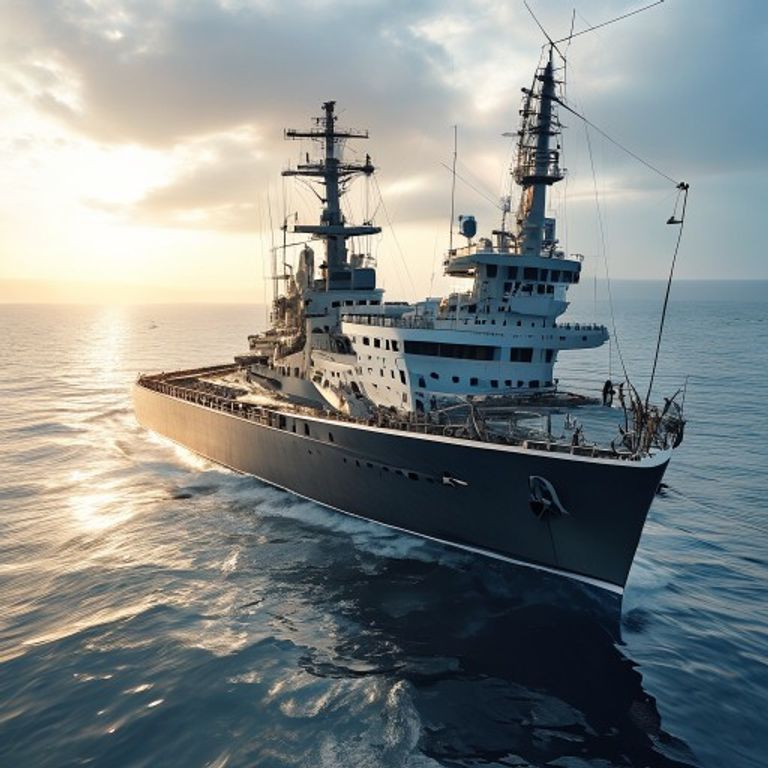
A massive United States Navy supply ship with over three hundred people on board disappeared without a single piece of wreckage or distress signal in 1918, becoming the largest non-combat loss of life in the institution's history.
⚠️ Research prepared with the aid of Deep Research is subject to referential ambiguity.
🖥️ Clean HTML code using a proprietary tool.
👥 Research by Guilherme Felipe, Curation by Sílvio Lôbo
The Ghost at Sea: The Enduring Enigma of the USS Cyclops
There are mysteries that time refuses to solve, enigmas that float in the mists of the past, challenging logic and fueling the imagination. Among them, few capture attention with the same somber intensity as the disappearance of the USS Cyclops, a United States Navy ship that, in 1918, evaporated without a trace, taking with it 306 souls and a trail of unanswered questions.
This is not a simple shipwreck account. The case of the Cyclops transcends common maritime tragedy, diving into the murky waters of speculation, conspiracy theory, and the inexplicable. How could a steel giant, over 150 meters long, simply vanish on a relatively well-known route during World War I? The answer, or the lack thereof, continues to haunt Navy archives and the minds of those who dare to investigate the abyss.
The Context and the Incident: A Farewell Without Return
The USS Cyclops (AC-4) was a collier (coal supply ship), part of a class of vessels designed to support the logistical demands of the American fleet. Launched in 1910, the ship was robust and relatively new when its final and fatal voyage began. The historical context is crucial: the world was immersed in World War I, and the North Atlantic was a vital, yet dangerous, artery for the Allied war effort. The Cyclops was in service to the Navy, transporting a massive cargo of manganese ore from Barbados, in the West Indies, to the east coast of the United States.
On March 3, 1918, the USS Cyclops departed from Barbados. On board were 306 men, including its commander, Captain George W. Worley, and the son of President Woodrow Wilson, Charles S. Wilson, who was traveling as a passenger. The planned route was through the Bermuda Triangle, an area that, at the time, had not yet acquired the sinister aura that would envelop it in the following decades. The ship was scheduled to make a stop in São Tomé (present-day São Vicente, Cape Verde) to refuel, but it never arrived. The last communication received was a telegram on March 3, 1918, indicating the ship was underway. From then on, silence.
Timeline of Events: The Shadow that Swallowed the Giant
Reconstructing the final days of the USS Cyclops is an exercise in piecing together a puzzle with most of the pieces missing. What we know is fragmented, based on navigation logs and scattered communications:
- January 1918: The USS Cyclops arrives in Barbados with a load of coal for the naval fleet.
- February 1918: The ship is loaded with 7,700 tons of manganese ore. The additional weight and the nature of the cargo would be crucial factors in many theories.
- March 3, 1918: The USS Cyclops departs from Barbados. This is the last time the ship is sighted or has any recorded communication.
- Date unspecified: The ship was scheduled to stop in São Tomé (Cape Verde) for refueling. Its absence there was the first alarm signal.
- March 1918: The ship is declared missing when it fails to arrive at its final destination, the United States coast.
- Following years: Several searches are conducted, but no trace of the USS Cyclops or its crew is found. The Navy initiates formal investigations.
The Main Theories: Unraveling the Abyss of Hypotheses
The absence of concrete wreckage opened a range of speculations, varying from the scientific to the supernatural. We will analyze the most prominent ones:
Scientific and Logical Theories (Provable or Plausible)
- Extreme Weather Conditions: The most direct hypothesis is that the Cyclops encountered a sudden and violent storm. The Atlantic, especially in March, can be the stage for severe storms. The lack of communication could be attributed to the rapid destruction of the ship or the inability to send a signal amidst the chaos. However, the Cyclops was considered a robust ship, and the total absence of wreckage is a weak point of this theory.
- Overloading and Cargo Instability: The cargo of 7,700 tons of manganese ore was heavy and potentially unstable. Manganese ore is denser than water. If the cargo shifted (which is common in cargo ships), it could have made the ship dangerously unstable, leading to capsizing and rapid sinking. Subsequent reports of accidents involving cargo ships carrying manganese ore corroborate this concern.
- Structural Problems or Mechanical Failure: Although the ship was relatively new, catastrophic mechanical failures or structural problems cannot be ruled out. A compromised hull, an internal explosion (though there is no evidence of explosive cargo), or a failure in the propulsion system in open sea could have led to the sinking.
- Submarine Attack (German U-Boat): In 1918, submarine warfare was a real threat. It is possible that the Cyclops was torpedoed by a German submarine. However, if that were the case, one would expect to find some kind of wreckage, a trace of the torpedo, or even a German war communiqué confirming the attack. None of these elements emerged.
Alternative and Conspiracy Theories (Speculative)
- The Bermuda Triangle: The area through which the Cyclops was sailing would become famous as the Bermuda Triangle, a region where countless ships and planes allegedly disappeared under mysterious circumstances. Explanations for this phenomenon range from magnetic anomalies and unknown atmospheric phenomena to extraterrestrial intervention. However, scientifically, the high incidence of disappearances in the area can be explained by the high volume of naval traffic and the presence of strong ocean currents and frequent storms. For the Cyclops, this theory lacks concrete proof, being more of a later attribution than a cause contemporary to the disappearance.
- Sabotage or Cover-up: A line of thought suggests that the ship was deliberately sunk for unknown reasons, perhaps linked to its cargo or secret information it was carrying. A cover-up by the Navy would be to avoid panic or protect sensitive information. There is, however, no documentary evidence to support this hypothesis.
- Paranormal or Extraterrestrial Theories: Although less likely in the field of serious journalistic investigation, one cannot ignore the existence of theories involving paranormal phenomena or alien abductions. These hypotheses lack any empirical basis and are purely speculative.
Controversies and Blind Spots: What Did the Navy Not Tell?
The official investigation into the disappearance of the USS Cyclops, led by the United States Navy, was marked by several controversies and gaps that fuel the mystery:
- Expert Reports and Ignored Testimonies: Over the years, reports have emerged that certain testimonies from sailors on other ships that sailed the same route had sighted the Cyclops in precarious conditions or near dangerous locations. However, the Navy claims that all searches were exhaustive and that no evidence was found. Some speculate that crucial information from other captains, who might have seen something unusual, was disregarded or underestimated.
- The Disappearance of Evidence: As in many long-standing cases, there is a feeling that crucial information may have been lost over time, whether through neglect or, in more conspiratorial theories, through intentional disposal. The absence of detailed records regarding the exact conditions of the manganese ore cargo and any mechanical problems prior to boarding is a significant blind spot.
- The Connection to Other Disappearances: The disappearance of the USS Cyclops was not an isolated incident. The USS Proteus and the USS Nereus, ships of the same class and with similar missions, also disappeared under mysterious circumstances in 1941 and 1942, respectively. This coincidence, although separated by decades, intensifies the debate about design flaws or inherent dangers in this class of ships. The Navy, however, has always treated these cases as separate incidents, not establishing an official causal link.
- The Lack of Human Remains: The complete absence of bodies or wreckage is perhaps the most disturbing aspect. A 150-meter-long ship, with 306 people on board, simply evaporating in open waters, without leaving a single piece of wreckage or body, defies physics and human experience in maritime disasters.
Curiosities and Legacy: The Shadow that Persists
The USS Cyclops transcended its military role to become an icon of maritime mystery. Its legacy is a testament to our fascination with the unknown and human vulnerability in the face of the forces of nature and the enigmas of the ocean.
- The "Ghost Ship": The ship is frequently referred to as a "ghost ship," evoking images of vessels that sail without a crew or that disappear without explanation.
- Influence on Popular Culture: The case inspired books, documentaries, and countless discussions in forums about unsolved mysteries. It became an archetype of an inexplicable disappearance in open sea.
- Current Status: The case of the USS Cyclops remains officially classified as a mystery. Although new underwater search technologies could theoretically offer new hope of finding some trace, the United States Navy has not formally reopened the investigation. Information about the case remains, for the most part, in declassified archives and in the memories of those who dedicate themselves to unraveling its secrets.
- A Silent Memorial: At Arlington National Cemetery, a memorial in honor of the 306 men lost on the USS Cyclops perpetuates the memory of the crew, a tangible reminder of the lives that were swallowed by the abyss, leaving behind one of the greatest maritime enigmas in history.
As long as the waves continue to kiss the shores of Barbados and the vastness of the Atlantic stretches endlessly, the question will persist: Where did the USS Cyclops go? The answer, perhaps, lies somewhere in the unexplored depths, guarded by the secrets of the ocean, a ghost at sea that refuses to be found.





