



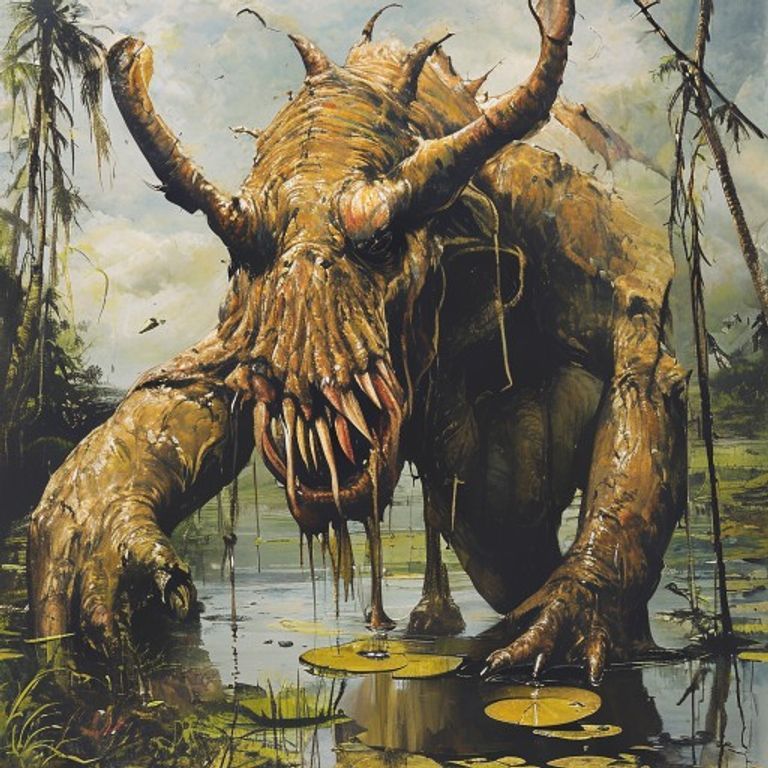
Reports of a bipedal, hairy creature said to inhabit the Louisiana swamps since the sixties, with evidence of footprints that fuel the local legend.
⚠️ Research conducted with the aid of Deep Research is subject to referential ambiguity.
🖥️ Clean HTML code using a proprietary tool.
👥 Research by Guilherme Felipe, Curation by Sílvio Lôbo
The Persistent Mystery: The Honey Island Swamp Monster Case
Amidst the dark and misty swamps of Louisiana, an enigma has lingered for decades, fueling the popular imagination and defying logic. The case of the Honey Island Swamp Monster is not just a regional legend; it is an intricate puzzle of sightings, conflicting testimonies, and investigations with gaps—a testament to how the unknown can persist, even in the face of an incessant search for the truth.
1. The Context and the Incident: The Birth of the Legend
The setting for the emergence of this mystery is the vast and intricate Honey Island swamp system, located in the southeastern part of Louisiana, near the Mississippi border. An area of wild and unforgiving beauty, with dense vegetation, murky waters, and rich biodiversity, which in itself evokes an aura of mystery.
The incident that triggered the monster's fame occurred in July 1963. Initial reports described an attack on a group of young people. The story, disseminated rapidly by local and later national press, spoke of a bipedal, hairy, and foul-smelling creature that had allegedly chased and attacked the individuals.
2. Timeline of Events
Reconstructing the timeline of crucial events is fundamental to unraveling the case:
- July 1963: The first sightings and the alleged attack on the youths in the swamp. The press begins covering the story, dubbing the creature the "Honey Island Swamp Monster."
- 1963-1970s: Various reports of sightings and strange footprints in the area spread. The legend gains strength and attracts the attention of amateur cryptozoologists and the curious.
- 1971: Sheriff Harrison M. "Hamp" Lee, of St. Tammany Parish, begins an official investigation, drawn by growing public pressure and persistent reports. Police reports and forensic examinations are conducted, including the analysis of footprints.
- 1970s-Present: Despite official investigations and the absence of conclusive evidence, the legend of the Honey Island Swamp Monster persists, fueled by new sporadic sightings and popular culture.
3. The Main Theories
Over the years, several theories have emerged to explain the existence and sightings of the monster. Each with its own logic, but all with their respective challenges in terms of proof:
3.1. Scientific and Police Hypotheses
- Unknown Animal: The most "earthly" theory suggests that the sightings could be of a known animal, but rarely seen or misinterpreted. Primates such as chimpanzees or gorillas, although not native to the region, could have escaped from somewhere and adapted to the environment. However, the size and characteristics described hardly fit known primates.
- Malformed or Atypical Black Bear: Black bears are common in Louisiana. An unusually sized bear, with a more upright posture due to running or frustration, or even a sick animal, could be mistaken. The dense fur and potential agitation could mask its true form.
- Hoax or Fraud: The possibility that the sightings were created by individuals with fraudulent intentions, whether to gain attention, play pranks, or cover up other activities, cannot be ruled out. The sensationalist nature of the story may have encouraged invention.
- Collective Psychosis or Hysteria: The rapid spread of stories and fear may have led to a phenomenon of suggestion, where people began to "see" what they expected to see, or to interpret normal events in an anomalous way.
3.2. Alternative, Conspiracy, or Paranormal Theories
- Unknown Cryptid (Sasquatch/Bigfoot): This is the most popular theory among cryptozoology enthusiasts. It suggests the existence of an unknown hominid, similar to the "Sasquatch" or "Bigfoot" of other regions, inhabiting the remote swamps. The physical description (bipedal, hairy, strong) and the strong odor fit some reports of similar cryptids. The difficulty lies in the lack of irrefutable physical evidence, such as fossils or DNA samples.
- Alien or Otherworldly Creature: A more paranormal strand suggests that the monster could be an entity of extraterrestrial origin, a biological creature adapted to the swampy environment, or even an interdimensional being. This theory lacks any scientific basis and relies solely on speculation and belief.
- Government or Military Conspiracy: In conspiracy theory lines, some suggest that the government or military could be aware of the creature, or even responsible for its presence, perhaps as part of secret experiments or to keep the area isolated. This theory is fueled by the lack of definitive answers from the authorities.
4. Controversies and Blind Spots
The Honey Island Swamp Monster case is full of blind spots and controversies that hinder a definitive resolution:
- Insufficient Physical Evidence: The main difficulty in proving the monster's existence is the scarcity of irrefutable physical evidence. Reports of footprints, although some forensic examinations were carried out by Sheriff Lee, were often described as "difficult to identify" or "possibly from a bear," but never conclusively. The lack of hair, feces, or any confirming genetic material is a significant obstacle.
- Conflicting Testimonies: Over the years, reports of sightings have shown significant variations in terms of the creature's size, color, and behavior, generating confusion and questions about the veracity of the testimonies.
- Limited Official Investigations: Although Sheriff Lee conducted an initial investigation, subsequent research by official authorities was sporadic and with limited resources. The lack of a continuous effort and public pressure as the main driver of the investigations limited their scope and depth.
- The Nature of the Location: The swampy environment is extremely challenging for any type of investigation. The difficulty of movement, the presence of other wild animals, and the rapid decomposition of organic matter may have led to the loss or destruction of possible evidence.
- The "Secret" of the Swamps: The vastness and isolation of Honey Island Swamp have always allowed mysteries to flourish. What may have happened in the swamp may have been deliberately obscured or simply never discovered due to the lack of access and surveillance.
5. Curiosities and Legacy
The Honey Island Swamp Monster has transcended the status of a simple local legend to become an icon of cryptozoology and American folklore.
- Cultural Impact: The case has inspired books, documentaries, articles, and discussions on online forums, attracting the attention of paranormal enthusiasts, legend hunters, and the curious from all over the world. The image of the hairy and scary monster has consolidated itself in popular culture.
- The Skeptical Gaze and Fascination: While the scientific community maintains a healthy skepticism, given the lack of concrete proof, human fascination with the unknown and the mysteries that nature still holds continues to fuel interest in the case.
- Current Status: The Honey Island Swamp Monster case remains officially unsolved. There are no recent reports of the reopening of formal investigations by the authorities. However, the legend lives on, fueled by sporadic sightings that continue to be reported in the region, keeping the swamp as a stage for the inexplicable.
The Honey Island Swamp Monster is, ultimately, a reminder that even in an increasingly explored and explained world, the dark and wild corners of the Earth can still harbor secrets that defy our understanding, leaving a trail of mystery and fascination.





