



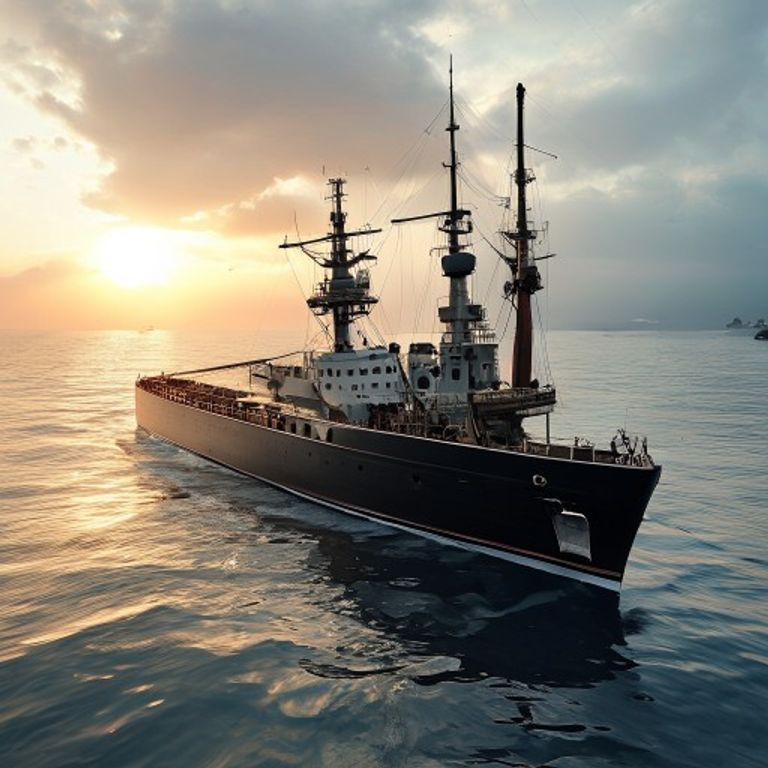
An ocean liner that disappeared off the coast of South Africa in 1909 with two hundred and eleven people on board, leaving behind no wreckage, lifeboats, or any clue to its final destination.
⚠️ Research prepared with the aid of Deep Research is subject to referential ambiguity.
🖥️ Clean HTML code using a proprietary tool.
👥 Research by Guilherme Felipe, Curation by Sílvio Lôbo
The Ghost Ship of the Indian Ocean: The Immortal Enigma of the SS Waratah
In the vast and unforgiving theater of the Indian Ocean, a robust and promising passenger ship vanished without a trace. The SS Waratah, a name that echoes through the decades with the force of a silenced scream, has become one of the most enduring and disturbing maritime mysteries of the 20th century. Its absence was not a mere accident, but a terrifying lapse in reality, swallowing 211 souls on its final and fateful cruise. This investigative article delves into the depths of a case that defies rational explanation and has fueled the imagination for over a century.
1. The Context and the Incident: Where, When, and How the Mystery Began
The SS Waratah was a passenger and cargo steamship, built in 1908 for the Shire Line, a British shipping company. Designed for routes between the United Kingdom and Australia, the ship was considered an example of modern engineering and comfort for its time. At 127 meters long and with a gross tonnage of 4,494, it was equipped with triple-expansion engines that allowed it to reach a respectable speed.
The ship completed its maiden voyages without incident. However, tragedy unfolded on its third voyage. After leaving Sydney, Australia, on July 10, 1909, the Waratah headed for Cape Town, South Africa. It carried a diverse cargo, including wool, tin, gold ore, and equipment. On board, in addition to the crew of 113, there were 98 passengers, among them Henrietta L. L. Van Nymegen, a 29-year-old woman on her way to join her husband in South Africa.
The last known visual contact with the Waratah occurred on July 12, 1909. The Dutch cargo ship Geleen spotted the Waratah sailing about 200 nautical miles south of Port Elizabeth. The sailors of the Geleen reported that the Waratah appeared to be in good order, but that thick smoke seemed to be emanating from its funnels, which, at the time, was considered a minor detail.
After this sighting, the SS Waratah simply disappeared. Not a single distress signal, piece of wreckage, or body was ever found. The ocean, relentless and mysterious, had swallowed an entire ship.
2. Timeline of Events
- 1908: Construction of the SS Waratah in Glasgow, Scotland.
- 1909 (early): Start of the SS Waratah's voyages.
- July 10, 1909: The SS Waratah departs from Sydney, Australia, on its third voyage, with 98 passengers and 113 crew members on board.
- July 12, 1909: The Dutch ship Geleen spots the SS Waratah about 200 nautical miles south of Port Elizabeth, South Africa. This is the last confirmed sighting.
- July 1909 (after the 12th): The SS Waratah does not arrive at its scheduled destination, Cape Town.
- August 1909: Official start of the search for the missing ship.
- Subsequent decades: Multiple expeditions and investigations fail to locate the SS Waratah or any traces.
3. The Main Theories: A Range of Possibilities
The absence of any concrete evidence regarding the fate of the Waratah has given rise to a kaleidoscope of theories, ranging from the pragmatic to the downright fantastic.
3.1. Scientific and Official Theories (The Most Likely)
- Shipwreck due to extreme weather conditions: This is the hypothesis most accepted by official investigations. The region where the Waratah disappeared is known for its sudden and violent storms, especially in the austral winter. A rogue wave or an unexpected cyclone could have caused the ship to become overloaded, capsize, and subsequently sink. The nature of the Waratah's hull, while modern, could have been vulnerable to certain conditions.
- Structural instability/Internal disaster: Reports that the Waratah could roll excessively in rough seas raise the possibility of an inherent stability problem in the design. A catastrophic structural failure, perhaps a malfunction in the rudder or engines, or a major fire, could have incapacitated the ship, leading to a rapid sinking.
- Collision with an unidentified object: Although less likely without any wreckage, the possibility of a collision with a large iceberg (though uncommon in the region at that time), an unknown vessel, or a submerged object cannot be entirely ruled out.
3.2. Alternative and Conspiracy Theories
- Sabotage/Act of War: In a pre-World War I period, the idea of sabotage or an attack by a rival nation could be considered. However, there is no evidence to support this theory. The ship was not of particular strategic interest, and a secret act of war without a claim or traces is highly unlikely.
- Modern Piracy: Although large-scale piracy had decreased significantly by the early 20th century, isolated acts could still occur. However, capturing and making a passenger ship of that size disappear without a trace is a colossal and high-risk feat, with no subsequent indication of diversion or sale.
3.3. Paranormal and Science Fiction Theories
- Disappearance into a Parallel Dimension/Wormhole: This theory, popular in circles of unexplained mysteries, suggests that the Waratah may have been swallowed by an unknown natural phenomenon or even a temporal or spatial anomaly. The total absence of wreckage fuels this speculative idea.
- Unusual Maritime Phenomena: From "milky seas" (mare obscura) to gravitational or electromagnetic phenomena not yet understood, the vastness and mysterious nature of the ocean leave room for speculation about unknown natural forces.
- The Ghost Ship: One of the most persistent legends is that the Waratah became a "ghost ship," condemned to wander the oceans eternally. Rumors of sightings of the ship after its disappearance, although without official confirmation, fuel this dark narrative.
4. Controversies and Blind Spots
The official investigation into the disappearance of the Waratah was widely criticized for its superficiality and the lack of resources allocated.
- Insufficient Searches: The initial searches were considered inadequate and delayed, limited mainly to the expected navigation area. The vast Indian Ocean did not offer an easy target.
- Lack of Detailed Information: Nautical communication at the time was rudimentary. There were no satellite location or real-time tracking systems, making triangulation and the search for a missing ship extremely difficult.
- Vague Final Report: The official investigation report concluded that the ship likely sank due to "uncertain circumstances," a verdict that left more questions than answers and fueled the frustration of the victims' families.
- Conflicting Testimonies (Potential): Although the sighting by the Geleen is a crucial reference point, details about the exact appearance of the Waratah at that moment may have been influenced by distance and visibility conditions. Any inconsistency, however small, could have been an ignored lead.
- Missing Evidence (Speculation): The possibility that some fragment, an emergency radio signal (if the ship had a rudimentary one), or even a body was recovered and "lost" in the annals of naval bureaucracy cannot be completely ruled out in cases of such magnitude and disorientation.
5. Curiosities and Legacy
The case of the SS Waratah has transcended the realm of navigation to become a cultural icon of mystery and unexplained disappearance.
- "The Ghost Ship": The ship earned the nickname "Ghost Ship of the Indian Ocean" and became the subject of countless books, articles, documentaries, and even short stories.
- The Curse of the Waratah: Some popular stories suggest that the ship was cursed, fueling maritime folklore.
- The Account of Henrietta Van Nymegen: The posthumous survival of a diary or letter attributed to Henrietta, which supposedly describes her final moments and growing apprehension, is a recurring narrative, but its authenticity is highly questionable and not proven by official sources.
- Continuous Location Attempts: Over the decades, various private and amateur expeditions have attempted to locate the wreckage of the Waratah, using side-scan sonar and other cutting-edge equipment. None of them have achieved conclusive success.
- Current Status: The case of the SS Waratah remains officially unsolved. Although the initial investigations were concluded, the absence of any definitive outcome means that the mystery of the ship that disappeared with everyone on board continues to haunt the oceans and the human imagination. The hope, however small, of one day finding the remains of the Waratah and unraveling its final secret still motivates explorers and maritime historians.





