



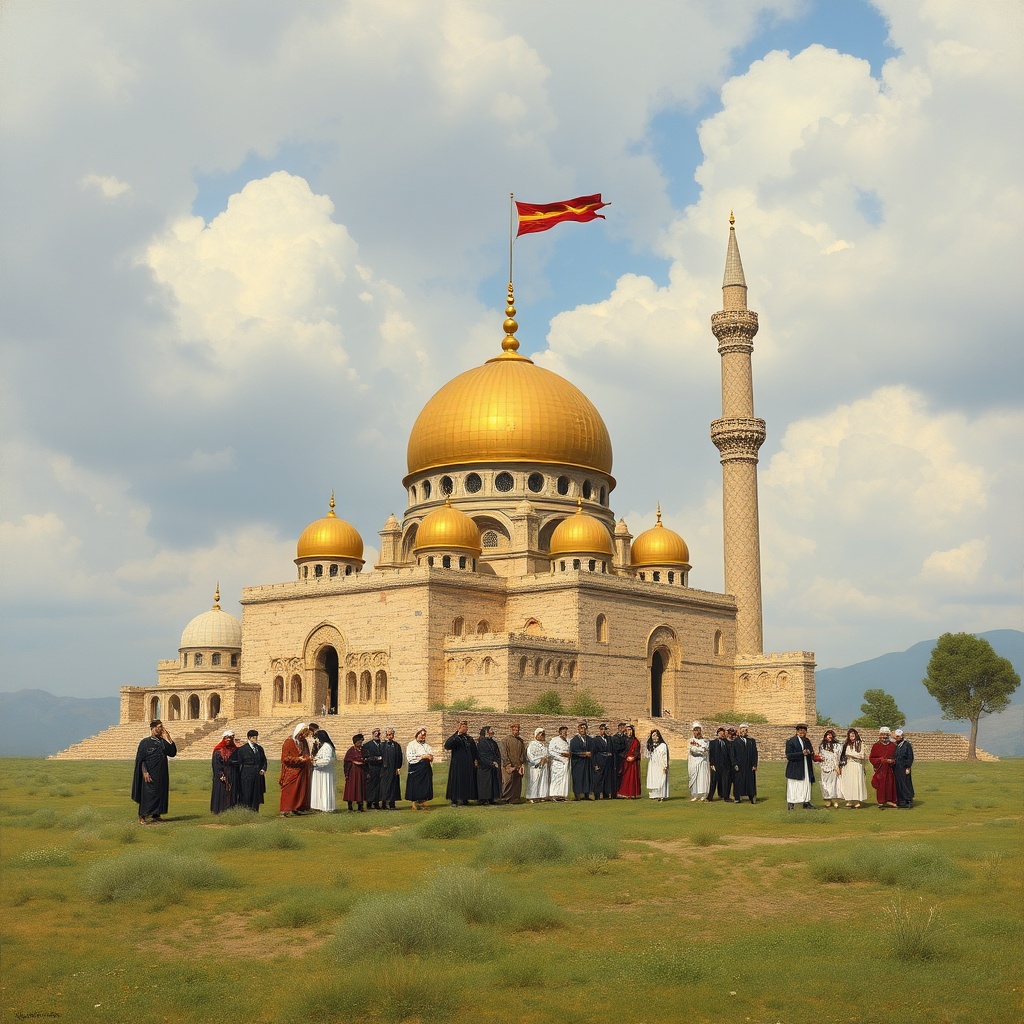
Yazidism is an ancient monotheistic religion with deep roots in Mesopotamia, combining elements from various religious traditions, including Zoroastrianism, Islam, and Christianity. Its followers, the Yazidis, have faced centuries of persecution and marginalization, which has significantly shaped their identity and practices. This article aims to explore the complexity of Yazidism from an academic perspective, addressing its theology, history, social structure, and the contemporary challenges it faces, with special attention to any allegations of destructive practices or abuses, always based on factual and documentary rigor.
Yazidism: A Sociological, Historical, and Theological Analysis
Yazidism, a syncretic faith with ancient origins in the Mesopotamian region, represents a fascinating case study for the social sciences and the history of religions. Its complexity lies in the fusion of elements from diverse traditions, its long history of persecution and marginalization, and its capacity for adaptation and survival in often hostile contexts. This article proposes to dissect Yazidism through academic lenses, seeking to offer an in-depth and impartial understanding of its beliefs, practices, social structure, and contemporary relevance, without neglecting, however, the critical analysis of any controversies or reports of harmful conduct, when these are proven to be factual and documented.
1. Sociological and Theological Definition
Sociologically, Yazidism can be defined as a system of beliefs and practices that, while possessing a strong collective identity and a sense of community belonging among its adherents, has historically been characterized by its esoteric nature and the difficulty of proselytism. The Yazidi community is strictly endogamous, meaning that marriage outside the group is discouraged or prohibited. This social characteristic contributes to the preservation of their traditions but can also lead to isolation and vulnerability to external pressures. The religion is transmitted orally and through specific rituals, with a body of sacred knowledge that is not widely disclosed to non-initiates.
Theologically, Yazidism is a monotheistic system that venerates a single, transcendent God, known as Êzidā (or Xwedê). However, its theology is complex and often misunderstood by external observers. A central figure in Yazidi theology is Melek Taus, the "Peacock Angel." This figure is often misinterpreted as a demon or Satan, a confusion that has historically been the root of much persecution against the Yazidis. It is crucial to understand that, from the Yazidi perspective, Melek Taus is not seen as an evil entity, but rather as a divine being who, in his wisdom, chose not to bow to Adam by God's command, thus demonstrating an act of obedience to his own nature and the divine will, rather than an act of rebellion.
Yazidi beliefs incorporate the belief in angels, the importance of purity, reincarnation (though this is a point of debate and variation within the tradition itself), and reverence for sacred figures such as Sheik Adi ibn Musafir, the religion's principal reformer and saint, who lived in the 12th century and whose teachings are fundamental to modern Yazidism. The religion also emphasizes the importance of balance and harmony in the universe, reflecting a worldview that may have influences from Zoroastrianism.
2. Historical Origin, Founders, and Geographic/Cultural Context
The exact origins of Yazidism are a subject of academic debate. Most scholars agree that the religion emerged in Mesopotamia, possibly in northern Iraq, between the 9th and 12th centuries AD. The most prominent figure associated with the consolidation and reform of Yazidism is Sheik Adi ibn Musafir (c. 1073–1162 AD), a Sufi preacher who settled in the Lalish region of present-day Iraq. It is believed that Sheik Adi synthesized and organized pre-existing elements of local beliefs and religious traditions, infusing them with a more formal structure and a coherent theological body.
The geographic and cultural context in which Yazidism emerged is of paramount importance. Mesopotamia, a melting pot of ancient civilizations and religions, offered fertile ground for the development of new beliefs. Yazidism emerged in a region inhabited by diverse ethnic and religious communities, including Christians, Jews, Muslims, and followers of pagan and Zoroastrian beliefs. This cultural and religious interaction certainly influenced the formation of its doctrines and practices.
Historically, the Yazidis have been a frequently misunderstood and persecuted religious minority. Their distinct faith, especially the veneration of Melek Taus, led to accusations of being "devil worshippers" by some Muslim and Christian communities, which resulted in massacres and genocides over the centuries. The most recent and devastating persecution occurred in 2014, when the terrorist group Islamic State (ISIS) launched a systematic attack against the Yazidis in northern Iraq, perpetrating war crimes, crimes against humanity, and genocide, including mass sexual slavery, murder, and forced displacement.
3. Main Beliefs, Dogmas, Rites, and Practices
Yazidi beliefs are characterized by a strong emphasis on purity and cosmic order. The central pillars of their faith include:
- Monotheism: The belief in a single, creator God.
- Melek Taus: The figure of the "Peacock Angel," a divine being of great importance, seen as an ambassador of God and a symbol of beauty, wisdom, and sovereignty. The misinterpretation of this figure as Satan is a historical source of persecution.
- Sheik Adi ibn Musafir: Revered as the principal saint and reformer of the religion, whose teachings are central to Yazidi practice.
- Purity: A strong sense of ritual and moral purity permeates Yazidi life. Certain colors, such as blue, are considered sacred, and the wearing of trousers is seen as impure by some.
- Reincarnation: Although not universally accepted in all branches of the faith, some Yazidis believe in the transmigration of the soul.
- Cosmology: A worldview that emphasizes duality and balance, with the belief in seven celestial beings, of which Melek Taus is the principal one.
Yazidi rites and practices include:
- Prayer: Yazidis pray three times a day, facing the sun.
- Pilgrimage: The pilgrimage to Lalish, the most important sacred site, is a religious duty and a central point of devotion.
- Festivals: Important celebrations include "Êzîdî Newroz" (Yazidi New Year, celebrated on the Wednesday of the first week of April) and the "Festival of the Night" (Jahda-i-Xwedan), a six-day festival in December.
- Baptism and Circumcision: Initiation rites are important, although not universally mandatory for all members.
- Marriage: Marriage is an important sacrament and is strictly endogamous.
The transmission of religious knowledge is predominantly oral, with a body of sacred hymns and prayers (Kawls) that are taught from generation to generation. Access to deeper knowledge is restricted to the clergy and certain members of the community.
4. Organizational Structure and Leadership Profile
The organizational structure of Yazidism is hierarchical and divided into spiritual and secular castes. The spiritual leadership is composed of:
- Pirs: These are high-ranking clergy responsible for interpreting sacred scriptures and conducting important rituals.
- Faqirs: These are lower-level clergy who assist the Pirs and perform ritual and administrative tasks.
The secular leadership is represented by the Mir (prince), who historically held authority over the Yazidi community, especially regarding civil and social matters. The Mir is considered the temporal leader of the community. The current Mir is Khanem Mir Tahsin Beg, although the succession and authority have been the subject of internal and external debates, especially after the events of 2014.
Community organization is strongly influenced by tribal and family structure, with a strong emphasis on respect for elders and the authority of religious and secular leaders. The Yazidi community is traditionally divided into different spiritual "families" or "lineages," which have their own lines of Pirs.
5. [WARNING/CONTROVERSIES] Factual Analysis of Potential Legal Controversies, Ethical Deviations, or "Destructive Cult" Characteristics
It is fundamental to address this point with extreme rigor and based on factual evidence. Yazidism, as a traditional and established religion, does NOT present characteristics of a "destructive cult" in the sense of coercive social isolation, systematic financial exploitation, mind control, or harm to third parties by its religious structure or central leadership. On the contrary, Yazidism has historically been a religion that is a victim of persecution and genocide, which makes it more vulnerable than a perpetrator of evil acts against society.
The controversies and polemics associated with Yazidism derive almost exclusively from:
- Theological Misunderstandings: The erroneous interpretation of Melek Taus as a demon, perpetuated by external groups, has been the primary cause of persecution and violence against the Yazidis. This is an issue of religious intolerance and misinformation, not of destructive practices inherent to the faith.
- Persecution and Genocide: Yazidism was the target of systematic genocide by the Islamic State (ISIS) in 2014. The crimes committed against the Yazidis include mass murder, sexual slavery of women and girls, kidnapping of children, torture, forced displacement, and the destruction of sacred sites. These reports are widely documented by international organizations such as the UN, Human Rights Watch, and Amnesty International. (See: UN Commission of Inquiry on Syria, "The Siege Within: Life and Death in Raqqa," 2018; Human Rights Watch, "They Tried to Erase Us: The Islamic State's Campaign of Annihilation against the Yazidis," 2017).
- Internal Debates and Contemporary Challenges: Like many religions, Yazidism faces internal challenges, such as the preservation of cultural and religious identity in the face of diaspora and globalization, and debates over the interpretation of certain traditions in a modern world. There has been, for example, a debate over the succession of the Mir leadership after the death of Mir Tahsin Beg, with different factions presenting claims. These are internal issues of governance and tradition, not indicative of a "destructive cult."
It is crucial to distinguish between the Yazidi faith itself and the acts of violence perpetrated against it, or the distorted interpretations that lead to this violence. Yazidism is an ancient religion with rich traditions and a people who have suffered immensely. Any allegation that Yazidism as a whole constitutes a "destructive cult" is unfounded and based on historical misinformation and prejudice.
6. Social, Cultural Impact, and Contemporary Relevance
The social and cultural impact of Yazidism is profound, despite its relatively small population (estimated at about 500,000 to 1.5 million people globally). The Yazidi community possesses a rich cultural heritage, expressed through its music, dance, cuisine, and oral traditions. Their resilience in the face of centuries of persecution is a testament to the strength of their community identity and their faith.
In the contemporary context, Yazidism faces existential challenges. The genocide perpetrated by ISIS in 2014 decimated communities, destroyed infrastructure, and caused deep psychological trauma. The fight for justice and reconstruction is a priority. Many Yazidis live as refugees or internally displaced persons, and the preservation of their culture and religion in a diaspora environment is a significant challenge.
The contemporary relevance of Yazidism lies not only in its history of persecution and its struggle for survival, but also as an example of the religious and cultural diversity of the Middle East. International recognition of the crimes committed against the Yazidis as genocide has been an important step in the search for justice and reparation. The Yazidi community continues to work to preserve its traditions, rebuild its lives, and ensure that its voices are heard on the global stage.
References and Research Sources
- UN Commission of Inquiry on Syria. (2018). *The Siege Within: Life and Death in Raqqa*.
- Human Rights Watch. (2017). *They Tried to Erase Us: The Islamic State's Campaign of Annihilation against the Yazidis*.
- Kreyenbroek, P. G. (1995). *Yezidism: Its Origins, Beliefs and Practices*.
- Maisel, S. (2018). *The Yazidis: A Complete History*.
- Özoğlu, H. (2001). *Minority Rights, National Identities: Kurdish Nationalism and the Turkish State*.
- Al-Jamil, Y. R. (2018). *The Yazidis: The History and Culture of a People*.
- Academic articles available in databases such as JSTOR, Project MUSE, and Google Scholar, with search terms such as "Yazidism," "Yazidi religion," "Melek Taus," "Sheik Adi," "Yazidi persecution," "ISIS Yazidi genocide."
- Reports from human rights organizations such as Amnesty International and Human Rights Watch.
- Documentaries and reports from reliable news sources that have covered the Yazidi genocide and the contemporary situation.





