



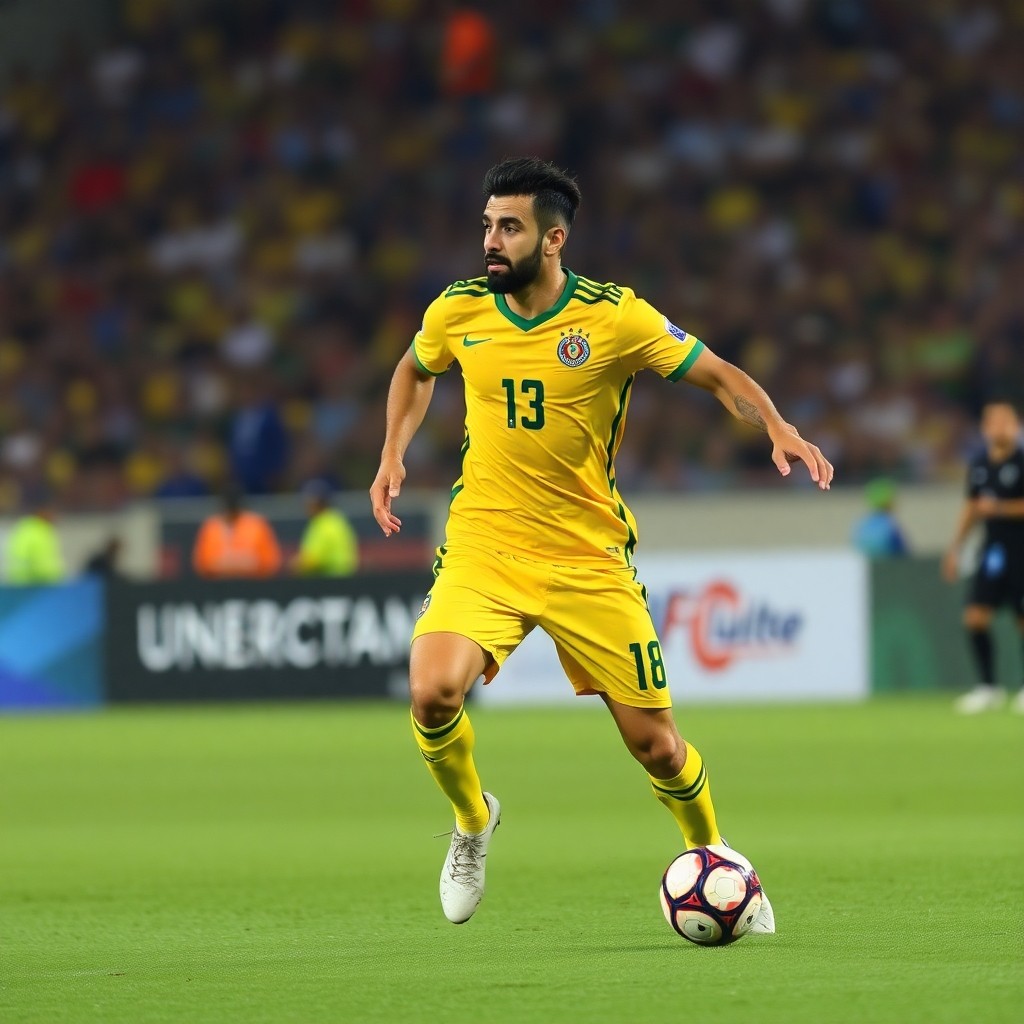
Football, in its purest essence, is often described as a metaphor for life. In Iraq, however, this definition is insufficient. For the nation that inhabits the alluvial plains between the Tigris and Euphrates rivers, football is not a metaphor; it is the very chronicle of its survival, a mirror of its social fractures, and the only common thread capable of stitching together a national identity constantly threatened by wars, foreign occupations, ruthless dictatorships, and sectarian divisions. Known as the "Lions of Mesopotamia," the Iraq national football team carries on its shoulders a geopolitical burden that few teams on the planet can comprehend. Far from being just a sports team, the Iraqi squad functions as a sociological laboratory where Shias, Sunnis, Kurds, and Assyrian Christians shed their historical rivalries to partake in the same secular liturgy. From the institutionalized terror under Saddam Hussein's regime to the mystical epic of the 2007 Asian Cup title, and through decades of forced exile from their home pitches, Iraqi football re-emerges on the contemporary scene not only as an emerging force in the Asian continent but as a fascinating case study on resilience, tactical transition, and the complex integration of a vast global diaspora seeking to reconnect with its origins through a football.
1. Origins and Formation of National Identity
The genesis of football in Iraq dates back to the twilight of the Ottoman Empire and the subsequent British occupation after World War I. It was through the boots of British soldiers stationed at military bases like those in Basra and Baghdad that the sport was introduced to ancient Mesopotamia. In the first decades of the 20th century, the game quickly captured the imagination of local youth, who saw in the sport a form of physical expression and cultural resistance against the colonial presence. In 1948, amidst a climate of political fervor and the quest for sovereignty, the Iraq Football Association (IFA) was founded, which would join FIFA in 1950 and, subsequently, the Asian Football Confederation (AFC) in 1970. This initial period was marked by the creation of clubs linked to government ministries and security forces, a corporatist structure that would shape the country's football for the following decades. Clubs like Al-Shorta (Police), Al-Quwa Al-Jawiya (Air Force), and Al-Zawraa became the pillars of the national sport, channeling popular passion and serving as a breeding ground for the national team.
The consolidation of football as a central element of Iraqi national identity occurred in parallel with the country's transition to a republic, especially after the 1958 revolution. The new republican regime saw in sports a tool for propaganda and the unification of a territory deeply fragmented by ethnic and religious lines. Iraq, a complex mosaic composed of a Shia Arab majority in the south, a historically dominant Sunni Arab minority in the center, and a Kurdish population in the mountainous north, in addition to minorities like Turkmens and Christians, found on the football pitch the only public space of absolute civil equality. The iconic Al-Shaab Stadium, inaugurated in Baghdad in 1966 with a friendly match against Eusébio's Benfica, was financed by Armenian tycoon Calouste Gulbenkian as a gift to the Iraqi people. The stadium became the country's secular cathedral, a place where sectarian tensions were temporarily suspended in favor of supporting the "Lions of Mesopotamia."
In this context of identity formation, the figure of Emmanuel Baba Dawud, popularly known as Ammo Baba, emerges as the greatest symbol in the history of Iraqi football. Of Assyrian Christian origin, Ammo Baba was a formidable striker in his youth, but it was as coach of the national team, a position he held on several occasions between the 1970s and 1990s, that he became a living legend. Ammo Baba personified Iraqi unity: a man from a religious minority who commanded the absolute respect of players from all ethnic and sectarian backgrounds. Under his technical command, Iraq developed a style of play characterized by physical imposition, unwavering determination, and a refined technique that contrasted with the tactical rigidity of other Middle Eastern neighbors. He shaped the mentality of a generation that understood football not as mere entertainment, but as a patriotic duty to represent a suffering yet proud people.
The political instrumentalization of football reached its peak with the rise of the Baath Party and, eventually, the consolidation of Saddam Hussein's power. The Baathist regime realized that national team victories could legitimize its narrative of Pan-Arabism and social modernization. Iraqi football began to be funded directly by the State, which allowed for the development of infrastructure and the hiring of prestigious foreign coaching staffs, especially from the Brazilian and Eastern European schools. However, this symbiosis between sport and state power would pave the way for one of the darkest and most dramatic periods in world football, where the playing field would turn into a board of psychological and physical terror for the athletes who dared to wear the national jersey.
2. Golden Era, Great Campaigns, and Eternal Idols
Despite growing political turmoil, the 1980s represented Iraq's sporting peak on the international stage, a golden period that paradoxically coincided with the devastating Iran-Iraq War (1980-1988). Under the technical guidance of Brazilian coaches like Jorge Vieira and, later, Evaristo de Macedo, the Iraqi team achieved the historic feat of qualifying for the 1986 World Cup, held in Mexico. The achievement was even more extraordinary given that Iraq had been barred by FIFA from playing its home matches on national soil due to the war, forcing them to play all their home games in neutral countries like Jordan, Saudi Arabia, and Kuwait. This itinerant team, led on the pitch by the brilliant striker Ahmed Radhi and the refined midfielder Hussein Saeed, demonstrated impressive tactical resilience. In Mexico, Iraq fell into a difficult group alongside Paraguay, Belgium, and the host nation, Mexico. Although they were eliminated in the group stage with three narrow defeats (1-0 to Paraguay, 2-1 to Belgium, and 1-0 to Mexico), the Iraqi participation was considered heroic. Ahmed Radhi's goal against Belgium, a cross-shot of rare quality, remains frozen in the country's collective memory as the moment the Iraqi flag fluttered at the pinnacle of world football.
After years of isolation and decay resulting from the Gulf War and UN economic sanctions in the 1990s, Iraqi football wrote the most unlikely and cinematic chapter of its history in 2007. Four years after the US-led invasion that toppled Saddam Hussein, Iraq found itself plunged into a brutal sectarian civil war. Car bombs exploded daily in Baghdad, and daily violence threatened to disintegrate the country's social fabric. It was in this scorched-earth scenario that the national team gathered to compete in the 2007 Asian Cup, co-hosted by four Southeast Asian nations. Under the command of charismatic Brazilian coach Jorvan Vieira, who took the job just two months before the tournament, the team was a microcosm of the wounded Iraq itself: Sunni, Shia, and Kurdish players shared hotel rooms, sharing the pain of having lost family and friends in the sectarian violence ravaging their homeland.
The Iraqi campaign in the 2007 Asian Cup defied all laws of sporting logic. After advancing from the group stage, which included a categorical 3-1 victory over the powerful Australia, Iraq overcame Vietnam in the quarterfinals and South Korea on penalties in the semifinals. The celebration of the victory over the South Koreans, however, was marred by tragedy: in Baghdad, a bomb attack against fans celebrating in the streets left dozens dead. Faced with the horror, the players considered abandoning the tournament, but were convinced by a mother who had lost her son in the attack; she publicly declared that she would only bury the young man after the final, begging the team to play and bring a fraction of joy to the mourning nation. On July 29, 2007, in Jakarta, Iraq faced favorites Saudi Arabia in the final. In the 72nd minute, after a corner kick by Hawar Mulla Mohammed (a Kurd), captain Younis Mahmoud (a Sunni) rose higher than the Saudi defense to head the ball into the back of the net. The title-winning goal was not just a sporting achievement; it was an act of collective catharsis. For the first time in years, the streets of Baghdad, Erbil, and Basra did not witness bomb explosions, but millions of Iraqis celebrating together, united by the same jersey.
The heroes of that 2007 generation became eternal idols and demigods in Iraq. Younis Mahmoud, nicknamed "The Helicopter" for his formidable leap, established himself as the spiritual leader of national football. Alongside him stood midfielder Nashat Akram, known for his cerebral vision and pinpoint passing; left-back Hawar Mulla Mohammed, who brought the speed and pride of the Kurdish people to the left flank; and goalkeeper Noor Sabri, whose miraculous saves in penalty shootouts secured the path to the final. This generation proved that when sectarian barriers were torn down for a common goal, Iraqi football possessed a mystical strength capable of overcoming any structural or psychological adversity.
3. Rivalries, Crises, and Behind-the-Scenes Power
The history of Iraqi football cannot be dissociated from the power struggles and brutal political interference that shaped the sport in the country. The darkest period began in 1984, when Uday Hussein, the eldest son of dictator Saddam Hussein, took over the presidency of the Iraqi Olympic Committee and the Iraq Football Association. Known for his sadistic cruelty and mental instability, Uday turned the sport into a regime of personal terror. Under his management, national team players were subjected to physical punishment and systematic torture in the event of losses or performances considered unsatisfactory. The Olympic Committee headquarters in Baghdad and the dreaded Al-Radwaniyah prison became places of horror for the athletes.
Reports documented after the fall of the regime in 2003 revealed that players were whipped on the soles of their feet (a torture known as falaka), forced to kick concrete balls during training, forcibly shaved as public humiliation, and kept in filthy cells for days. One of the most notorious episodes occurred after Iraq's elimination in the 1994 World Cup Qualifiers, when several players were beaten on Uday's direct orders. Striker Sharar Haydar, who later fled the country, detailed how he was tortured after a defeat, being dragged on his back over gravel and then dipped in sewage tanks so his wounds would become infected. This climate of constant terror stifled the technical development of a brilliant generation, as athletes entered the pitch paralyzed by the fear of the physical consequences of a technical error.
Beyond internal terror, Iraq faced severe administrative crises resulting from its geopolitical situation. After the invasion of Kuwait in 1990, the country was internationally isolated, facing harsh economic sanctions that stifled sports funding. The national team was banned by FIFA from playing matches on its own territory due to a lack of security, a punishment that would extend, with brief interruptions, for nearly three decades. This "football nomad" condition forced Iraq to play its matches in Amman, Doha, Dubai, or Tehran, depriving players of the warmth of their fans and imposing an exhausting routine of travel and precarious logistics. Even after the fall of Saddam Hussein in 2003, political instability continued to haunt the federation. In 2008 and 2009, FIFA even suspended the IFA due to direct government interference in its internal affairs, when the Shia-majority Iraqi government attempted to dissolve the federation's executive committee under allegations of corruption and ties to the old Baathist regime.
On the geopolitical front, Iraq's rivalries reflect the historical tensions of the Persian Gulf. The clash against Iran goes beyond the four lines, carrying the weight of the bloody war that claimed over a million lives in the 1980s. Each match between Iraqis and Iranians is treated as a battle of national prestige and regional sovereignty. Another intense rivalry is against Kuwait. The 1990 Iraqi invasion left deep scars that transferred to football, turning Gulf Cup duels into high-voltage emotional and political clashes. More recently, the rivalry with Saudi Arabia has taken on the contours of a dispute for hegemony in Arab football and a representation of the geopolitical tensions between the Sunni axis led by Riyadh and the Shia influence in Baghdad. These matches are not just football games; they are diplomatic extensions of unresolved conflicts in the region.
4. The Current Moment: Tactics, Generation, and Challenges
After years of transition and technical instability, the Iraq national team is experiencing a moment of profound tactical and structural reformulation under the command of Spanish coach Jesús Casas. Hired in late 2022, Casas, a former assistant to Luis Enrique for the Spanish national team, brought with him a modern playing philosophy based on the European model of ball possession, high pressing after loss, and quick transitions. The Spanish coach initiated a process of modernizing Iraqi football, breaking with the defensive pragmatism and direct physical play that characterized the team in recent decades. The 2023 Gulf Cup victory, played in Basra in front of passionate fans, was the first major calling card of this new era, restoring to the Iraqi people the pride of celebrating a title on home soil.
Tactically, Jesús Casas usually structures Iraq in a dynamic 4-2-3-1 that shifts into a 4-3-3 in the offensive phase. The team seeks to build play from the defense, using the technical quality of its midfielders to break through opposing pressing lines. The great offensive pillar of this generation is center-forward Aymen Hussein. With his imposing stature and immense physical strength, Hussein acts as the classic reference in the box, being lethal in the air and crucial as a pivot for the arrival of fast wingers. Alongside him, the great revelation of Iraqi football is young Ali Jasim, a winger with unpredictable dribbling, explosive speed, and great decision-making ability in the final third of the field. Jasim, whose standout performances in the Asian Champions League and youth national teams have caught the attention of European football, represents the creativity and irreverence of the new generation.
In the heart of the midfield, the team relies on the technical leadership of Zidane Iqbal. Born in England and developed in the Manchester United youth academy, Iqbal chose to represent the Iraq national team (his mother's country of origin), instantly becoming a marketing icon and a beacon of technical hope for the country. Currently playing in Dutch football, Iqbal brings the intensity, technical refinement, and vision of the game molded in European football, serving as the metronome of the Iraqi midfield alongside Amir Al-Ammari, another athlete with excellent dynamics who plays in Scandinavian football. This technical backbone gives Iraq a capacity for game control that the team previously lacked, allowing them to compete on equal terms against continental powerhouses like Japan, South Korea, and Australia.
However, the path to international consolidation still presents significant challenges. The transition to a more proactive model of play sometimes exposes the team's defensive fragility during quick defensive transitions. The defensive sector, although physically robust, suffers from a lack of greater speed and tactical coordination when facing world-class strikers. Furthermore, the psychological pressure on the shoulders of this young generation is immense. With the expansion of the 2026 World Cup to 48 teams, increasing Asia's direct spots, the Iraqi people see a return to the planet's main tournament as a historical obligation. Managing this popular expectation in an environment where football is still seen as the only escape valve for daily hardships is one of the main challenges for Jesús Casas and his coaching staff.
5. Talent Development, Structure, and Future
The rebirth of Iraqi football necessarily involves a profound transformation in its athlete development structure and human resource management. Historically, talent development in Iraq occurred almost spontaneously on the dirt pitches (the so-called sha'biya) of the outskirts of Baghdad and the southern provinces. The lack of modern infrastructure, professionalized training academies, and structured youth leagues limited the technical potential of young athletes. However, in recent years, the IFA has sought to modernize this landscape through international partnerships and investment in training local coaches, aiming to create a unified development curriculum that integrates the natural physical strength of the Iraqi player with modern tactical concepts.
One of the most fascinating and complex phenomena of contemporary Iraqi football is the integration of the so-called "Mughtaribin" (players from the diaspora). Due to decades of armed conflict, millions of Iraqis fled the country, establishing robust communities in Europe—especially in Sweden, the Netherlands, Germany, and the United Kingdom. The children of this diaspora, raised and developed tactically and physically in advanced European youth academies, today represent a vital slice of the national team. Players like Hussein Ali (a right-back developed in Sweden), Merchas Doski (a left-back playing in the Czech Republic), and Osama Rashid (an experienced midfielder with a consolidated career in Europe) have brought a level of professionalism, tactical discipline, and athletic rigor that has transformed the national team's environment.
This integration, however, does not occur without tensions. There is an intense cultural and media debate in Iraq between defenders of "local" players (developed in Iraqi league clubs) and defenders of "diaspora" players. Sectors of the local press and former nationalist coaches sometimes accuse athletes raised in Europe of a lack of identification with the country's reality or of "privilege" for having had access to better training conditions. On the other hand, defenders of the diaspora argue that the arrival of these athletes is the only way to raise the team's competitive level in the short term. Jesús Casas's role has been fundamental in pacifying this division, establishing a strict technical meritocracy where the passport or place of birth does not determine the lineup, but rather performance on the pitch and commitment to the group.
In parallel, sports infrastructure in Iraq has experienced an unprecedented revolution. The construction and inauguration of modern international-standard stadiums, such as the Basra International Stadium (known as "The Palm Trunk," with a capacity for 65,000 spectators), the Al-Minaa Stadium, and the new Al-Madina Stadium in Baghdad, symbolize the country's reconstruction. The definitive lifting of FIFA's ban on international matches in Iraq allowed the national team to return to playing in front of its home crowd in Basra, turning the southern city into an almost unbeatable fortress. The warmth of the Iraqi fans, famous for their deafening passion and spectacular mosaics, has once again become a factor of sporting imbalance. With renewed infrastructure, a European-level coaching staff, a generation that blends local grit with the refinement of the diaspora, and a people who breathe football as an element of national unity, the Lions of Mesopotamia roar loudly toward the future, ready to reclaim their rightful place on the world football stage.





