



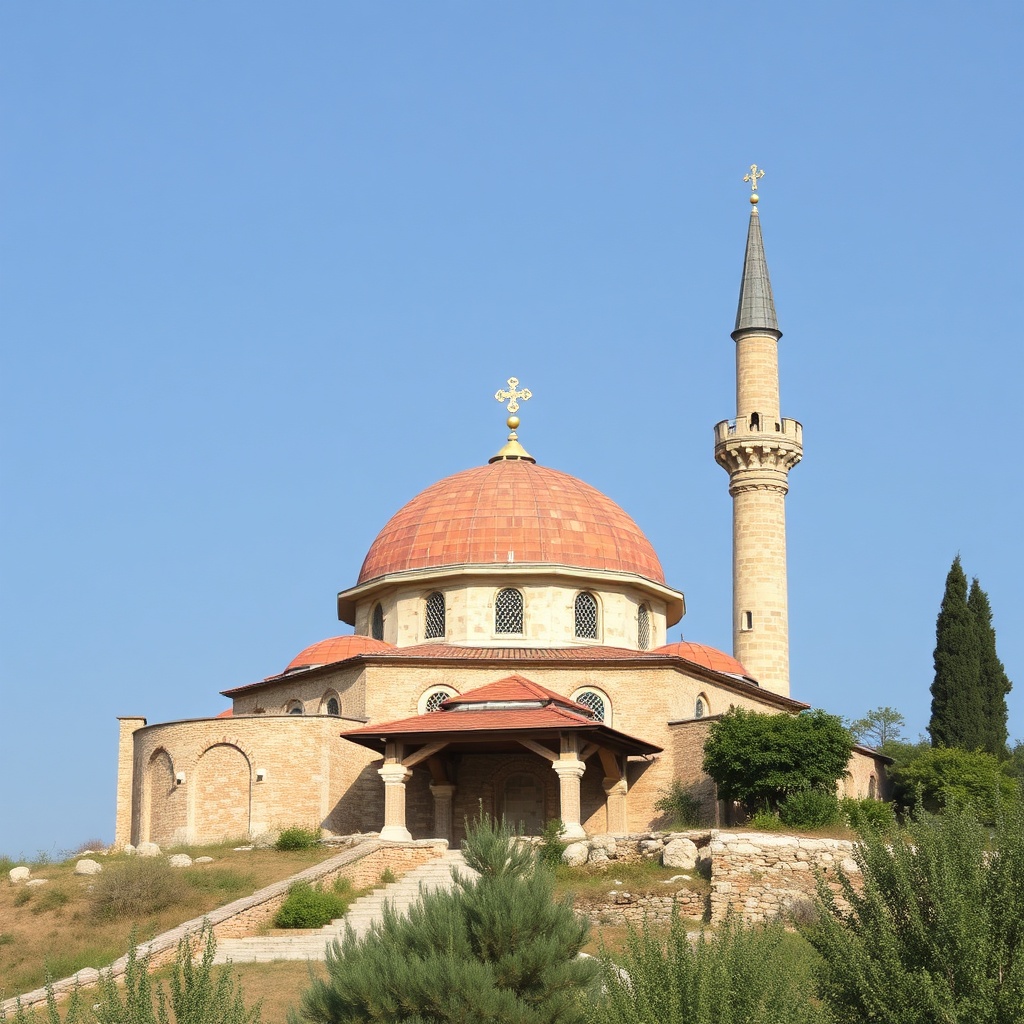
The Druze faith is a monotheistic and esoteric religious tradition that emerged in the 11th century in the Middle East. With a distinctive doctrine that blends elements of Shia Islam, Gnosticism, and other philosophical traditions, the Druze have developed a unique religious and cultural identity, maintaining a strong sense of community and discretion regarding their inner beliefs.
Druze Faith: A Sociological, Historical, and Theological Analysis
The Druze faith, known among its practitioners as Tawhid (Divine Unity), represents a syncretic and esoteric faith with a rich and complex history. Its emergence on the religious landscape of the Middle East at the beginning of the second millennium marked the formation of a distinct community, whose beliefs and practices differentiate it from other Abrahamic religions. This article aims to demystify the Druze faith, addressing its origins, dogmas, structure, and, crucially, analyzing its social and cultural impact, with special attention to any controversies or deviations that may have arisen throughout its history.
1. Sociological and Theological Definition of the Druze Faith
Sociologically, the Druze faith can be defined as an ethno-religious religion, characterized by a strong sense of collective identity and exclusivity. Adherence to the Druze faith generally occurs by birth, with external conversions being extremely rare and discouraged, which contributes to social cohesion and the preservation of their traditions. Its esoteric nature means that many of its deepest teachings are reserved for an inner circle of initiates, the 'Uqqal (the Wise or "Those who know"), while the majority of adherents, the Juhhal (the Ignorant or "Those who do not know"), are familiar only with the more external aspects of the faith.
Theologically, the Druze faith is fundamentally monotheistic, believing in a single transcendent and unknowable God. Its central doctrine revolves around the idea of Tawhid, emphasizing the absolute oneness of God. A central figure in Druze theology is al-Hakim bi-Amr Allah, the sixth Fatimid caliph, whom the Druze believe was the divine manifestation on Earth. They reject the divinity of Muhammad and most Islamic prophets, although they recognize the importance of Jesus and other spiritual reformers in different eras. The belief in continuous reincarnation and the transmigration of the soul is a fundamental pillar, with each individual's soul reincarnating into another human being immediately after death, without an intermediate period of judgment or purgatory. Salvation is achieved through strict adherence to the moral and spiritual principles of the faith and the development of the soul toward divine unity. The concept of Fitna (discord, trial) is also relevant, indicating the challenges the community faces and the need for perseverance in faith.
2. Historical Origin, Founders, and Geographic/Cultural Context
The Druze faith emerged in Fatimid Egypt in the early 11th century, during the caliphate of al-Hakim bi-Amr Allah (996–1021 AD). The founding of the faith is attributed to Hamza ibn Ali ibn Ahmad, a Persian who became a prominent preacher and theologian within the Fatimid court. Other important figures include Muhammad ibn Ismail al-Nasimi and Sulaiman al-Baghdadi. The Druze doctrine was formally presented to the public in 1017 AD.
The historical context was that of the Fatimid Empire, a Shia Ismaili state that ruled parts of North Africa and the Levant. Al-Hakim bi-Amr Allah was known for his eccentric and, at times, authoritarian rule. The Druze doctrine emerged in a period of intellectual and religious effervescence, where various mystical and philosophical currents interacted. It is believed that the doctrine was initially promoted as a radical branch of Ismailism, but it soon developed its own distinctive characteristics, culminating in the divinization of al-Hakim, an idea that orthodox Ismailism rejected.
Geographically, the faith spread rapidly to the Levant, especially to the mountainous regions of Mount Lebanon, Syria, and Israel, where the Druze community settled and flourished, often seeking refuge in areas difficult for other communities to access. The Druze diaspora also formed in other parts of the world, especially in North America and Europe, but the majority of adherents remain in the Middle East.
3. Main Beliefs, Dogmas, Rites, and Practices
The core beliefs of the Druze faith include:
- Tawhid (Divine Unity): The belief in a single, absolute, and transcendent God, who manifested on Earth through al-Hakim bi-Amr Allah.
- Reincarnation (Tanasukh): The human soul continuously reincarnates into human bodies, in a cycle that is completed when the soul reaches spiritual perfection and unites with the Divine Unity.
- The Divinity of al-Hakim: Considered the last and most complete manifestation of God on Earth.
- Direct Accessibility to Truth: The belief that divine truth can be accessed directly by the soul through wisdom and spiritual practice, without the need for clerical intermediaries at all levels.
- The Concept of "The Five Doors": Represented by key spiritual figures who served as messengers of divine truth in different eras, including Hamza ibn Ali, Isma'il ibn Muhammad, Muhammad ibn Wahb al-Qurashi, Abu Ibrahim al-Taimi, and Abu Abdullah Muhammad ibn al-Imam al-Aghmar.
- Morality and Ethics: Emphasizes honesty, loyalty, piety, renunciation of falsehoods, abandonment of idolatry, and submission to the divine will.
Druze rites and practices are largely private and not public. The Juhhal participate in more general community prayers and celebrations, but esoteric teachings and deeper rituals are restricted to the 'Uqqal. A significant practice is the Khalwa, a weekly meeting of the wise in sacred places where they study sacred texts and discuss spiritual doctrines. Important religious celebrations include Eid al-Adha (Feast of the Sacrifice), which for the Druze commemorates closeness to God, and Eid al-Ghadir, which they celebrate as a day of divine revelation. Fasting is not a central practice, although abstinence from certain items, such as tobacco and alcohol, is common among the 'Uqqal and many Juhhal.
4. Organizational Structure and Leadership Profile
The Druze organizational structure is hierarchical, divided between the 'Uqqal (the Wise) and the Juhhal (the Ignorant). The 'Uqqal are the guardians of esoteric knowledge and doctrine, responsible for guiding the community spiritually and morally. They undergo a rigorous process of initiation and study to attain this status. Leadership is exercised by a council of elders and wise men, who make important decisions for the community.
The Juhhal constitute the vast majority of adherents and follow the teachings and guidelines of the 'Uqqal. The distinction between the two groups is fundamental for the preservation of the esoteric nature of the faith and for the maintenance of community discipline. Leadership, therefore, is not centralized in a single figure, but rather distributed among the most respected wise men, with the Supreme Spiritual Council (Majlis al-Ruhani al-A'la) acting as the main deliberative body in larger communities, such as in Israel and Lebanon.
5. Factual Analysis Regarding Controversies, Ethical Deviations, or "Destructive Cult" Characteristics
It is essential to address the question of whether the Druze faith falls into the category of a "destructive cult." Based on extensive academic research and serious reporting, the Druze faith, as a whole, is not considered a destructive cult. On the contrary, it is an ancient and established religion with a resilient community and a strong system of ethical and moral values.
Characteristics frequently associated with destructive cults, such as extreme social isolation (leading to alienation from society), systematic financial exploitation, coercive mind control, abuse of minors or adults, and harm to third parties, are not systemic traits of the Druze faith. The Druze community, while discreet and possessing a strong sense of self-identity, is integrated into the societies where it resides, actively participating in civic and political life, especially in Israel and Lebanon, where they hold positions in government and the armed forces.
However, like any religious or community group, the Druze faith faces its own challenges and internal debates. A point of historical attention has been its relationship with the religious and political majorities in the regions where they live. At times, their discretion and distinct identity have led to misunderstandings and, in certain historical periods, to persecution. For example, during the Ottoman period and in some regional conflicts, the Druze community faced periods of violence and oppression by rival groups.
The exclusivity of the faith and the difficulty of conversion for outsiders may be seen by some as an obstacle to external understanding, but it is a characteristic intrinsic to their identity and the preservation of their traditions. It is not a matter of coercive isolation, but a community choice to maintain their cultural and religious heritage.
It is crucial to distinguish between the nature of the Druze faith and the actions of individuals or small groups who may have distorted its teachings. There is no documentary or academic evidence to support that the Druze faith, as a religion and community, promotes or tolerates abuse, exploitation, or violence in a systemic way. References to the Druze faith as a "destructive cult" would be inaccurate and prejudiced, disregarding the long history of coexistence and social contribution of the Druze community.
6. Social, Cultural Impact, and Contemporary Relevance
The Druze faith has had a significant social and cultural impact in the regions where it is present. The Druze community is known for its loyalty, resilience, and strong sense of unity. In Israel, the Druze are full citizens, serving in the Israel Defense Forces (IDF) and participating actively in politics. Their loyalty to the State of Israel, despite being a religious and cultural minority, is a topic of sociological and political study.
In Lebanon, the Druze play an important role in the country's sectarian politics, with significant autonomy in their traditional areas. Their ability to maintain a distinct identity while navigating complex regional political dynamics is a testament to their community strength and adaptability.
Culturally, the Druze maintain unique traditions in terms of clothing, cuisine, and social customs. Discretion regarding their inner beliefs has contributed to a certain mystery surrounding their faith, but also to the preservation of their identity in an often turbulent environment. The architecture of Druze villages, often located on hills, reflects their history of seeking security and autonomy.
In contemporary times, the Druze faith continues to be a vibrant community, facing the challenges of modernity, globalization, and regional tensions. The preservation of their faith and cultural identity in a constantly changing world is a theme of continuous interest for sociologists of religion and historians. Their existence and ability to adapt offer a valuable case study on the resilience of religious minorities and the dynamics of ethno-religious identity.
References and Research Sources
- "Druze" in Encyclopædia Britannica. (Accessed on [date])
- MAIS, Daniel. The Druzes: A History. New York: Oxford University Press, 2000.
- CHAMBERS, Richard. The Druze: A New Religious Movement. London: Routledge, 2017.
- NISSIM, Livia. The Druze: A New Religious Community in the Middle East. London: I.B. Tauris, 2014.
- Academic articles available in databases such as JSTOR, Project MUSE, and Google Scholar, with search terms such as "Druze religion," "Druze history," "Druze sociology," "Tawhid."
- Reports from reliable news sources such as BBC News, Reuters, Associated Press, The Guardian, The New York Times, which have covered the Druze community in political and social contexts.





