



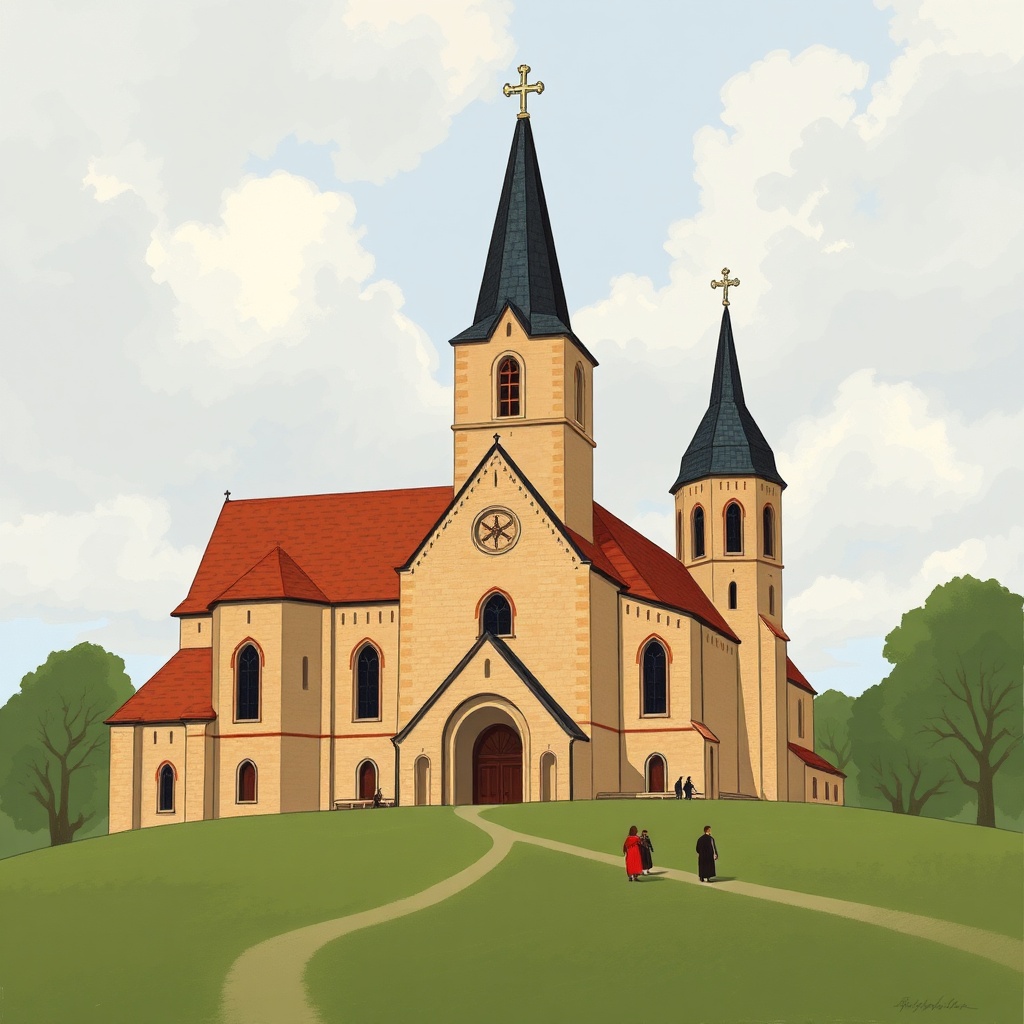
Lutheranism, which originated in the 16th century with Martin Luther, is a branch of Protestantism that emphasizes salvation through faith. Its reforming theology broke away from the dogmas and practices of the Roman Catholic Church, establishing pillars such as the supreme authority of the Bible and justification by divine grace. Although it brought with it a legacy of significant reforms and cultural influences, it is essential to analyze the movement in its complexity, addressing both its theological and historical foundations as well as its evolution and potential controversies over time.
Origin and Historical Foundation
Lutheranism emerged in the turbulent religious and political landscape of 16th-century Europe, with Martin Luther, an Augustinian monk and German theology professor, as its central figure. The genesis of the movement is intrinsically linked to the 95 Theses posted by Luther on the door of the Castle Church in Wittenberg on October 31, 1517. These theses, full of criticisms of the Catholic Church, especially the practice of selling indulgences—which promised the forgiveness of sins in exchange for money to finance, for example, the construction of St. Peter's Basilica—marked the beginning of the Protestant Reformation. Luther did not initially seek a split, but an internal reform of the Church, contesting clerical corruption and certain doctrines and practices that, in his view, distanced themselves from evangelical foundations. Luther's dissatisfaction also extended to priestly mediation between the faithful and God, advocating for the universal priesthood of believers. The geographical and cultural context was the Holy Roman Empire (modern-day Germany), a mosaic of territories with growing nationalist sentiment and discontent with papal interference in local affairs, which contributed to the receptivity of reformist ideas by the nobility and segments of the population. Luther's excommunication by Pope Leo X in 1521, after the public burning of the papal bull, sealed the definitive break with the Catholic Church.
Sociological and Theological Definition
Sociologically, Lutheranism is one of the main branches of classical Protestantism, with approximately 77 to 90 million followers globally. It is characterized by its decentralized organization, with various national and regional churches operating autonomously, although many are affiliated with global organizations such as the Lutheran World Federation and the International Lutheran Council. From a theological point of view, Lutheranism is based on the Bible as the sole and highest authority in matters of faith and practice (Sola Scriptura), and on the three ecumenical Creeds (Apostolic, Nicene, and Athanasian). Lutheran doctrine is explained in documents such as the Book of Concord, which includes the Augsburg Confession (1530)—a fundamental summary of Lutheran teachings—and Luther's catechisms. The central theological pillars, known as the "Five Solas," summarize the essence of the Lutheran faith: Sola Scriptura (Scripture Alone), Sola Gratia (Grace Alone), Sola Fide (Faith Alone), Solus Christus (Christ Alone), and Soli Deo Gloria (Glory to God Alone).
Main Beliefs, Dogmas, Rites, and Practices
The fundamental belief of Lutheranism is justification by faith, which teaches that salvation is a free gift from God, received solely through faith in Jesus Christ, and not through human works or merits. Lutherans believe that faith is the guarantee of salvation, and that man is incapable of fearing or believing in God without divine grace and the help of the Holy Spirit. Baptism and the Eucharist (Holy Communion) are the two recognized sacraments, seen as means by which God grants his grace. The Lutheran Church maintains many liturgical practices from the pre-Reformation period, including the structure of the mass, known as the Divine Service (Gottesdienst), with particular emphasis on the Eucharist, where the real presence of Christ in the Sacramental Union is affirmed. Other important practices include the universal priesthood of the believer, which guarantees the direct relationship of the faithful with God without the need for clerical intermediaries, and the translation of the Bible into the vernacular (German, in Luther's case), encouraging its reading and interpretation by all the faithful. Lutheranism does not recognize the authority of the Pope, the tradition taught by the Catholic Church, nor the cult of saints and the adoration of religious images.
Organizational Structure and Leadership
The organizational structure of Lutheran churches is predominantly decentralized. Although there are national and regional headquarters organized independently, decisions are made locally through synods and councils. Each Lutheran church in different countries may have its own national president, council, or synod. The Evangelical Church of the Lutheran Confession in Brazil (IECLB), for example, is affiliated with the Lutheran World Federation and operates based on normative documents such as internal regulations and public constitutions, approved by its highest decision-making body, the General Council. Spiritual leadership is exercised by various pastors and ministers. Luther, despite having been the central figure and the driving force of the movement, expressed reluctance to have his name associated with the doctrine, preferring that followers be called simply "Christians." The structure, although human and subject to revision, requires discipline and compliance with established laws and orders for the maintenance of communion.
Warnings, Controversies, and Contemporary Challenges
Lutheranism, as a reforming movement that broke with the Catholic Church, generated and still generates debates and controversies. Historically, tensions with the Catholic Church were marked by mutual accusations of heresy and persecution. The publication of the 95 Theses and the subsequent Protestant Reformation led to significant divisions in European Christendom, with religious conflicts such as the Thirty Years' War. Currently, although Lutheranism is an established religion and lacks characteristics of a "destructive cult," such as social isolation, financial exploitation, or mind control, there are relevant internal challenges and debates. For example, the Evangelical Church in Germany (EKD), which brings together various Protestant denominations in Germany, including Lutherans, was at the center of a sexual abuse scandal against minors, with investigations revealing a vast network of institutional complicity in the cover-up of crimes by pastors and other church members between 1946 and 2020. The leadership of the Evangelical Church expressed shock and dismay at the findings of the report, acknowledging the depth of the violence that occurred and the connivance of part of the community. There are also theological disagreements between different Lutheran currents, such as the variation in the interpretation of biblical authority between the Evangelical Lutheran Church in America (ELCA) and the Lutheran Church–Missouri Synod (LCMS), where the ELCA admits the possibility of errors in the Bible in areas such as science or history, while the LCMS considers it infallible. In general, there is no documentary or academic evidence that classifies Lutheranism, in its entirety or in its main denominations, as a "destructive cult" with a proven history of systemic abuse, crimes, or malicious conduct against people, animals, or society, in the same sense that would apply to groups with characteristics of extreme manipulation and coercion. However, as demonstrated by the abuse scandal in Germany and the complexity of theological disagreements, it is crucial that religious institutions maintain transparency, accountability, and effective mechanisms for protection against abuse and for the promotion of healthy theological dialogue.
Social Impact, Cultural Influence, and Contemporary Relevance
Lutheranism has had a profound and multifaceted impact on global society, culture, and politics. The Protestant Reformation, driven by Luther, contributed significantly to the transition from the Middle Ages to the Modern Age, the decline of the feudal system, and the rise of nation-states. The emphasis on translating the Bible into vernacular languages and on literate education for the masses promoted a general increase in literacy and access to knowledge. The notion of the universal priesthood of the believer encouraged greater individual autonomy and the development of a Protestant work ethic that, according to some sociologists, influenced the development of capitalism. Culturally, Lutheranism influenced sacred music, literature, and art. In the social sphere, Luther's condemnation of celibacy and his marriage to a former nun paved the way for the appreciation of marriage and family life for the clergy. In Brazil, the Lutheran presence, celebrating 200 years in 2024, has contributed mainly through its schools, which have promoted inclusion and community development, admitting students from diverse backgrounds. Currently, Lutheranism continues to be a relevant religious force on the world stage, seeking in many cases reconciliation with the Catholic Church and engaging with the challenges of contemporary times, such as social justice, ethics, and sustainability.
References and Research Sources
- Lutheranism: summary, context, principles - História do Mundo. (vertexaisearch.cloud.google.com)
- Lutheranism – Wikipedia, the free encyclopedia. (wikipedia.org)
- Lutheranism: what it is, context, basic principles - Brasil Escola. (brasilescola.uol.com.br)
- Lutheranism. (vertexaisearch.cloud.google.com)
- What is the origin of the Lutheran Church?. (portal-luterano.com.br)
- Lutheranism: what it is, emergence and doctrines - Toda Matéria. (todamateria.com.br)
- What is the Lutheran Church and what do Lutherans believe? | GotQuestions.org. (gotquestions.org)
- Lutheranism: what it is and what it defends - Escola Kids. (escolakids.uol.com.br)
- Lutheranism - Religion Enem | Educa Mais Brasil. (educamaisbr.com)
- Lutheranism - StudHistória. (studhistoria.com.br)
- Lutheranism. (vertexaisearch.cloud.google.com)
- Protestant Reformation: 5 social consequences of Lutheranism - Mega Curioso. (megacurioso.com.br)
- Lutheran Presence in Brazil - 200 years of history - Abre Aspas. (abreasas.com.br)
- Structure - Portal Luteranos. (luteranos.com.br)
- A look at the historical legacy of the Lutheran Reformation. (vertexaisearch.cloud.google.com)
- Controversies in Protestantism – Wikipedia, the free encyclopedia. (wikipedia.org)
- Complementary Management - Portal Luteranos. (luteranos.com.br)
- Luther's Heresies and the Schism in the Church - YouTube. (youtube.com)
- Germany: the sexual abuse scandal also plagues Protestant churches - Instituto Humanitas Unisinos - IHU. (ihu.unisinos.br)
- Spanish justice admits that Jehovah's Witnesses be considered a “destructive cult”. (setemargens.com)
- LUTHER'S HERESIES AND THE PROTESTANT 'REFORMATION' | Father Gabriel Vila Verde. (youtube.com)





