



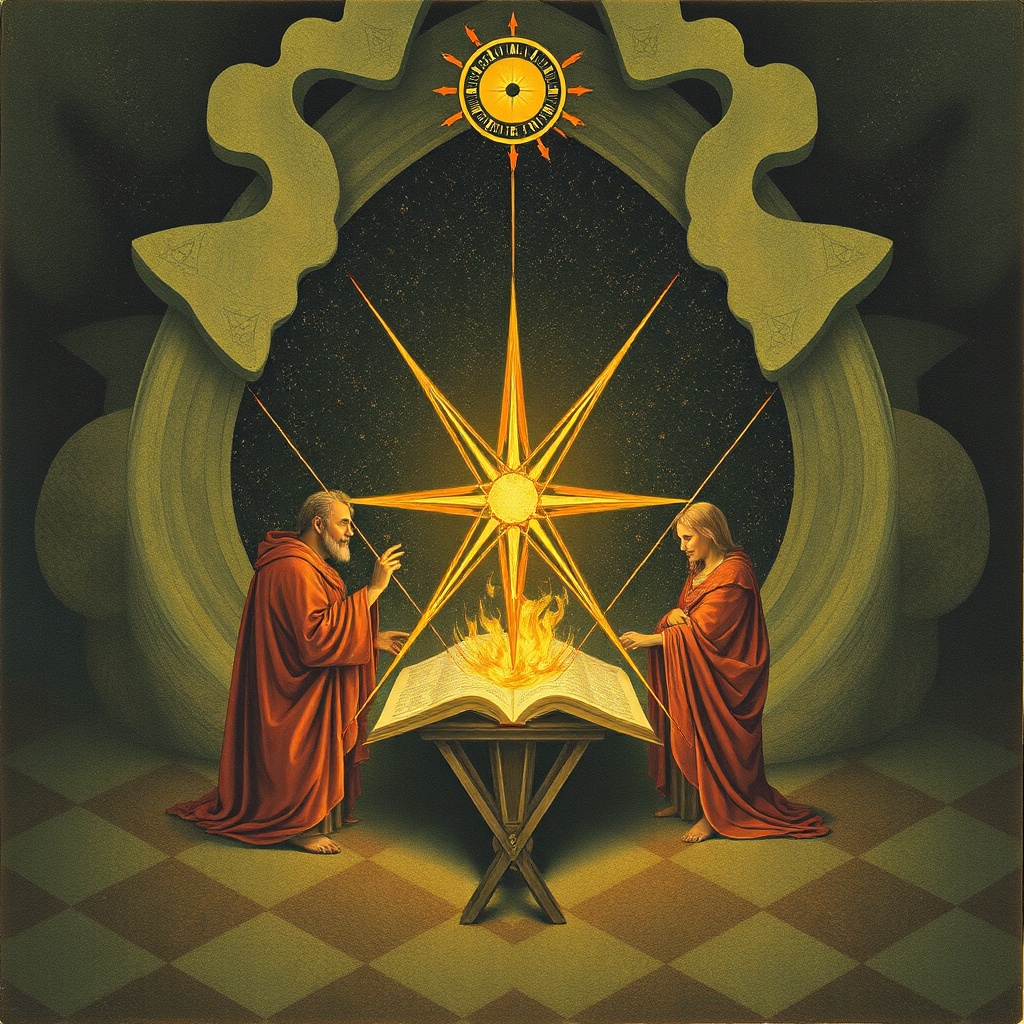
Hermeticism is an ancient esoteric tradition that combines philosophical, religious, and magical elements, with deep roots in Hellenistic antiquity. Involving a complex set of teachings attributed to Hermes Trismegistus, this current of thought has influenced various mystical and occult schools over the centuries, and its study is fundamental to understanding unconventional spiritual currents.
Origin and Historical Foundation
Hermeticism emerged in Ptolemaic Egypt, around the 2nd or 3rd century AD, as a syncretic synthesis of ancient Egyptian wisdom and Greek philosophy, particularly Platonism and Stoicism. The name "Hermes Trismegistus" (Hermes the Thrice-Great) is a mythical figure, a fusion of the Greek god Hermes with the Egyptian god Thoth, the deity of wisdom, writing, and magic. It is believed that the Hermetic texts, known as the Corpus Hermeticum, were compiled during this period, although they present a literary and philosophical style that suggests authorship from different eras and locations. The transmission of these texts occurred primarily through the Arab world and, subsequently, in Renaissance Europe, where they gained enormous popularity among humanists and occultists. The geographical and cultural context of its emergence was Hellenistic Egypt, a melting pot of cultures where religious and philosophical syncretism was a striking feature.
Sociological and Theological Definition
Sociologically, Hermeticism can be classified as a spiritual or esoteric tradition that often operates on the fringes of institutionalized religions. It is characterized by the pursuit of gnostic or initiatory knowledge, which promises illumination and union with the divine through the study and practice of spiritual and philosophical disciplines. Theologically, Hermeticism presents a complex, though often abstract, pantheon, with an emphasis on the underlying unity of all existence and the immanent divinity in the cosmos and the human being. They believe in a single, transcendent God, the Supreme Mind or the All, from which all reality emanates. The ultimate goal of the Hermeticist is the "Great Work" (Magnum Opus), which can be interpreted both spiritually and materially, aiming at the purification of the soul and the attainment of divine wisdom.
Main Beliefs, Dogmas, Rites, and Practices
Hermetic beliefs are vast and multifaceted, but some central principles stand out. The doctrine of correspondence, encapsulated in the aphorism "As above, so below; as below, so above," is fundamental, indicating that the macrocosm and the microcosm reflect each other. The belief in the unity of all creation and the presence of the divine in everything (pantheism or panentheism) is recurrent. Hermeticism also encompasses concepts such as the transmigration of souls, astrology as a sacred science, and alchemy as a path to purification and spiritual and material transformation. Hermetic practices may include meditation, prayer, study of sacred texts, initiation rituals, and the use of symbols and correspondences to influence reality. Alchemy, in particular, is seen as a symbolic path to the purification of the self, the dissolution of the ego, and reintegration with the divine.
Organizational Structure and Leadership Profile
Historically, Hermeticism has not organized itself as a church or religious denomination with rigid hierarchies and a unified dogma. Traditionally, it has been transmitted through lines of masters and disciples in small initiatory groups or esoteric schools. The profile of leadership in such groups varies considerably, but generally falls upon individuals who demonstrate deep knowledge of Hermetic teachings, experience in spiritual practices, and the ability to guide others on their path of development. Authority in such contexts is often based on spiritual merit and knowledge, rather than formal apostolic succession. However, the private and often secret nature of these traditions makes it difficult to generalize about their contemporary organizational structures.
Warnings and Controversies: Contemporary Hermeticism
It is crucial to distinguish Hermeticism as a historical philosophical and spiritual tradition from contemporary groups that may claim to follow its teachings. The vast majority of historical and contemporary Hermetic currents do not exhibit characteristics of a "destructive cult." However, as in any spiritual tradition, history and the present may present isolated cases or specific groups that deviate from ethical principles, or that become controversial. The search for esoteric knowledge and spiritual practices can, in some contexts, be exploited by individuals or groups with manipulative intentions. Serious academic and journalistic sources that investigate "destructive cults" rarely associate Hermeticism itself with these systemic behaviors. If a specific group that calls itself Hermetic is the subject of police investigations, lawsuits, allegations of abuse, financial exploitation, social isolation, or mind control, such allegations must be evaluated based on factual evidence and reports from reliable sources. An example to observe is how some groups that exploit interest in occultism and esotericism may, in practice, present characteristics of manipulation and coercion, distancing themselves from the philosophical ideals of classical Hermeticism. However, it is imperative not to generalize these anomalies to the entire Hermetic tradition, which has historically been a vehicle for the pursuit of wisdom and self-knowledge.
Social, Cultural Impact, and Contemporary Relevance
The impact of Hermeticism on Western culture is immeasurable, although often subtle and subterranean. Its influence can be traced through the Renaissance, Rosicrucianism, Freemasonry, Theosophy, and various New Age currents. Many of the philosophical and esoteric concepts that shaped Western thought, especially regarding mysticism, alchemy, and astrology, have their roots in or were significantly influenced by the Hermetic tradition. In contemporary times, Hermeticism continues to attract researchers, spiritual practitioners, and scholars who seek a deeper understanding of the nature of reality, consciousness, and human potential. Modern esoteric movements and the popularization of practices such as meditation and self-knowledge, in part, echo Hermetic principles of inner search and understanding of the universe. The reinterpretation and adaptation of Hermetic teachings to modern contexts demonstrate their perennial relevance as a source of philosophical and spiritual inspiration.
References and Research Sources
- 1. Yates, Frances A. Giordano Bruno and the Hermetic Tradition. University of Chicago Press, 1964.
- 2. Mahé, Jean-Didier. Hermès et Hermétisme. Presses Universitaires de France, 1975.
- 3. The Corpus Hermeticum. Translated by C. H. Roberts. Princeton University Press, 1975.
- 4. Ebeling, Richard. Hermetic Traditions in Western Esotericism. Brill, 2009.
- 5. Faivre, Antoine. Access to Western Esotericism. SUNY Press, 1994.
- 6. Richardson, James T. Regulating Religion: Case Studies in the Social Scientific Study of Religion and Law. Springer, 2003.
- 7. Rizzuto, Anthony. The Search for Meaning in an Age of Information: How to Navigate the Information Age. Praeger, 2004.





