



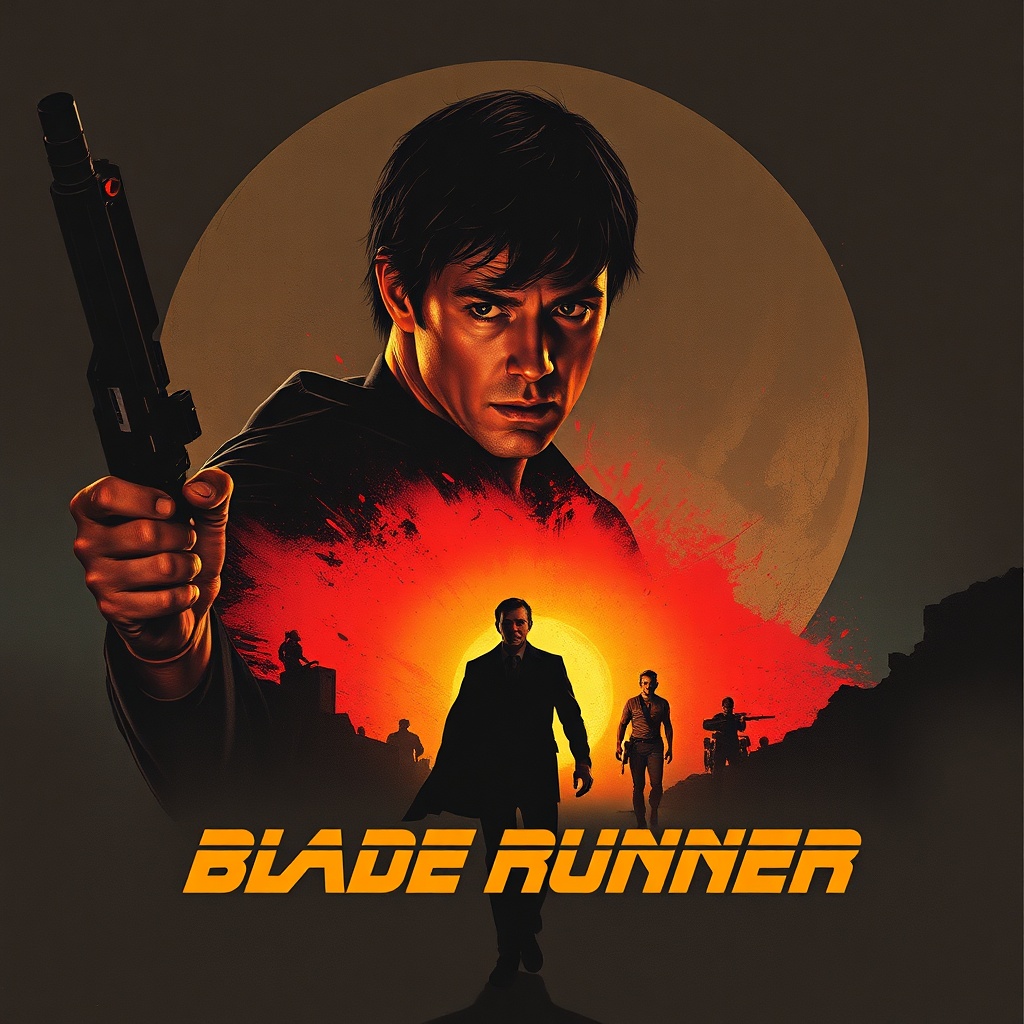
Released in 1982 under the visionary direction of Ridley Scott, Blade Runner transcended the boundaries of science fiction cinema to establish itself as one of the most influential and aesthetically revolutionary masterpieces in the history of pop culture. Combining the existential melancholy of classic film noir with a dystopian and technocratic vision of the future, the feature film adapted from Philip K. Dick's work not only redefined the cyberpunk genre but also established a timeless philosophical debate about the very essence of humanity, memory, and mortality.
Analysis and Plot: The Neon and Concrete Dystopia of 2019
To understand the impact of Blade Runner, one must first deconstruct the Los Angeles of November 2019 projected by Ridley Scott and visual futurist Syd Mead. Unlike the clean and optimistic space utopias that dominated previous decades, the future of Blade Runner is a suffocating metropolis, saturated with pollution, incessant acid rain, monumental neon advertisements, and a linguistic babel known as "Cityspeak." It is a world of decadent hyper-capitalism, where nature has been completely eradicated and replaced by technological simulacra.
The Complete Plot: Rick Deckard's Existential Hunt
The plot follows Rick Deckard (Harrison Ford), a former police officer from the special unit known as "Blade Runners." His job is to hunt and "retire" (a euphemism for exterminating) replicants — synthetic humans created through genetic engineering by the powerful Tyrell Corporation for slave labor and dangerous tasks in extraterrestrial colonies. The new Nexus-6 series replicants possess superhuman strength and agility, but were programmed with a crucial safeguard: a life expectancy of only four years, designed to prevent them from developing complex emotions.
The central conflict arises when four fugitive replicants — led by the brilliant and charismatic Roy Batty (Rutger Hauer), accompanied by Leon (Brion James), Zhora (Joanna Cassidy), and Pris (Daryl Hannah) — hijack a ship and infiltrate Los Angeles. The group's goal is desperate and profoundly human: to find their creator, Dr. Eldon Tyrell (Joe Turkel), and demand an extension of their limited lives.
Forced back into service by his former superior, the cynical Captain Bryant (M. Emmet Walsh), Deckard begins his investigation. He visits the imposing Tyrell Corporation headquarters to test the Nexus-6 model with the "Voight-Kampff" empathy test. There, he meets Rachael (Sean Young), Tyrell's assistant. Upon subjecting her to the test, Deckard discovers that she is an experimental replicant with implanted memories of a childhood that never existed, which makes her firmly believe she is human. The discovery shakes Rachael's identity and awakens an unprecedented ethical crisis in Deckard.
As Deckard systematically tracks down and eliminates Zhora and Leon (the latter with the crucial help of Rachael, who shoots Leon to save the detective), he sinks into a moral abyss. The hunt culminates in the apartment of genetic designer J.F. Sebastian (William Sanderson), a man suffering from premature aging who serves as a bridge for Roy Batty to reach Tyrell. Upon confronting his "father" and discovering that life extension is biologically impossible, Batty, in a mix of biblical fury and existential despair, crushes Tyrell's skull and murders Sebastian, leaving only him and Pris.
The Decoded Ending: Tears in Rain and the Unicorn Enigma
The climax of Blade Runner takes place in an abandoned and decaying structure, where Deckard confronts Pris and Roy Batty. After eliminating Pris, Deckard finds himself hunted by Batty in a gothic and expressionist chase across the rooftops under the torrential rain. Batty, whose body begins to fail due to the end of his four-year life cycle, demonstrates absolute physical and psychological superiority over the detective.
When Deckard slips and hangs on the verge of death at the top of a building, Roy Batty makes a decision that redefines the film's morality: he grabs Deckard by the hand and saves him. Sitting before the man who was sent to kill him, Batty delivers the most famous monologue in science fiction history:
"I've seen things you people wouldn't believe. Attack ships on fire off the shoulder of Orion. I watched C-beams glitter in the dark near the Tannhäuser Gate. All those moments will be lost in time, like tears in rain. Time to die."
Batty's death, accompanied by the release of a white dove that flies toward the gray sky, symbolizes the triumph of dignity and human consciousness in a synthetic body. He dies with more empathy and appreciation for life than any of the biological humans portrayed in the film.
The film's resolution brings the greatest and most debated enigma of the work. Upon returning to his apartment to rescue Rachael and flee with her, Deckard finds on the floor a small origami unicorn made by Gaff (Edward James Olmos), the mysterious police colleague who communicates via Cityspeak. Gaff had let Rachael live, but the origami carries a much deeper meaning, especially when analyzed in conjunction with the sequence of Deckard's dream of a unicorn (present in the 1992 Director's Cut and the 2007 Final Cut).
The presence of the origami suggests that Deckard's most intimate memories and dreams are, in fact, synthetic implants known to the police. Deckard is, in fact, a replicant. Although Harrison Ford disagrees with this interpretation (arguing that Deckard needed to be human for the connection with the viewer to work), Ridley Scott has always reiterated that the blade runner was a Nexus-6 unaware of his own artificial nature.
The Cast: Synthetic Humanity and Organic Coldness
The cast of Blade Runner delivered performances that challenged the conventions of action cinema at the time. Harrison Ford, fresh from the charismatic heroism of Star Wars and Indiana Jones, subverted his cinematic persona by playing Rick Deckard as a broken, morally ambiguous, physically vulnerable man who is constantly defeated in physical combat by the replicants. His performance is marked by a palpable existential weariness.
However, it is Rutger Hauer who steals the spotlight as Roy Batty. Hauer brought an almost Shakespearean intensity to the antagonist, balancing physical threat with a poetic, childlike, and desperate vulnerability. It was Hauer himself who improvised and edited the final monologue ("Tears in Rain"), cutting excessive lines from David Peoples' original script and adding the iconic metaphor of tears in rain the night before filming the scene, leaving the film crew moved on set.
Sean Young perfectly embodied the 1940s femme fatale aesthetic with her geometric makeup, structured clothing, and melancholic vulnerability as Rachael. Daryl Hannah, as Pris, and Brion James, as Leon, brought physicality and a sense of constant danger, while Edward James Olmos (Gaff) created a magnetic presence with almost no formal dialogue, developing the "Cityspeak" dialect from a mixture of Hungarian, German, Japanese, and Spanish.
Behind the Scenes and Conflicts: Ridley Scott's Battle Against Hollywood
The production of Blade Runner was marked by legendary turbulence that almost destroyed the film even before its premiere. Ridley Scott, known for his obsessive perfectionism and rigorous visual style, clashed directly with the American technical crew (who considered his directing methods authoritarian and slow). This conflict generated the famous "T-shirt War," where crew members wore shirts with slogans like "Yes Guv'nor, whatever you say" in protest of Scott's demands.
The relationship between Ridley Scott and Harrison Ford was also extremely tense during filming. Ford felt frustrated by Scott's lack of direction regarding character development, as the director focused most of his attention on lighting, practical effects, and production design.
Furthermore, the budget went significantly over. Concerned about the dark tone, slow pace, and ambiguity of the original ending, executive producers Jerry Perenchio and Bud Yorkin took control of post-production. They imposed two drastic changes for the 1982 theatrical release:
- A forced and apathetic voice-over narration recorded by Harrison Ford (which the actor supposedly delivered sloppily in the hope that it wouldn't be used);
- An artificial happy ending, using outtakes from Stanley Kubrick's The Shining (1980), showing Deckard and Rachael driving through sunny mountains.
Another crucial behind-the-scenes element was the soundtrack composed by the Greek artist Vangelis. Using innovative analog synthesizers (such as the Yamaha CS-80), Vangelis created an electronic, melancholic, and futuristic soundscape that became inseparable from the film's imagery, setting the gold standard for the sound of science fiction cinema.
Critical Reception, Box Office, and the Birth of Cyberpunk
When it premiered on June 25, 1982, Blade Runner was a resounding commercial failure. The film grossed only about 27 million dollars in the United States, a paltry box office compared to its estimated budget of 28 million. The audience that American summer was under the spell of the welcoming optimism of Steven Spielberg's E.T. the Extra-Terrestrial, rejecting Scott's rainy nihilism.
The initial critical reception was widely polarized. Influential critics like Pauline Kael described the film as "aesthetically extraordinary, but dramatically empty." Reviews at the time complained about the deliberately slow pace and the lack of narrative clarity. Philip K. Dick, the author of the original book, unfortunately passed away in March 1982, months before the premiere, but was able to watch 20 minutes of finished special effects before dying, declaring that the film captured exactly the world he had imagined in his mind.
The true miracle of Blade Runner occurred in the following years, driven by the home video market (VHS) and cult cinema screenings. The film underwent a monumental critical re-evaluation. The accidental discovery of a 70mm workprint in 1989 led to the release of the Director's Cut in 1992, which removed the voice-over and the happy ending, reintegrating the unicorn dream. Finally, in 2007, Ridley Scott obtained full artistic control to release the Final Cut, widely considered the definitive version of the work.
Today, Blade Runner is widely revered as the aesthetic bible of the cyberpunk subgenre, influencing literary works like William Gibson's Neuromancer, revolutionary animations like Akira and Ghost in the Shell, and all modern science fiction cinematography. Its philosophical investigation into memory, mortality, and what defines us as human remains as urgent, beautiful, and painfully relevant as it was in 1982.
Sources Researched
- IMDb - Blade Runner (1982): https://www.imdb.com/title/tt0083658/
- Rotten Tomatoes - Blade Runner: https://www.rottentomatoes.com/m/blade_runner
- Box Office Mojo - Blade Runner (1982): https://www.boxofficemojo.com/title/tt0083658/
- American Film Institute (AFI) Catalog - Blade Runner: https://catalog.afi.com/Catalog/MovieDetails/55122
- British Film Institute (BFI) - Blade Runner Analysis: https://www.bfi.org.uk/features/blade-runner





