



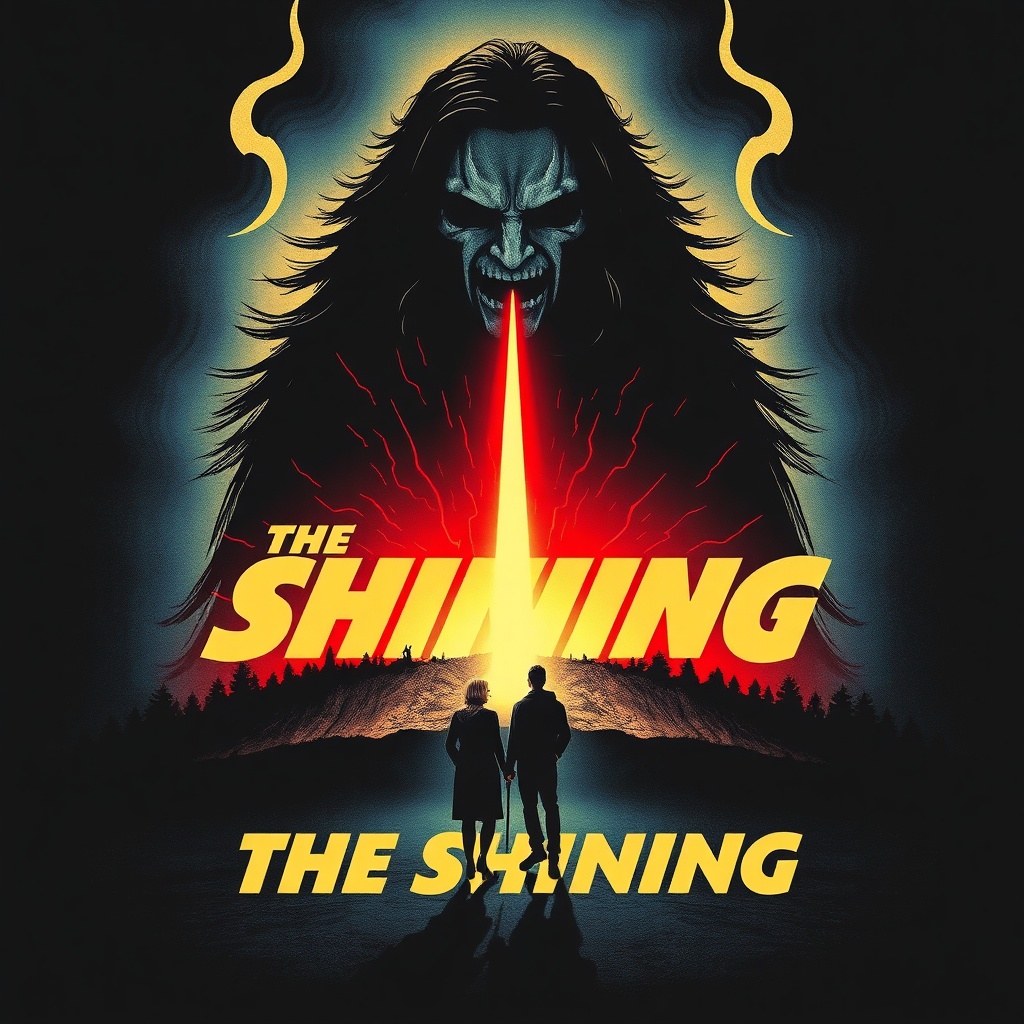
Considered one of the greatest masterpieces of psychological horror cinema, "The Shining," directed by the legendary Stanley Kubrick in 1980, transcended the conventions of the genre to become a profound study on insanity, isolation, and family disintegration. Starring Jack Nicholson in an iconic performance, the film is a loose adaptation of Stephen King's novel of the same name, and its cultural and cinematic impact endures to this day, redefining horror as an immersive and disturbing experience.
Analysis and Plot
"The Shining" delves into the human psyche through the story of Jack Torrance (Jack Nicholson), a former teacher and aspiring writer who accepts a job as the winter caretaker of the isolated Overlook Hotel in the Colorado Rocky Mountains. He sees this opportunity as the perfect chance to dedicate himself to his writing and restructure his life, bringing along his wife, Wendy (Shelley Duvall), and his young son, Danny (Danny Lloyd).
The hotel's premise, with its dark history of a previous caretaker who went insane and murdered his family, serves as an omen for the horrors that will unfold. Danny, however, possesses a special psychic ability, the "shining," which allows him to have visions of the past and foresee future events. He soon establishes a telepathic connection with Dick Hallorann (Scatman Crothers), the hotel's chef, who also shares the same gift and warns him about the dangers of Room 237 (in the book, Room 217).
As winter progresses and the family finds themselves completely isolated by snow, the hotel begins to manifest its malevolent presence. Jack, who was already struggling with alcoholism and an aggressive temper, is gradually consumed by loneliness, writer's block, and the supernatural forces of the Overlook. His sanity deteriorates, and he begins to have vivid hallucinations, interacting with ghostly figures such as the bartender Lloyd and the previous caretaker, Delbert Grady, who incite him to violence against his family.
The film explores "cabin fever," where isolation and boredom lead to paranoia and irritability, amplifying Jack's internal conflicts and family tensions. Wendy, initially fragile, is forced to fight for her son's survival and her own against Jack's growing homicidal madness.
The Enigmatic Ending and Its Theories
The conclusion of "The Shining" is one of the most discussed and interpreted in film history. After a tense chase through the hotel's snow maze, Danny manages to escape, while Jack freezes to death, lost in the labyrinth. The final scene is the most enigmatic: the camera slowly focuses on a black-and-white photograph from 1921, where Jack Torrance appears smiling in the center of a party at the Overlook Hotel.
There are several theories to explain this image. The most widespread suggests that Jack is, in fact, the reincarnation of a former guest or employee of the hotel, and his soul had a strong connection to the place. This idea is corroborated by a line from Jack, where he mentions to Wendy that he feels "totally familiar" with the hotel, as if he had known it before. His death in the maze and his appearance in the 1921 photo would mean he finally found his "home" and became part of the Overlook's hauntings, trapped in an eternal cycle of violence and permanence.
Another interpretation views the photograph as a metaphor for Jack's mind. His hallucinations and the pressure of alcohol and confinement would lead him to justify his murderous intentions, projecting himself into a glorious and dark past of the hotel. The final image would consolidate the idea that violence and madness are cyclical at the Overlook, only changing the victims.
Some critics and theorists, such as in the documentary "Room 237," have explored even deeper meanings, such as the theory that the film is an allegory for the Holocaust, a crime that Kubrick might have felt powerless to film directly. Another theory suggests that the Overlook Hotel represents the Minotaur's Labyrinth, with Jack as the creature, reflecting the claustrophobia and terror of isolation.
Cast and Memorable Performances
The main cast of "The Shining" delivered intense and unforgettable performances, shaping the public's perception of psychological horror.
- Jack Nicholson as Jack Torrance: Nicholson's performance is frequently cited as one of the most iconic and disturbing in cinema. He embodies the descent into madness viscerally, with his manic grin and the improvised line "Here's Johnny!" becoming legendary elements of pop culture. Although Stephen King criticized Nicholson's interpretation, considering him "already crazy" from the start without the gradual transition from the book, critics and audiences hailed it as a brilliant piece of work.
- Shelley Duvall as Wendy Torrance: Shelley Duvall's portrayal of Jack's terrified wife is central to the film's atmosphere of dread. Her performance, marked by fragility and despair, is a direct reflection of the intense filming conditions.
- Danny Lloyd as Danny Torrance: Young Danny Lloyd, who was only 6 years old at the time, delivered a remarkable performance, capturing the innocence and disturbance of his character, especially through the imaginary entity "Tony" and his psychic visions.
- Scatman Crothers as Dick Hallorann: Crothers played the charismatic chef Dick Hallorann, who shares the "shining" with Danny and tries to help him. His presence offers a brief respite of normalcy before the terror intensifies.
Behind-the-Scenes Trivia and Controversies
The production of "The Shining" was as legendary and disturbing as the film itself, generating numerous behind-the-scenes stories and controversies that contributed to its mythical aura.
The Troubled Relationship between Kubrick and Stephen King
One of the biggest controversies involved Stanley Kubrick's creative liberties regarding Stephen King's source material. King publicly expressed his dissatisfaction with the adaptation, criticizing what he saw as Kubrick's "cold" approach, the lack of emotional investment in the Torrance family, and the characterization. King felt that Kubrick portrayed Jack as disturbed from the beginning, in contrast to the book, where Jack was an ordinary man who gradually succumbed to the hotel's evil influence. He also disapproved of the portrayal of Wendy as a "screaming machine" and the ending, which differed significantly from the novel.
The creative rivalry between the two was so intense that some theorize Kubrick inserted an "easter egg" in the film as a jab at King. In the novel, the Torrance family arrives at the Overlook in a red Volkswagen. In the film, the car is yellow, but a crushed red Volkswagen is seen under a truck on the road to the hotel, supposedly Kubrick's way of telling King that he had "broken" the original version.
Shelley Duvall's Trauma
Stanley Kubrick's perfectionism is notorious, and "The Shining" is a striking example of his exhaustive working method. Shelley Duvall, who played Wendy Torrance, was particularly affected by this. Kubrick demanded dozens, sometimes hundreds, of takes for specific scenes, pushing the actress to her physical and mental limits. The staircase scene, where Wendy wields a baseball bat, required 127 takes, a record for the time. Behind-the-scenes documentaries reveal Duvall's emotional exhaustion; she suffered a nervous breakdown and developed mental health issues, largely attributed to the traumatic filming experience. Although some reports suggest Duvall embraced the challenge, the prevailing version in film history is that the process was deeply detrimental to her health.
Other Trivia
- Room 237: In the book, the haunted room is 217. The change to 237 in the film was a request from the Timberline Lodge, the hotel that served as the inspiration for the Overlook's exterior, to prevent guests from being afraid to stay in the real room 217.
- The Steadicam: Kubrick was a pioneer in the use of the Steadicam, a stabilized camera that allowed for fluid and immersive chase sequences, such as Danny on his tricycle through the hotel corridors, which contributed to the sense of claustrophobia and disorientation.
- The Grady Twins: The iconic twins murdered by the previous caretaker, who appear to Danny, were not in Stephen King's book. They were an addition by Kubrick, inspired by a photograph by Diane Arbus, to intensify the fear factor.
Reception and Legacy of the Film
At the time of its release in 1980, "The Shining" received mixed reviews from critics. Some, including the influential Roger Ebert in his first review, found it difficult to connect with the characters and the narrative, and the film even received Razzie Award nominations (Worst Actress for Shelley Duvall and Worst Director for Stanley Kubrick). It was not a massive box-office success upon release, grossing about 46 to 47.5 million dollars worldwide against a 19 million dollar budget, although it was profitable.
However, over the decades, the reputation of "The Shining" has grown exponentially. The film has been re-evaluated and is now widely considered a masterpiece of horror and one of the greatest films of all time. Roger Ebert's review, for instance, was later revised, and he became a champion of the work.
Its legacy is immense, influencing generations of filmmakers and redefining the horror genre. Kubrick demonstrated how horror can be less about cheap scares and more about psychological tension, suffocating atmosphere, and the exploration of the human psyche. Visual elements, such as the symmetry of his shots, the use of the Steadicam, and the unsettling soundtrack, have become cultural and cinematic references. "The Shining" is proof of the enduring power of cinema to confront us with our deepest fears and the fragility of the human mind when faced with isolation and the supernatural.





