



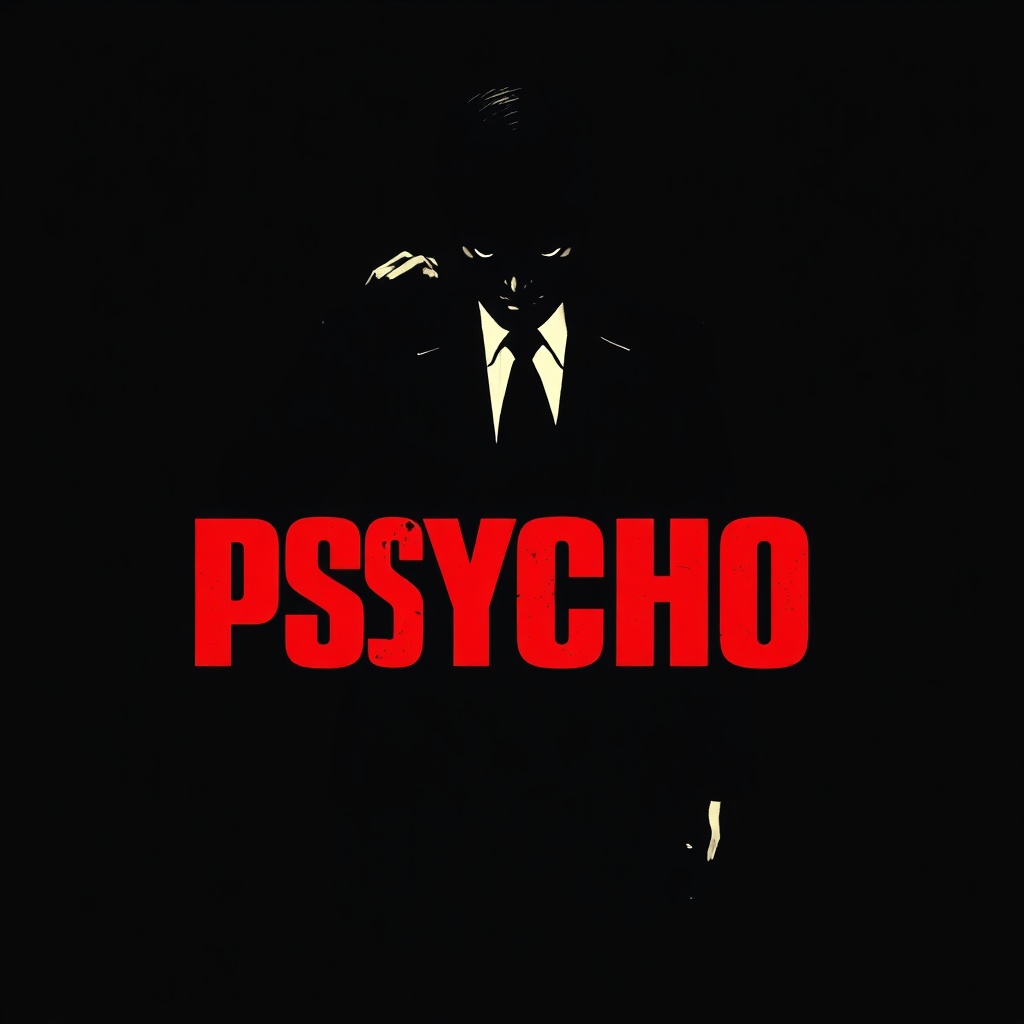
Released in 1960, Alfred Hitchcock's "Psycho" is more than just a film; it is a watershed moment in cinema history. Moving masterfully between suspense and psychological horror, the "Master of Suspense's" masterpiece redefined narrative and aesthetic conventions, shocking audiences with its unpredictability and delving into the disturbing depths of the human psyche. Its impact resonates to this day, influencing generations of filmmakers and solidifying its place as one of the most studied and revered films of all time.
Analysis and Plot
"Psycho" begins in Phoenix, Arizona, on a rainy Friday, introducing Marion Crane (Janet Leigh), a secretary who impulsively steals $40,000 from her employer to marry her debt-ridden boyfriend, Sam Loomis (John Gavin). While driving away, Marion is consumed by paranoia, imagining the police on her trail and the consequences of her actions. Detouring from the main road during a storm, she seeks refuge at the isolated Bates Motel.
There, she meets the shy and peculiar proprietor, Norman Bates (Anthony Perkins), a young man who lives in an old Gothic house next to the motel with his sick and domineering mother. A tense and revealing conversation between Marion and Norman exposes the strange family dynamics of the Bates and Norman's frustrations with his mother. Disturbed but with a clear mind, Marion decides to return and give the money back. While taking a shower to relax, she is brutally stabbed by a shadowy figure, who appears to be Norman's mother.
The shocking death of the protagonist in the first third of the film was an unprecedented subversion of expectations, completely disorienting the audience. Norman, upon discovering the body, panics and, driven by a twisted loyalty to his mother, disposes of Marion's body and her car in a nearby swamp, meticulously cleaning the crime scene. From there, the narrative follows Sam Loomis and Lila Crane (Vera Miles), Marion's sister, who, worried about her disappearance, begin an investigation. They enlist the help of private detective Milton Arbogast (Martin Balsam), who eventually arrives at the Bates Motel.
Arbogast suspects Norman and his mother but is murdered in an equally brutal fashion while investigating the house. Sam and Lila intensify the search, meeting with the local sheriff and eventually going to the Bates Motel themselves. The tension reaches its peak when Lila ventures into the Bates house, discovering Norman's terrible secret: the mummified corpse of his mother in the basement. Norman, dressed in his mother's clothes, attacks her with a knife, revealing the shocking truth about his identity and mental state.
The Ending Explained: A Fragmented Mind
The ending of "Psycho" is one of the most impactful and discussed in cinema history. The big reveal is that Norman's "Mother" is not alive, but is one of Norman's personalities. Norman, unable to accept the death of his mother Augusta Bates, murdered her out of jealousy when she found a new love. Consumed by guilt, he stole her corpse and, in a psychotic state, "revived" her in his mind, developing an alternative personality that believed it was his mother. This "Mother" personality was jealous, moralistic, and controlling, responsible for the murders of any woman who might awaken Norman's desires, including Marion Crane and detective Arbogast.
The explanation is consolidated by a psychiatrist (Simon Oakland) in the final scenes, who details Norman's disorder as an extreme identity dissociation, where the mother's personality took complete control, with Norman becoming a submissive child in his own mind. The final scene shows Norman, institutionalized, with an enigmatic smile and the voice of "Mother" in his mind, promising that he "wouldn't even harm a fly," while a fly lands on his hand, symbolizing the total dominance of the murderous personality.
Critics like Roger Ebert, however, argued that this extensive psychiatric explanation at the end of the film, while clarifying, was an anticlimax and unnecessary for an intelligent audience that had already grasped the depth of Norman's psychological horror. Despite this, the twist of Norman Bates as the true killer, a seemingly gentle man transformed into a monster, was revolutionary and disturbing, redefining the archetype of the villain in horror cinema.
Cast and Memorable Performances
The success of "Psycho" owes much to the striking performances of its cast. **Anthony Perkins** immortalized Norman Bates. His portrayal of a seemingly innocent, shy, and awkward young man, but with a dark and complex side, fooled the audience and critics, who did not expect the character's terrible secret. Perkins managed to convey the duality and fragility of Norman, making him simultaneously sympathetic and terrifying. The actor integrated so deeply into the character that, it is said, it took him a long time to break out of the role of Norman.
**Janet Leigh** delivered a powerful performance as Marion Crane, the protagonist who steals the money and whose early, brutal death shocked the world. The vulnerability and regret she expresses before her death are crucial to the film's emotional impact. Her performance earned her an Oscar nomination for Best Supporting Actress and a Golden Globe in the same category. Leigh even revealed that she could never take a shower peacefully again after filming.
**Vera Miles**, as Lila Crane, the determined sister of Marion, and **John Gavin**, as Sam Loomis, the victim's boyfriend, also played crucial roles in driving the second half of the plot, fueling the investigation and suspense. **Martin Balsam** as detective Milton Arbogast, with his investigative stance and tragic death, added another layer of shock and plot twists.
Behind the Scenes: Innovation and Controversy
The production of "Psycho" is as legendary as the film itself. After Paramount Pictures refused his usual budget for the project, considering the premise "too brutal" and "eccentric," Alfred Hitchcock decided to finance the film himself, mortgaging his house and giving up his standard salary in exchange for a percentage of the profits. With a budget of only $806,947 (equivalent to about $6.2 million today), Hitchcock used the crew from his television series "Alfred Hitchcock Presents," which was cheaper. The decision to film in black and white was partly to reduce costs, but also to soften the visual impact of the blood, which would have been very graphic in color.
The screenplay, adapted by Joseph Stefano from Robert Bloch's 1959 novel of the same name, was loosely inspired by the crimes of serial killer and grave robber Ed Gein, known for his morbid relationship with his mother. Bloch, in turn, portrayed Norman in the book as an obese man, but Hitchcock opted for Anthony Perkins to make him more handsome and less frightening, aiming for audience sympathy.
The most iconic of all sequences, the **shower scene**, is a technical and narrative masterpiece. Lasting only 45 seconds, it took seven days to film, with approximately 70 camera setups and 77 different angles. To simulate blood, chocolate syrup was used, and a nude model was used in some shots for realism. Originally, Hitchcock thought about filming it without music, but composer Bernard Herrmann convinced him otherwise, creating the high-pitched, cutting violin sounds that became synonymous with terror.
Hitchcock employed a revolutionary and highly secret marketing strategy. He anonymously bought most copies of Bloch's book to avoid spoilers. He also imposed a "no late admission" policy in theaters, ensuring that the audience would not miss Marion Crane's shocking death at the beginning of the film. This tactic, initially viewed with suspicion by exhibitors, ended up generating lines and unprecedented word-of-mouth buzz.
The film also sparked controversy for challenging the Hays Code (Hollywood Production Code) of the time. The opening scene, showing Marion and Sam in a motel room in a post-coital situation, was bold for the era. Furthermore, the explicit violence of the shower scene and the unprecedented display of a toilet flushing on screen were transgressions that helped weaken the censorship code. The Catholic Legion of Decency even rated the film a "B" ("morally objectionable").
Reception, Legacy, and Cultural Impact
The initial reception of "Psycho" was mixed. Some critics were divided due to its controversial and shocking content. However, the public embraced the experience, and the film became a resounding commercial success, grossing $50 million worldwide against a budget of just over $800,000, becoming the biggest box-office success of Hitchcock's career. Hitchcock himself earned more than $15 million from the film, which would be equivalent to more than $120 million in 2016.
Over time, "Psycho" was universally re-evaluated and acclaimed as a cinematic masterpiece. The film was nominated for four Oscars, including Best Director for Hitchcock and Best Supporting Actress for Janet Leigh. In 1992, it was selected by the United States Library of Congress for preservation in the National Film Registry for being "culturally, historically, or aesthetically significant."
The legacy of "Psycho" is immense. It is widely considered one of the first and most influential examples of the modern horror genre and the "slasher" subgenre. Horror filmmakers like George A. Romero, Tobe Hooper, John Carpenter, and Wes Craven, as well as directors like David Lynch, Steven Spielberg, and Martin Scorsese, have acknowledged the profound influence of Hitchcock's work. The shower scene, in particular, is frequently cited as one of the most important and imitated in cinema history, not only for its violence but for its editing and ability to shock.
Hitchcock, with "Psycho," demonstrated that low-budget films could be works of art and that horror could be not just bloody, but deeply psychological and human, exploring the "real monsters that live within us." The film spawned a franchise, with three sequels, a 1998 remake directed by Gus Van Sant, and the acclaimed television series "Bates Motel," solidifying Norman Bates' status as a pop culture and horror icon.
Sources Researched
- Rolling Stone Brazil: Psycho: how did Alfred Hitchcock break the barriers between horror and suspense in the 1960 classic?
- Filmography- Rear Window - Facom/UFBA: Psycho
- AdoroCinema: Psycho: Cast, actors, technical crew, production
- Wikipedia: Psycho
- Wikipedia: Psycho (1960 film)
- MobDica: Psycho: the most famous scene in cinema history influenced several filmmakers
- Wix.com: Psycho | cine
- WordPress.com: Films: Psycho (1960) – THIS WAS HOLLYWOOD
- Wikipedia: Psycho (novel)
- Sou Mais Pop: Film Analysis: Psycho (1960)
- Projeto A Sala: From Fear to Mastery: Psycho as a Connection Point in Suspense Cinema
- YouTube: DID PSYCHO REVOLUTIONIZE HORROR IN HOLLYWOOD? | HALLOWEEN SPECIAL #2
- AdoroCinema: Trivia about the film Psycho
- Britannica: Psycho (novel by Bloch) | Summary & Significance
- Omelete: Psycho | Ending of Alfred Hitchcock's classic explained
- Revista Cinética: Psycho, by Alfred Hitchcock (USA, 1960)
- WordPress.com: Psycho (1960): The Timeless Classic | History in 35mm
- Portal E7: 10 facts about the film Psycho (1960)
- YouTube: Psycho: 10 facts you didn't know
- August Cosentino: Film: “Psycho” (1960) directed by Alfred Hitchcock
- Blog do Ben Oliveira: Review: Psycho – Robert Bloch
- YouTube: Psycho (1960) - Review of Alfred Hitchcock's film
- Caixa de Sucessos: Behind the scenes of a classic: Psycho (1960)
- Plano Extra: PSYCHO …60 years and still chilling! | REVIEW
- Macabra: Behind the shower curtains: macabre trivia of Psycho
- Reddit: "Psycho" by Robert Bloch. : r/books
- Student Film Reviews: Cutting through the Censors: How the film Psycho slashed its way past the censors of 1960
- Medium: Review | Psycho: with this film, Alfred Hitchcock left a legacy of innovation
- WordPress.com: Classics | Psycho - cinelogin
- Suntup Editions: Psycho by Robert Bloch
- ScreenRant: Psycho Ending & Norman Bates Mother Twist Explained
- Medium: Psycho and its legacy. The film 'Psycho' is from 1960 and was… | by Bhárbara Andrade
- Portal Splish Splash: Hitchcock's biggest box-office success, "Psycho" turns 50
- Medium: Hollywood Codebreakers: 'Psycho' Scares the Censors | by Kristin Hunt
- olhar cinéfilo: Psycho (1960)
- YouTube: THIS FILM IS NOT WHAT I EXPECTED - "PSYCHO" (1960)
- WordPress.com: Hitchcock Project: Psycho (1960) - Cine Analysis
- Celebrity Net Worth: Alfred Hitchcock Made A Psychotic Amount Of Money Off "Psycho" Thanks To TWO Brilliant Trades
- YouTube: The ending of Psycho (1960), re-edited according to Roger Ebert
- Reddit: 63 years ago, Alfred Hitchcock's "Psycho" premiered in theaters, grossing over $32 million worldwide, Hitchcock's most successful film. The feature was also released 4 days after the end of the 1960 WGA strike. : r/boxoffice
- YouTube: Psycho CENSORED?!
- Folha de S.Paulo: Hitchcock's biggest box-office success, "Psycho" turns 50
- Portal E7: Analysis of the film Psycho (1960)
- Revista Livre de Cinema: Hitchcock's psycho and its model operational aspects





