



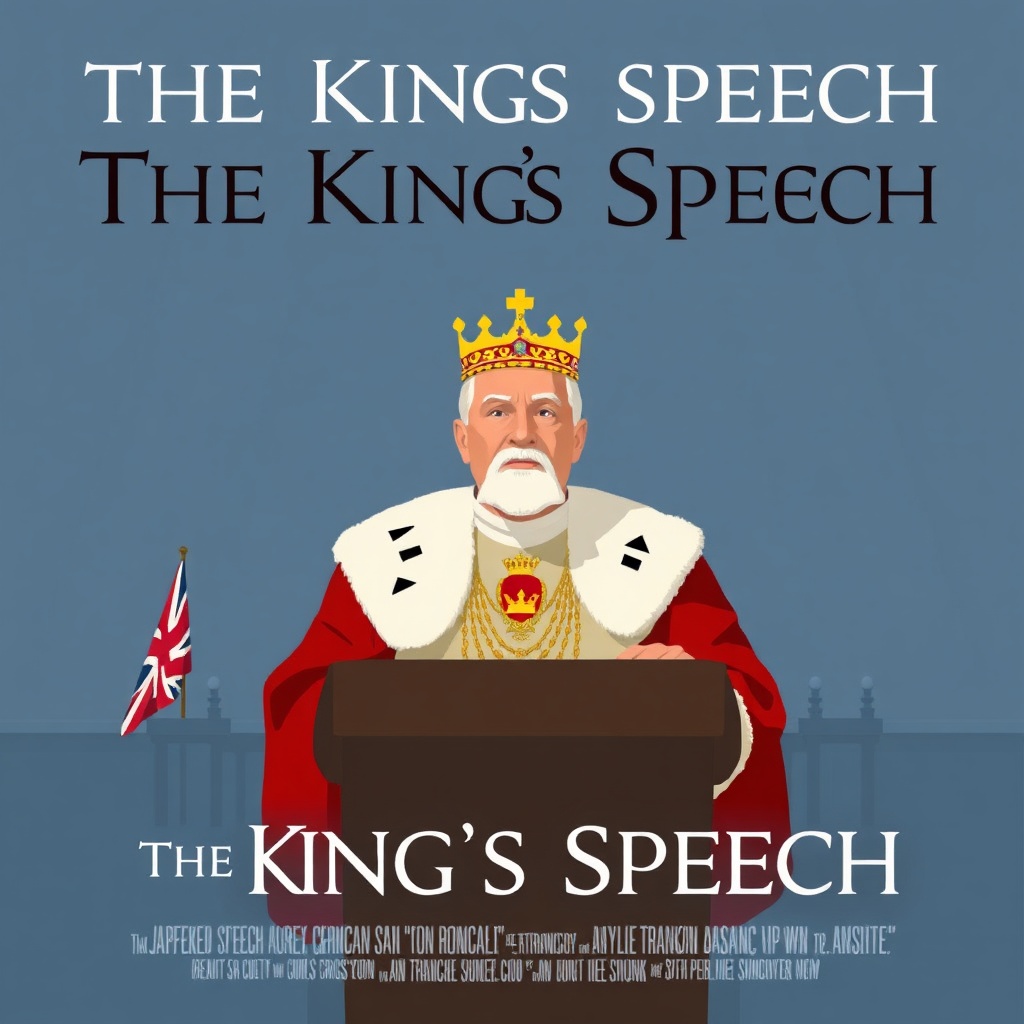
Directed by Tom Hooper and winner of four Academy Awards, including Best Picture, The King's Speech (2010) is a historical biographical drama of profound sensitivity that chronicles the painful journey of the Duke of York—the future King George VI—to overcome a severe and debilitating stutter. Through an intimate approach supported by masterful performances, the work transcends the boundaries of traditional period drama to establish itself as a universal study on vulnerability, unlikely friendship, and the monumental responsibility of leadership in times of global crisis. The film not only garnered contemporary critical acclaim but also became a massive box-office phenomenon and one of the most debated milestones in the recent history of prestige cinema.
Analysis and Plot
Set in 1930s Great Britain, The King's Speech follows Prince Albert, Duke of York (played by Colin Firth), affectionately called "Bertie" by his immediate family. Bertie has suffered from a severe stutter since childhood, a problem that exposes him to constant public humiliation in an era when radio was beginning to transform monarchs from distant symbols into voices present in the daily lives of citizens. The film's opening scene illustrates this dread brutally: Bertie attempts to speak at the closing of the 1925 British Empire Exhibition at Wembley Stadium. The awkward silence that follows, interrupted by his painful attempts to pronounce words, immediately establishes the scale of his internal suffering.
After the failure of various orthodox and bizarre treatments proposed by court physicians—which included smoking to "relax the throat" and placing marbles in his mouth—his dedicated wife, Elizabeth (Helena Bonham Carter), decides to seek out Lionel Logue (Geoffrey Rush), an Australian speech therapist without traditional academic credentials, but the owner of highly unorthodox methods. The initial meeting between Bertie and Logue establishes the film's central dynamic: Logue demands total equality within his office, insisting on calling the future king "Bertie" and forbidding royal protocol in the therapeutic space.
The narrative gains historical urgency with the death of King George V (Michael Gambon) and the subsequent ascension of Bertie's older brother, David, who takes the throne as Edward VIII (Guy Pearce). However, Edward is determined to marry Wallis Simpson, a twice-divorced American, sparking an unprecedented constitutional crisis. When Edward abdicates the throne to follow his love, Bertie is suddenly crowned as George VI. The new king finds himself facing the greatest challenge of his life: guiding the British Empire through radio broadcasts during the imminent and devastating Second World War.
The Outcome: The Hidden Meaning of the 1939 Speech
The climax of The King's Speech focuses on the radio broadcast of September 3, 1939, in which King George VI must announce to Great Britain and its overseas dominions that the country is officially at war with Adolf Hitler's Nazi Germany. This sequence is constructed by Tom Hooper with a tension comparable to an action thriller, using close-ups that capture the sweat, anxiety, and physical weight of speech.
In the acoustically isolated radio studio, Lionel Logue remains in front of the king, conducting him silently like the conductor of a human symphony. As Bertie delivers the speech to the sound of the second movement of Beethoven's Symphony No. 7, the film reaches its emotional peak. The hidden meaning of this outcome lies in the deconstruction of sovereignty itself. For the King to become the voice of resistance for an entire nation, he must first strip away his monarchical divinity and accept his vulnerable humanity. The stutter, which was previously seen as a sign of weakness and political incapacity, becomes the catalyst that connects him intimately to his people, who also felt powerless and terrified in the face of the fascist threat.
At the end of the speech, the contained celebration in the palace reveals that Bertie's triumph was not a magical cure for his pathology (he continues to stutter slightly at certain moments), but rather the conquest of his own agency and identity. The final scene, in which he waves to the crowd alongside his family on the balcony of Buckingham Palace, demonstrates that he has finally assumed, body and soul, the crown he so feared.
Memorable Performances and the Strength of the Cast
The artistic success of The King's Speech rests solidly on the shoulders of its trio of leads. Colin Firth delivers the performance of his career, for which he was awarded the Oscar for Best Actor. Firth avoids easy melodrama; he builds Bertie from the inside out, conveying the physical pain and psychological humiliation of his disorder through subtle tics, jaw spasms, and a constantly cowed look, like a frightened boy trapped in the body of a monarch.
Geoffrey Rush provides the perfect counterpoint as Lionel Logue. With a warm, astute, and theatrical presence, Rush acts as the film's emotional anchor. His performance deconstructs the image of the cold clinical therapist, transforming Logue into a genuine friend who sees the man behind the title of nobility. The "buddy movie" chemistry established between Firth and Rush elevates the film from an austere historical reconstruction to a warm drama about human connections.
Helena Bonham Carter, playing Queen Elizabeth (later known as the Queen Mother), delivers a performance filled with dignity, sweetness, and a quiet strength. She serves as the silent architect of her husband's recovery, balancing the pragmatism of the crown with unwavering marital love. The supporting cast, which includes Timothy Spall as Winston Churchill, Derek Jacobi as Archbishop Cosmo Lang, and Guy Pearce as the irresponsible Edward VIII, enriches the sociopolitical atmosphere surrounding the court.
Behind the Scenes and Production Trivia
The genesis of the film is filled with fascinating details that almost prevented its realization. Screenwriter David Seidler suffered from a severe stutter during childhood and found inspiration in the figure of King George VI during the Second World War, whose radio-broadcast speeches he listened to with admiration. Seidler began researching Lionel Logue's life in the 1970s, but, respecting a personal request from the Queen Mother (Elizabeth), who claimed that the memories of that period were still too painful, he postponed the project until her death in 2002.
- The discovery of the diaries: A few weeks before filming began, Lionel Logue's grandson found his grandfather's original diaries and medical notes on the king's treatment in his attic. This precious material was handed over to the production and incorporated into the script at the last minute, ensuring that literal phrases spoken by Bertie and Logue were kept in the film.
- Modest budget: Despite its sumptuous look and impeccable period reconstruction, the film had a budget considered low by Hollywood standards, costing approximately $15 million. To save money, many locations in London were adapted, and Tom Hooper's use of wide-angle lenses helped give a sense of claustrophobic grandeur to the real sets.
- The rating: Originally, the film received an "R" rating in the United States due to the famous therapy scene in which Lionel encourages Bertie to shout profanities to release his vocal tension. The producers appealed the decision, arguing that the profanities had no sexual or violent connotation, which sparked a wide discussion about the MPAA's censorship criteria.
Historical Controversies and the Battle of the Oscars
Although acclaimed, The King's Speech did not escape rigorous criticism from historians and political journalists. The main controversy revolves around the portrayal of Winston Churchill and the crown's stance regarding the policy of appeasement with Nazi Germany promoted by Prime Minister Neville Chamberlain. In historical reality, King George VI was an enthusiastic supporter of Chamberlain's appeasement and viewed Churchill's ideas of immediate confrontation against Hitler with suspicion. In the film, however, Churchill is portrayed anachronistically as a close ally and constant encourager of Bertie from the beginning, a clear narrative choice to align historical characters on the "right" side of history in the eyes of the modern public.
Another point of divergence is the timeline of the treatment. The film suggests that Lionel Logue began treating the king shortly before his coronation in 1937, and that progress was quick and miraculous. In fact, Bertie began his consultations with Logue in 1926, more than a decade before becoming king, and the improvement process was slow, continuous, and filled with daily ups and downs.
In the cultural field, the film was marked by its historic—and controversial—victory at the 2011 Oscar ceremony. Driven by an aggressive and relentless guerrilla marketing campaign led by the infamous producer Harvey Weinstein (then head of The Weinstein Company), the film surpassed the critic's favorite and the favorite of the youth audience at the time: The Social Network (directed by David Fincher). Influential film critics pointed out that the victory of The King's Speech represented the conservatism of the Academy of Motion Picture Arts and Sciences, which opted for a "safe," inspiring historical narrative to the detriment of a technically revolutionary work tuned into the contemporary digital era represented by the film about Facebook.
Critical Reception, Box Office, and Legacy
Despite behind-the-scenes controversies and historical liberties, the commercial and critical impact of The King's Speech is undeniable. The film grossed an impressive $427 million worldwide, an extraordinary feat for a low-budget period drama centered on speech therapy sessions. On the review aggregator Rotten Tomatoes, the production holds a 94% approval rating, based on more than 300 professional reviews.
Specialized critics massively praised the humanization of historical figures who are frequently portrayed in a caricatured or overly formal way. The film managed to demystify royalty without ridiculing it, focusing on the deeply human aspect of their frailties. More than a victorious period drama, The King's Speech remains in the popular imagination as an emotional tribute to the power of empathy, proving that, sometimes, a man's most heroic and difficult battle is simply managing to express his own voice.
Researched Sources
- British Film Institute (BFI): bfi.org.uk
- The Academy of Motion Picture Arts and Sciences (Oscars): oscars.org
- Box Office Mojo: boxofficemojo.com
- Rotten Tomatoes: rottentomatoes.com
- The Guardian - Film Review Section: theguardian.com/film
- The Hollywood Reporter - Behind the Scenes of The King's Speech: hollywoodreporter.com





