



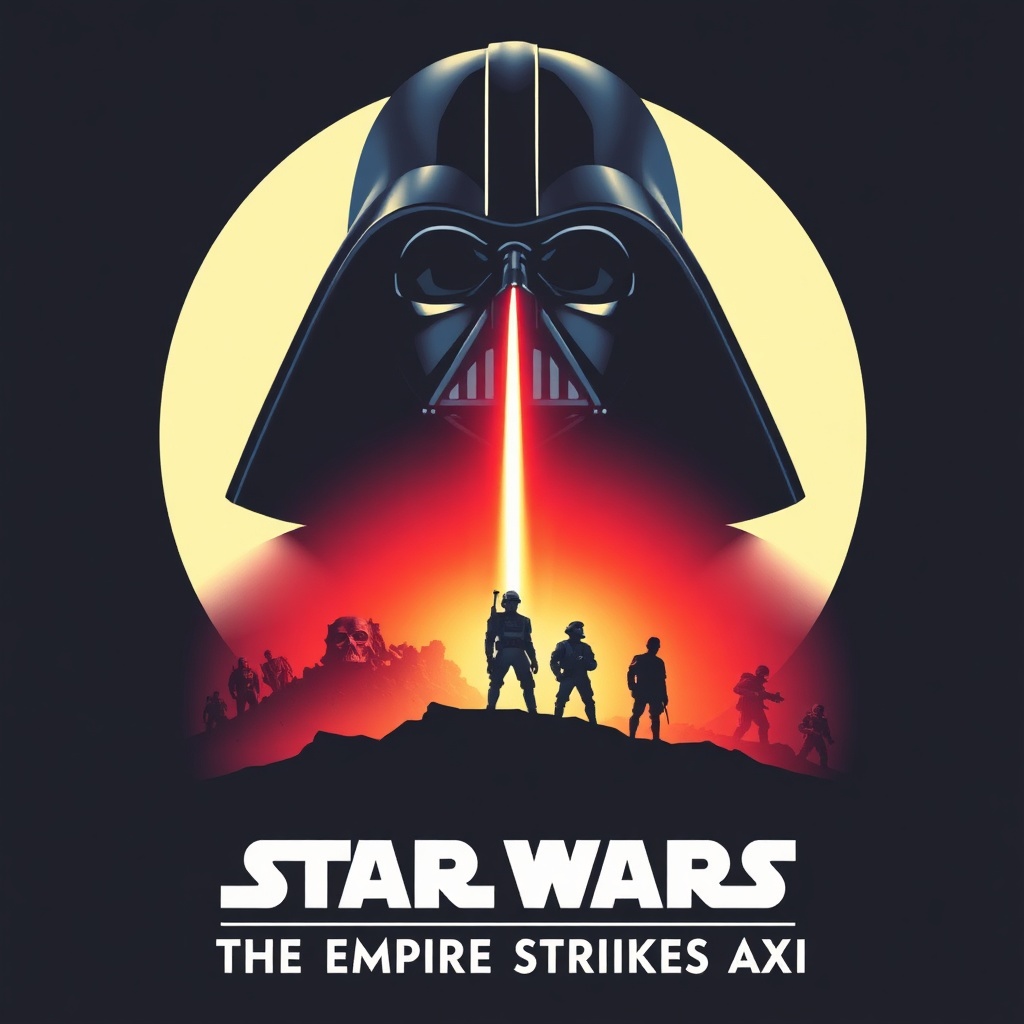
Released in 1980 under the direction of Irvin Kershner and written by Leigh Brackett and Lawrence Kasdan, Star Wars: Episode V - The Empire Strikes Back transcended the mere status of a cinematic sequel to establish itself as the undisputed masterpiece of space opera and one of the most influential pillars of global pop culture. By subverting the triumphant formula of its 1977 predecessor, the feature film delved into a dark, complex, and psychologically dense atmosphere, challenging the conventions of entertainment cinema and forever redefining the narrative structure of modern Hollywood franchises.
Analysis and Plot: The Darkness That Redefined a Galaxy
To understand the impact of The Empire Strikes Back, one must first understand the context of its conception. In 1977, the first Star Wars (later retitled A New Hope) delivered to the public a classic hero's journey, solar and with a cathartic resolution: good had triumphed over evil, the Death Star had been destroyed, and the heroes were decorated. Three years later, the sequel directed by Irvin Kershner — George Lucas's former film professor at USC — chose to systematically deconstruct that victory.
The film abandons the golden optimism of Tatooine and opens in a hostile atmosphere: the frozen wasteland of Hoth. The Rebel Alliance, far from celebrating its previous victory, finds itself cornered, living in hiding. The Galactic Empire, personified by Darth Vader's obsessive search for Luke Skywalker, locates the rebel base through space probes. The subsequent attack on Echo Base is one of the most realistic and desperate military battle sequences in science fiction cinema, where the Rebels do not fight to win, but to survive and retreat.
The Full Plot: From the Snows of Hoth to the Clouds of Bespin
After narrowly escaping the imperial attack on Hoth — and a near-fatal encounter with a Wampa predator — Luke Skywalker follows a vision of his late mentor, Obi-Wan Kenobi. He is instructed to travel to the swampy planet Dagobah to train with Yoda, the former Grand Master of the Jedi Order. In parallel, the narrative splits into a brilliant cross-cutting rhythm: Han Solo, Princess Leia, Chewbacca, and the droid C-3PO escape aboard a damaged Millennium Falcon, initiating a high-tension game of cat and mouse with imperial forces through a dangerous asteroid field.
While Han's group seeks refuge in Cloud City on Bespin — a mining colony governed by the charismatic Lando Calrissian, an old friend and professional gambler — Luke faces rigorous physical, mental, and spiritual training on Dagobah. There, the young Skywalker confronts not only the limitations of his own body but the abysses of his mind in the mysterious Cave of the Dark Side, where he defeats a projection of Darth Vader only to see his own face behind the Sith Lord's mask.
The dramatic climax converges when Darth Vader, aided by the infamous bounty hunter Boba Fett, anticipates the rebels' arrival on Bespin. Lando is coerced into betraying his guests under the threat of permanent imperial occupation. Captured, Han Solo is subjected to a carbonite freezing process to test the machinery Vader intends to use on Luke. Before being frozen and handed over to Fett to be taken to the gangster Jabba the Hutt, the iconic and improvised romantic farewell moment between Leia and Han occurs. Sensing his friends' pain through the Force, Luke abandons his incomplete training with Yoda, falling directly into the trap orchestrated by Vader.
The final clash between Luke and Vader in Cloud City is a sword duel that functions as an expressionist ballet, where blue and red neon lights cut through the industrial shadows of the setting. Luke is disarmed — literally and figuratively — by having his right hand severed and being confronted with the revelation that would change film history.
The Anatomy of a Legendary Conclusion: The Hidden Meaning of the Ending
The third act of The Empire Strikes Back is widely considered one of the bravest endings in the history of commercial cinema. Instead of a triumphant victory or a superficial cliffhanger, the film delivers an almost absolute defeat for the protagonists. Han Solo is captured and his whereabouts unknown; the Rebel Alliance is scattered; Luke Skywalker is physically mutilated and psychologically shattered.
Darth Vader's revelation — "No, I am your father" (often misquoted in pop culture as "Luke, I am your father") — operates on multiple symbolic and narrative levels:
- The Fall of the Paternal Myth: Luke spent his entire youth romanticizing the figure of his father, a supposed Jedi war hero murdered by the Empire. Upon discovering that the galaxy's greatest monster is, in fact, his progenitor, the hero is forced into a traumatic and instantaneous maturation. The moral black and white of the first film collapses into a complex gray.
- The Duality of the Shadow: The loss of Luke's right hand and its subsequent replacement with a mechanical prosthesis visually mirror Darth Vader's own cyborgization. The film warns that the path to the Dark Side is not paved by pure evil, but by the fear of losing those one loves and by impatience — flaws Luke demonstrated by abandoning Dagobah.
- The Subversion of Destiny: By choosing to throw himself into the abyss of Cloud City rather than join his father in ruling the galaxy, Luke chooses symbolic death over moral corruption. It is an act of absolute free will that breaks the manipulation of Vader and the Emperor.
The final shot of the film, where Luke, Leia, Lando, and the droids observe the vastness of a spiral galaxy from a medical frigate, evokes a profound melancholy, but also a spark of hope based on resilience and brotherly love. There is no applause, only the silent promise of a reunion and a necessary reconstruction.
The Cast and the Power of Performances
If the 1977 film relied heavily on visual spectacle and the freshness of its premise, The Empire Strikes Back demanded much more dramatically from its cast, who responded with mature and emotionally charged performances.
Mark Hamill (Luke Skywalker): The actor delivers a physically and emotionally exhausting performance. Hamill masterfully conveys the transition from an idealistic and impatient farm boy to a warrior tormented by the weight of a terrible destiny. His scenes on Dagobah, acting almost entirely with a latex puppet, required a level of belief and scenic commitment that few young actors could sustain.
Harrison Ford (Han Solo) and Carrie Fisher (Princess Leia): The chemistry between the two reaches its peak in this film. Far from the purely platonic tone of the previous feature, here they star in a classic screwball romantic comedy dynamic under military pressure. Ford brings an unprecedented vulnerability behind the cynical mercenary mask, while Fisher humanizes Leia, showing that beneath the inflexible political leader beats a heart deeply affected by the imminence of loss.
Frank Oz (Yoda): It is impossible to discuss the cast without highlighting the revolutionary work of Frank Oz. Controlling the Yoda puppet and giving him his voice, Oz managed to create one of the most vivid, expressive, and philosophically rich characters in cinema history. Yoda does not look like a special effect; he is, for all dramatic purposes, a top-tier supporting actor who steals every scene he appears in.
Billy Dee Williams (Lando Calrissian): Williams brought a necessary dose of ambiguous charm to the franchise. Lando is not an altruistic hero, but a pragmatic politician trying to protect his people from a fascist empire. His betrayal and subsequent redemption are played with nuances of guilt and desperation that enrich the saga's moral universe.
Behind the Scenes, Secrets, and Production Tensions
The production of The Empire Strikes Back was an exercise in extreme resilience and financial risk. George Lucas made the bold decision to finance the film entirely independently, using the profits from the first film and colossal bank loans. This meant that if the film failed at the box office, Lucas would be personally and professionally ruined.
The Ideal Director and the Clash of Styles
Recognizing that he could not manage the growth of his business empire (the newly created Lucasfilm and Industrial Light & Magic) and direct the film at the same time, Lucas hired Irvin Kershner. While Lucas focused on technique, editing, and effects, Kershner was a director focused on characters and actor psychology. This collaboration, although occasionally tense due to delays and budget overruns in Norway (where the Hoth scenes suffered from real blizzards and temperatures of -20°C) and at Elstree Studios in England, proved to be the perfect formula to elevate the film's artistic level.
The Script and Leigh Brackett's Tragedy
The first draft of the script was written by legendary science fiction writer Leigh Brackett. However, she passed away from cancer shortly after delivering the manuscript in 1978. Lucas felt the story's direction needed to change and wrote the next draft himself before hiring Lawrence Kasdan — who had just written the brilliant script for Raiders of the Lost Ark. Kasdan refined the dialogue, sharpened the relationship between Han and Leia, and brought an impressive narrative fluidity to the script.
Hollywood's Best-Kept Secret
To avoid leaks of the biggest plot twist in history, the secret of Luke's parentage was kept under lock and key. In the script distributed to the cast, Vader's line to Luke was: "Obi-Wan killed your father." Only George Lucas, Irvin Kershner, Mark Hamill, and screenwriter Lawrence Kasdan knew the truth. During filming, Vader's physical actor, David Prowse, recited the false line. The iconic voice of James Earl Jones revealing the real parentage was only recorded months later, in post-production, under absolute secrecy.
| Production Challenge | Creative Solution / Consequence |
|---|---|
| Historic snowstorms in Norway (Hoth) | Filming scenes directly at the crew's hotel door and integrating the real weather into the narrative. |
| Technological limitations for moving Yoda | Construction of elevated sets in England to allow puppeteers to work from beneath the floor. |
| Budget overrun from $18M to over $30M | Lucas had to renegotiate bank loans and nearly lost creative control to the distributor, Fox. |
The Controversies and Critical Reception of 1980 vs. The Current Legacy
Although today it is widely considered one of the greatest films of all time, the initial reception of The Empire Strikes Back in May 1980 was surprisingly mixed and polarized among specialized critics.
Many critics at the time expressed discomfort with the radical shift in tone. Vincent Canby, of the prestigious The New York Times, wrote at the time that the film was "beautiful but soulless" and criticized the lack of a structure with a defined beginning, middle, and end, classifying the narrative as an "interstitial episode without a climax." Other outlets accused the film of being overly commercial, focused on preparing the ground for merchandising products and the next chapter of the trilogy.
Beyond the divided critical reception, the film generated behind-the-scenes controversies with Hollywood unions. George Lucas decided to place the filmmakers' credits (including the name of director Irvin Kershner and the screenwriters) only at the end of the film, keeping the beginning clean with only the saga's logo, exactly as he had done in the first film. The Directors Guild of America (DGA) and the Writers Guild of America (WGA) tried to ban the film's exhibition and fined Lucas heavily. In retaliation, Lucas resigned from both unions, which limited his future hiring in Hollywood but ensured his definitive artistic independence.
Over the decades, the public and critical perception of The Empire Strikes Back has undergone an unprecedented historical revision. The film proved that sequels did not just need to repeat the original's successful formula, but could expand the thematic boundaries of their universe. On the review aggregator Rotten Tomatoes, the film boasts near-unanimous approval from critics and audiences, being constantly cited as the gold standard for how to make a dark and mature cinematic sequel.
Its cumulative box office, adjusted for inflation, exceeds the impressive mark of 1.6 billion dollars worldwide, consolidating it not only as an absolute artistic milestone but also as one of the greatest commercial successes in the history of global entertainment.
Researched Sources
- StarWars.com (Official Lucasfilm production history)
- The New York Times (1980 film review archives)
- Empire Magazine (Special editions on the making of the classic trilogy)
- Box Office Mojo (Historical and consolidated box office data)
- American Film Institute (AFI - Cultural impact registry and analysis)





