



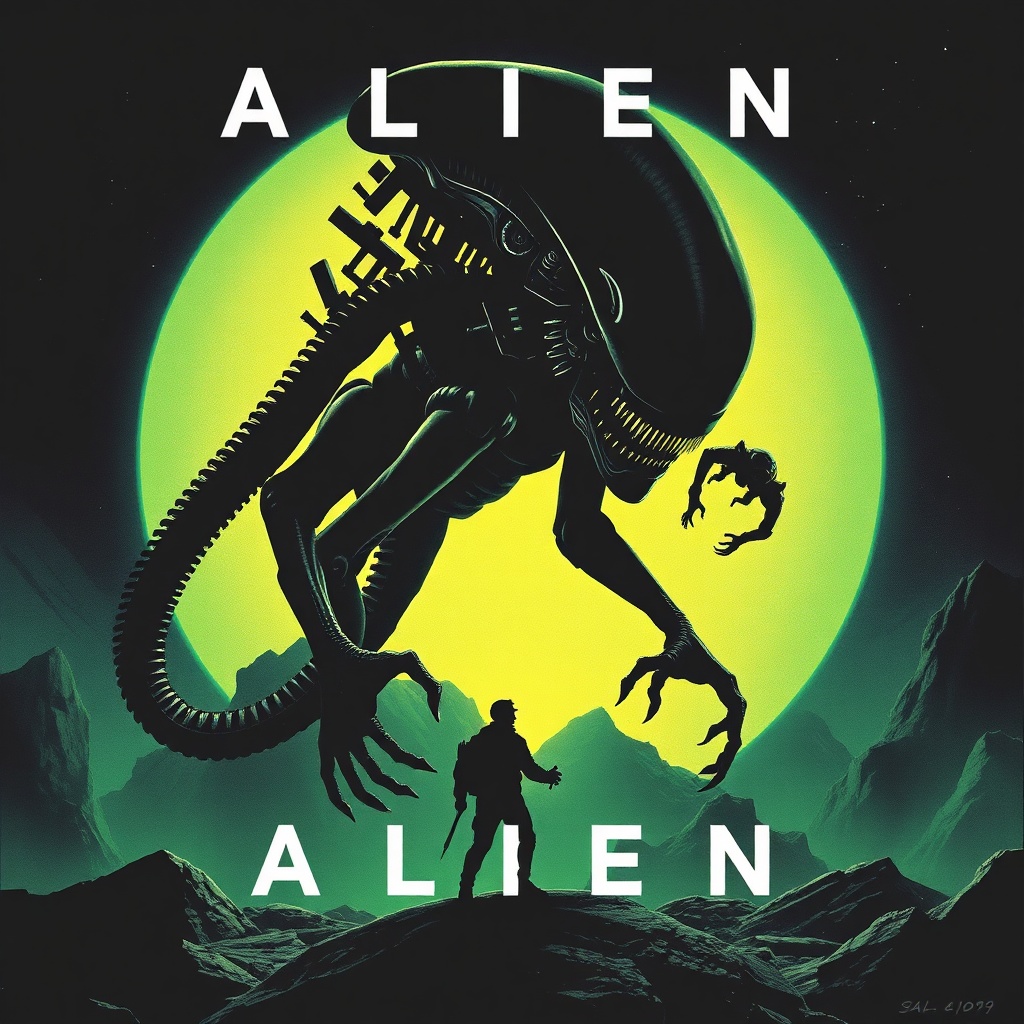
Released in 1979 under the direction of Ridley Scott, Alien transcended the boundaries of entertainment cinema to establish itself as an absolute masterpiece of horror and science fiction. By merging the claustrophobia of gothic horror with the cold pragmatism of outer space, the feature film not only introduced the world to one of the most terrifying and plastically perfect creatures in art history — the Xenomorph, conceived by the surrealist mind of H.R. Giger — but also set new paradigms for production design, subverted genre tropes through the iconic heroine Ellen Ripley, and inaugurated one of the most influential and profitable franchises in global pop culture.
Analysis and Plot
The Nostromo's Industrial Nightmare: A Complete Summary
The narrative of Alien deliberately departs from the utopian optimism of Star Trek and the epic fantasy of Star Wars (released just two years earlier). Here, space is dirty, commodified, and profoundly indifferent to human existence. The story follows the crew of the USCSS Nostromo, a massive commercial mining vessel transporting tons of ore back to Earth. The seven crew members — Captain Dallas (Tom Skerritt), Lieutenant Ripley (Sigourney Weaver), navigator Lambert (Veronica Cartwright), science officer Ash (Ian Holm), chief engineer Parker (Yaphet Kotto), technician Brett (Harry Dean Stanton), and officer Kane (John Hurt) — are ordinary space laborers, more concerned with their salary bonuses than the wonders of the cosmos.
The conflict begins when the ship's artificial intelligence, affectionately called "Mother," awakens the crew from hypersleep ahead of schedule. The Nostromo has detected an unknown transmission signal of apparently intelligent origin coming from an inhospitable planetoid designated LV-426. Bound by strict contractual clauses from the Weyland-Yutani Corporation (known simply as "The Company") to investigate any sign of life under penalty of losing their wages, Dallas, Kane, and Lambert descend to the surface in a shuttle, while Ripley, Ash, Parker, and Brett monitor the operation from the Nostromo.
On the desolate surface of LV-426, battered by dust storms, the exploration trio discovers a monumental crashed alien ship with a biomechanical architecture that seems to fuse bone and metal. Inside, they find the fossilized corpse of a massive extraterrestrial being with its ribcage exploded from the inside out (popularly known as the "Space Jockey"). Upon descending into the hold of the abandoned ship, Kane encounters a vast field of objects resembling organic eggs. As he approaches one, the egg opens and an agile, arachnid-like creature — the Facehugger — violently leaps at his helmet, breaking the visor and attaching itself to his face.
Upon returning to the Nostromo, Ripley, acting as interim security officer, refuses to allow the group entry, citing the 24-hour quarantine protocol to prevent contamination of the ship. However, Ash openly disobeys Ripley's orders and opens the airlocks, allowing the infected group inside — a decision that seals the fate of almost everyone on board. In the infirmary, the crew discovers that the invading organism keeps Kane alive through a tube inserted into his throat, feeding him oxygen and acidic blood capable of corroding the ship's metal hull should they attempt to cut it.
Inexplicably, the creature dies and detaches from Kane's face, who awakens appearing perfectly healthy. During the celebratory meal before returning to hypersleep, the most iconic scene in modern horror cinema occurs: Kane begins to suffer violent convulsions on the table. As his companions try to restrain him, his chest ruptures bloodily, giving birth to a serpentine, toothy creature — the Chestburster — which quickly escapes through the Nostromo's ventilation ducts.
From this point on, the film turns into a claustrophobic game of cat and mouse. The creature grows at an astonishing speed, shedding its skin and assuming an immense, predatory humanoid form perfectly adapted for hunting in the shadows. One by one, the crew members begin to fall. Brett is the first, ambushed while searching for the ship's cat, Jonesy. Dallas attempts to hunt the monster in the ventilation ducts using a rudimentary motion tracker, only to be cornered and captured in the darkness.
With Dallas's death, Ripley assumes command and discovers, upon accessing the "Mother" computer, the existence of Special Order 937. Weyland-Yutani had prior knowledge of the creature and deliberately ordered Ash to ensure the capture of the biological specimen for the company's weapons division, explicitly stating: "Crew expendable. Return priority: collect the organism." When confronting Ash about the betrayal, the science officer physically attacks Ripley in a violent manner, attempting to suffocate her with a rolled-up magazine (a clear visual allusion to forced penetration). Parker and Lambert intervene in time and decapitate Ash, revealing that he is, in fact, a synthetic android infiltrated by the corporation to ensure the mission's success.
Before being permanently deactivated, Ash's severed head expresses an almost religious admiration for the creature, describing it as a "perfect organism" whose "structural perfection is matched only by its hostility," free from any moral illusion or conscience. With no chance of defeating the monster directly, the three remaining survivors — Ripley, Parker, and Lambert — decide to activate the Nostromo's self-destruct sequence and evacuate in the escape shuttle, the Narcissus. However, while collecting supplies and coolant for hypersleep, the Xenomorph corners Lambert and Parker, killing them brutally.
Ripley, now alone with the cat Jonesy, manages to activate the ship's destruction countdown and races against time to reach the Narcissus, escaping seconds before the Nostromo explodes in a colossal fireball in the vacuum of space.
Deep Analysis of the Ending and Hidden Meanings
The climax of Alien does not end with the explosion of the Nostromo. Already aboard the small escape module Narcissus, Ripley prepares for hypersleep, undressing down to her underwear — a moment of apparent relief and extreme physical vulnerability. It is then that she discovers, horrified, that the Xenomorph has managed to infiltrate the escape shuttle and is camouflaged among the wiring and ceiling pipes, resting after the hunt.
The genius of this final showdown lies in the inversion of the "damsel in distress" trope. Ridley Scott uses camera framing to highlight Ripley's physical fragility in contrast to the monster's biomechanical and phallic imposing nature. Instead of panicking or screaming helplessly, Ripley demonstrates extraordinary coolness: she calmly puts on a spacesuit, straps herself into the pilot's seat, opens the Narcissus airlock to depressurize the cabin, and blasts the monster into the vacuum. When the creature tries to hold onto the edge, Ripley uses a propulsion harpoon to push it away definitively and engages the ship's engines, incinerating the Xenomorph in space.
The ending hides deep layers of psychosexual symbolism and social critique:
- Invasion and Bodily Violation: The entire aesthetic of Alien is grounded in the horror of male sexual violation. Screenwriter Dan O'Bannon openly stated that his intention was to metaphorically "rape the male audience," placing male characters in the position of victims of forced penetration (the Facehugger inserting the tube into Kane's throat) and an unwanted, fatal pregnancy (the birth of the Chestburster). The Xenomorph, with its phallic head, pointed tail, and corrosive saliva, represents the personification of sexual trauma and physical aggression.
- Critique of Late Capitalism: The true threat in Alien is not just the wild creature, but the invisible corporation that governs the characters' lives. Weyland-Yutani views its employees as expendable cogs in the pursuit of profit and military superiority. The android Ash is the logical extension of this cold corporate capitalism: devoid of empathy, he idolizes the alien's violent efficiency because the company operates under the same survival-of-the-fittest logic, at any cost.
- Deconstruction of Patriarchy: In 1979, placing a woman as the sole survivor capable of defeating the universe's greatest predator was a revolutionary decision. Ripley survives not through brute force, but through her strict adherence to rules, her analytical intelligence, and her refusal to submit to both the absurd orders of the men on the crew (who wanted to break quarantine) and the machinations of the "Mother" AI and Ash.
Cast and Notable Performances
The cast of Alien is widely praised for its naturalistic approach. Instead of glamorous action heroes, the actors play ordinary, tired people with whom the audience can immediately identify. This "blue-collar" chemistry gives the film an almost documentary-like realism before the horror begins.
- Sigourney Weaver (Ellen Ripley): Originally written to be a male character (or gender-neutral in Dan O'Bannon and Ronald Shusett's original script), the role of Ripley turned Weaver into an instant movie star. Her performance is marked by a brilliant transition: from a pragmatic, uniformed bureaucrat to a cunning and fierce survivor. Weaver avoids the histrionics typical of the "scream queens" of horror at the time, delivering an imposing, vulnerable, and resolute physical presence.
- Ian Holm (Ash): The late British actor delivers one of the most disturbing performances of his career. Holm plays Ash with an unsettling quietness, meticulous mannerisms, and an emotional detachment that gains a completely new and terrifying meaning after the revelation of his synthetic nature. His silent obsession with the creature is the engine that accelerates the Nostromo's tragedy.
- John Hurt (Kane): Despite his short screen time, Hurt left an indelible mark on global pop culture. His naive curiosity and subsequent physical agony during the Alien birth sequence are executed with a visceral realism that shocked audiences in 1979 and remains uncomfortable to watch to this day.
- Yaphet Kotto (Parker) and Harry Dean Stanton (Brett): The pair of engineers serves as the film's comic relief and anchor of reality. Their constant complaints about wages and precarious working conditions perfectly establish the social critique of labor exploitation, making their subsequent deaths even more tragic for the viewer.
Behind the Scenes, Trivia, and Controversies
H.R. Giger's Biomechanical Revolution
The hiring of Swiss artist H.R. Giger was the decisive factor in making Alien visually unique. Giger, known for his surreal and disturbing art that blended human forms with machines (a style he dubbed "biomechanical"), designed all stages of the Alien's life, the interior of the abandoned ship, and the "Space Jockey."
The production faced strong resistance from Twentieth Century Fox, which considered Giger's designs excessively grotesque, bizarre, and highly sexual. It was Ridley Scott who fought tirelessly with the studio to maintain the artist's vision. To create the life-sized model of the Xenomorph's head, Giger used real animal bones, plaster, and even a real human skull on the front of the mask, covered by a translucent plastic dome to give it a smooth, mysterious appearance.
The Secret Behind the Chestburster Scene
One of the most famous behind-the-scenes legends in cinema involves the filming of the scene where the baby Alien bursts from John Hurt's chest. To obtain genuine reactions of shock and revulsion from the cast, Ridley Scott and the special effects team kept the technical details of the scene a strict secret. The actors knew something would emerge from Hurt's artificial chest, but they had no idea of the amount of stage blood that would be used.
When the creature broke through the shirt and sprayed artificial pig blood directly into Veronica Cartwright's (Lambert) face, the actress went into real panic and even fainted. The look of surprise and horror from Yaphet Kotto and the other actors seen on screen is completely spontaneous and unscripted, becoming a hallmark of realism in horror cinema.
Bolaji Badejo: The Man Inside the Monster Suit
To bring the imposing Xenomorph to life without it looking like just "a man in a suit" (as was common in 50s and 60s monster movies), the casting director discovered Bolaji Badejo in a London pub. Badejo was a 7-foot-2-inch Nigerian design student with extremely long, thin arms and legs. Scott immediately realized that Badejo's silhouette looked non-human. He was hired and underwent mime and body language training to learn how to move in a slow, fluid, and reptilian manner, creating the Alien's elegant and lethal physical presence.
The Plagiarism Controversy
After the film's resounding success, heated debates arose regarding the origins of Dan O'Bannon's script. Critics and historians pointed out notable similarities between Alien and earlier B-movie science fiction productions, such as It! The Terror from Beyond Space (1958) — which also features an alien creature infiltrating a spaceship and hunting the crew through the ducts — and Planet of the Vampires (1965), directed by Mario Bava, from which Scott allegedly borrowed the idea of discovering a giant ship with giant alien skeletons. O'Bannon never denied the influences, stating pragmatically: "I didn't steal Alien from anyone. I stole it from everyone!"
Critical Reception, Box Office, and Legacy
Initial Critical Division and Historical Redemption
Although it is now universally considered a masterpiece, the initial reception of Alien in 1979 was polarized. Influential critics of the time, such as Pauline Kael of The New Yorker, harshly criticized the film, labeling it "a glorified B-movie with an A-class budget," focused only on cheap scares and lacking intellectual depth. Richard Schickel of Time magazine lamented what he called the script's "lack of literary imagination."
On the other hand, heavy-hitting critics like Roger Ebert defended the film warmly from the start, praising its oppressive atmosphere, impeccable pacing, and innovative art direction. Ebert wrote that the film was "an incredibly efficient suspense machine," highlighting how Ridley Scott used silence and shadows to create overwhelming psychological terror before revealing the monster in full.
Over the decades, critical perception has shifted radically. Today, the film holds a near-unanimous 98% approval rating on the review aggregator Rotten Tomatoes and is frequently listed by the American Film Institute (AFI) as one of the greatest thrillers and science fiction works of all time.
Resounding Commercial Success
Produced with an estimated budget of approximately 11 million dollars (a modest amount by the standards of major science fiction productions of the time), Alien was a resounding box office success. The film grossed over 80 million dollars in the United States and surpassed the 104 million dollar mark worldwide in its original release. Adjusted for current inflation, this figure represents an astronomical financial return for Twentieth Century Fox, cementing the brand in popular culture.
The Lasting Legacy in Pop Culture
The impact of Alien on pop culture is immeasurable. The feature film not only spawned three major direct sequels — most notably James Cameron's spectacular action follow-up, Aliens (1986) — but also expanded into prequels directed by Ridley Scott himself (Prometheus and Alien: Covenant), crossovers with the Predator franchise (Alien vs. Predator), as well as countless comics, expanded universe books, and critically acclaimed video games, such as the terrifying survival game Alien: Isolation (2014).
More than just a profitable franchise, Alien changed how cinema approaches space horror. Elements introduced by the film, such as the dirty, industrial aesthetic of spaceships (the so-called "used future"), the use of evil corporations as the true antagonists of the story, and the deconstruction of traditional action heroes in favor of strong, independent women, became fundamental tropes of contemporary works like Dead Space, The Matrix, Metroid, and Interstellar. Forty-five years after its release, the silent scream of terror in space echoes louder than ever in the history of the seventh art.
Research Sources
- IMDb - Alien (1979) Production Information: www.imdb.com/title/tt0078748/
- Rotten Tomatoes - Alien Critical Consensus: www.rottentomatoes.com/m/alien
- Box Office Mojo - Alien Box Office Gross: www.boxofficemojo.com/title/tt0078748/
- The Official H.R. Giger Estate & Museum Archives: www.hrgiger.com
- Roger Ebert's Great Movies - Alien Review: www.rogerebert.com/reviews/great-movie-alien-1979





