



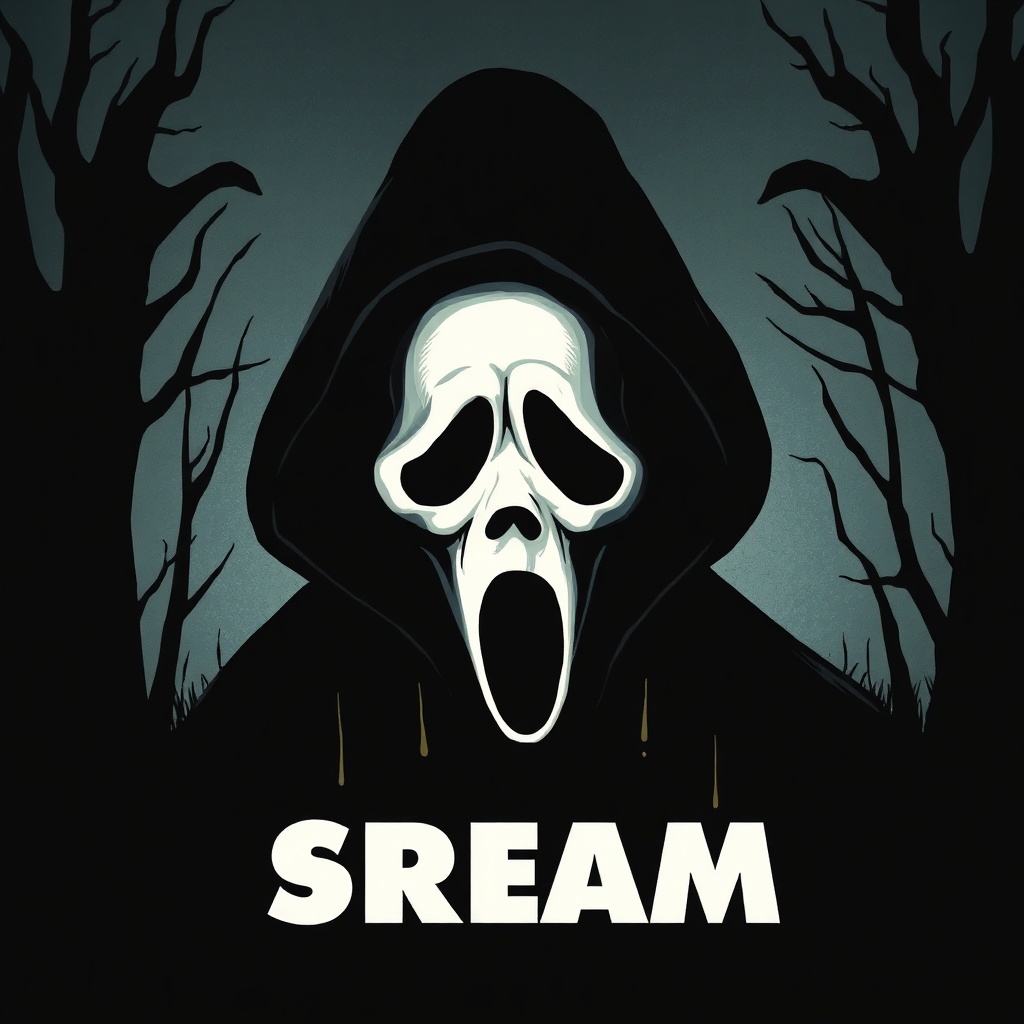
Released in 1996, "Scream" is an indelible milestone in the slasher genre, directed by horror master Wes Craven and written by Kevin Williamson. Combining genuine suspense, meta-humorous wit, and refreshing self-awareness, the film not only revitalized a genre on the brink of exhaustion but also established itself as a pop culture phenomenon, dictating new rules and influencing countless productions that followed.
Analysis and Plot
"Scream" begins with an impactful sequence, immediately shattering audience expectations. The opening scene shows Casey Becker (Drew Barrymore), a popular young woman, receiving a threatening phone call from a stranger who tests her with questions about horror movies. The game quickly turns deadly, culminating in the brutal murder of Casey and her boyfriend, Steve Orth. The shock is amplified by the casting of Barrymore, a major Hollywood star at the time, in a role many expected to be the lead, but which lasts only the first 15 minutes of the film, establishing that "Scream" would not follow conventional rules.
The central plot revolves around Sidney Prescott (Neve Campbell), a high school student in the small, fictional town of Woodsboro, California. Sidney is still dealing with the trauma of her mother's murder, Maureen Prescott, which occurred a year earlier. With the new murders, Sidney and her friends find themselves targeted by a mysterious masked killer known as Ghostface. This killer not only stalks his victims but also terrorizes them with phone calls, asking questions about horror movies and mocking the clichés of the genre.
The characters, especially film buff Randy Meeks (Jamie Kennedy), are aware of the "rules" of slasher horror films, which adds a meta-layer to the narrative. They openly discuss the clichés, formulas, and archetypes, while ironically finding themselves living in a real-life horror movie. Sensationalist journalist Gale Weathers (Courteney Cox) arrives in town to cover the crimes, linking them to the previous murder of Sidney's mother, and Deputy Sheriff Dewey Riley (David Arquette) attempts to protect the teenagers.
The Ending Explained and Hidden Meanings
The third act of "Scream" culminates in a party at the home of Stu Macher (Matthew Lillard), where most of the main characters gather. It is here that the identity of the killers is finally revealed: there is not just one Ghostface, but two – Billy Loomis (Skeet Ulrich), Sidney's boyfriend, and Stu Macher, Billy's best friend.
The reveal is one of the film's biggest shocks. Billy confesses that his motive for the murders is revenge: Sidney's mother, Maureen, had an affair with his father, which led to his parents' divorce. Billy, fueled by rage, decided not only to kill Maureen but also to destroy Sidney's life emotionally, turning it into a personal "horror movie." Stu, for his part, claims to participate for the pure adrenaline, fun, and the thrill of being "inside a movie," a dark reflection of the meta-language that permeates the work. Together, they had murdered Maureen a year earlier and framed Cotton Weary (Liev Schreiber).
The duo attempts to stage a final attack, wounding each other to appear as victims and frame Sidney's father, who had been kidnapped. However, Sidney, Randy, Dewey, and Gale fight to survive. In an iconic moment, Sidney turns the tables on Billy and Stu, using her knowledge of horror "rules" to her advantage. Billy is apparently killed by Sidney, and Stu, after being stabbed by Billy to forge an attack, is electrocuted in the head by Sidney with a television. There are theories and debates among fans about the possibility of Stu having survived, given the cartoonish nature of his death and Matthew Lillard's comments in interviews about the initial intention of his return in sequels. However, for the purposes of the original film, he is dead.
The ending also offers an interpretation of the fragility of memory and manipulation. Billy knew that planting the right doubt and telling the right story would be enough for the system to frame Cotton Weary, demonstrating a calculated and cold plan.
Cast and Standout Performances
The success of "Scream" is largely due to its charismatic cast and memorable performances that transcended genre archetypes.
- Neve Campbell as Sidney Prescott: The definitive "final girl" of the 90s, Campbell delivers a performance that balances vulnerability and strength. Sidney is not a passive victim; she is intelligent, resilient, and learns to fight back. Her journey from grief and trauma to an empowered survivor is the emotional heart of the franchise.
- Courteney Cox as Gale Weathers: The ambitious and morally ambiguous reporter is a fascinating counterpoint to Sidney. Cox infuses Gale with a mix of cunning, courage, and a touch of humor, making her a complex character and, eventually, an unlikely ally.
- David Arquette as Dwight "Dewey" Riley: The kind and somewhat clumsy deputy sheriff, Dewey is the comic relief and the heart of the group. Arquette brings a sweetness to the character that makes him instantly beloved by the audience, which led Craven to change his original death fate in the script.
- Skeet Ulrich as Billy Loomis: Ulrich embodies Sidney's mysterious and disturbing boyfriend with an intensity that makes his reveal as one of the killers even more impactful. His performance is crucial to the film's twist.
- Matthew Lillard as Stuart Macher: Lillard's anarchic and over-the-top performance as Stu is iconic. His hysteria and unpredictable behavior as the second Ghostface add a layer of madness and uncontrollable terror.
- Drew Barrymore as Casey Becker: Although her participation is brief, Barrymore's performance in the opening scene is legendary. Her vulnerability and the genuine horror she conveys set the tone for the film and shock the audience by subverting expectations.
- Jamie Kennedy as Randy Meeks: Randy is the horror movie "nerd," which allows Williamson's script to play with meta-language. Kennedy plays him with a peculiar charm, making him the voice of the audience and the "rules" that Ghostface is breaking (or following).
Behind-the-Scenes Trivia and Controversies
"Scream" is full of interesting stories and some behind-the-scenes controversies:
- Real Inspiration: Screenwriter Kevin Williamson was inspired by a real case to create the story. He watched a documentary about Danny Rolling, known as the "Gainesville Ripper," who murdered five college students in Florida in 1990.
- Drew Barrymore's Role Change: Drew Barrymore was initially cast as Sidney Prescott. However, she proposed playing Casey Becker, the film's first victim. Her intention was to subvert audience expectations, as they expected a star like her to survive until the end, reinforcing the film's unpredictability.
- The Ghostface Mask: The iconic Ghostface mask, inspired by Edvard Munch's famous painting "The Scream," already existed before the film. It was discovered by chance by producer Marianne Maddalena in an abandoned house while scouting for locations. The company Fun World held the rights to the mask, which was licensed for the film.
- Original Script Title: The original title of Kevin Williamson's script was "Scary Movie." However, the producers didn't like the name much and ended up changing it to "Scream" after hearing the Michael Jackson and Janet Jackson song of the same name. Interestingly, "Scary Movie" would become the title of the popular horror parody franchise, which even satirizes "Scream."
- Almost Canceled by Miramax: The brutal opening scene with Drew Barrymore caused concern for the heads of Miramax, who almost gave up on the project. They demanded cuts to the violence, but Wes Craven managed to bring much of the original content back.
- Change in Dewey's Fate: The character Dewey Riley, played by David Arquette, was destined to die in the original script. However, the actor's charisma and the positive reception of the character in test screenings led Wes Craven to film an alternative ending where Dewey survived.
- Rating Controversy: There was a battle with the Motion Picture Association of America (MPAA) to avoid an NC-17 rating, which would have drastically limited the film's distribution. Wes Craven had to make several cuts and even refuse to make others, arguing that certain scenes were "comedy" to achieve the R rating.
Reception and Legacy
"Scream" was released at a time when the slasher genre was in decline, saturated by predictable, low-quality sequels. Wes Craven and Kevin Williamson's film arrived as a breath of fresh air, revitalizing teen horror and redefining its rules.
Critical reception was overwhelmingly positive. Critics like Kevin Thomas of The Los Angeles Times praised it as "a bravura, provocative satire of horror imagery," highlighting it for being "scary and terrifying" without being morbid. Williamson's script was widely acclaimed for its "diabolically complicated and clever plot," which skillfully "mixes irony, self-reference, and ironic social commentary with chills and bloodshed." Adam Smith of Empire described it as "smart, active, and entertainingly bloody." However, some controversial opinions emerged over the years, with some critics or viewers questioning whether the film's satire was "too obvious" or if the film "hasn't aged well," comparing it to a "violent Dawson's Creek."
However, the general consensus is that "Scream" was a resounding success, both critically and commercially. With a budget of about $14-15 million, the film grossed over $173 million worldwide, becoming a massive commercial hit and spawning a lasting franchise. Its cultural impact was immense; the Ghostface mask became an instantly recognizable pop icon, rivaling classic horror monsters. The film spawned several sequels, a television series, and even a parody franchise ("Scary Movie").
The legacy of "Scream" lies in its ability to be both a tribute to and a deconstruction of the slasher genre. It took all the clichés the audience expected and subverted them, creating an experience that was simultaneously familiar and shocking. By making its characters aware of the rules of horror cinema, the film established a new form of meta-language that became a trademark. It proved that horror can be smart, fun, and scary all at once, solidifying its place as a modern classic and one of the most influential films in horror cinema.
Sources Researched
- AdoroCinema: www.adorocinema.com
- Wikipedia: en.wikipedia.org/wiki/Scream_(1996_film)
- Hollywood Forever Tv: hollywoodforevertv.com.br
- Cinema em Cena: cinemaemcena.com.br
- TecMundo (Minha Série): www.tecmundo.com.br/minha-serie
- Jovem Nerd: jovemnerd.com.br
- Rolling Stone Brasil: rollingstone.uol.com.br
- Aventuras na História: aventurasnahistoria.uol.com.br
- PublishNews: publishnews.com.br
- Sou Mais Pop: soumaispop.com.br
- A Gazeta: agazeta.com.br
- Nosso Cinema: nossocinema.com.br
- Reddit (r/horror, r/Scream, r/MovieDetails): www.reddit.com
- YouTube (various channels): www.youtube.com
- ReviewMorte: reviewmorte.blogspot.com
- Cine Mundo: cinemundo.pt
- Filmes e Tal: filmeseetal.com
- Muito Molho: muito-molho.blogspot.com
- Matinê Cine&TV: matinecinetv.com.br
- Sangue Tipo B: sanguetipob.com
- Script Slug: scriptslug.com
- Scream-Thrillogy.com: scream-thrillogy.com
- Cine Alerta: cinealerta.com.br
- Cinema10: cinema10.com.br
- Papelpop: papelpop.com
- KZMIROBOOKS: kzmirobooks.com





