



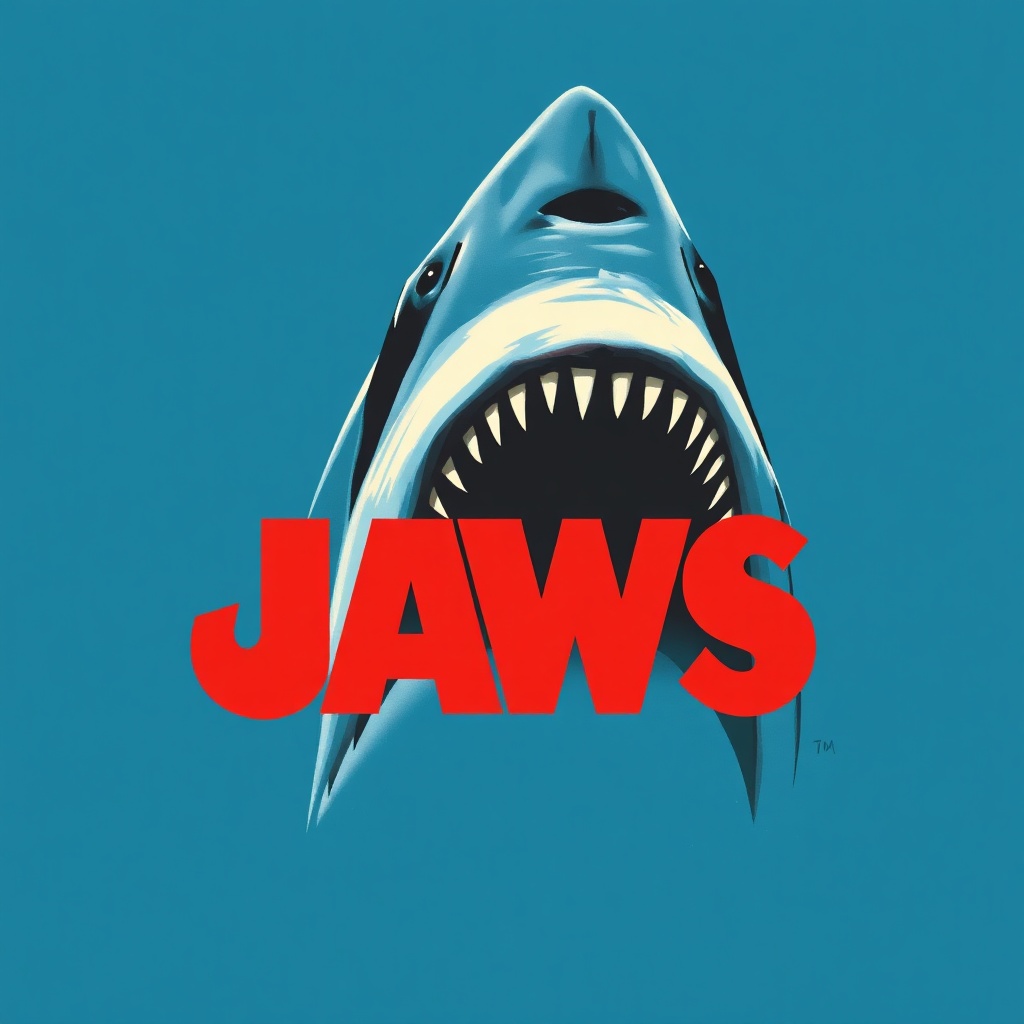
Released in 1975 and directed by a young and then-promising Steven Spielberg, "Jaws" transcended the thriller genre to become a cultural landmark and a watershed moment in the film industry. Based on Peter Benchley's bestseller, the film transformed the primal fear of the marine unknown into a chilling suspense, redefining the concept of the "summer blockbuster" and influencing generations of filmmakers and pop culture globally.
Analysis and Plot
The story of "Jaws" unfolds on the fictional island of Amity, a quiet coastal town that relies on tourism. The local tranquility is brutally interrupted when the remains of a young swimmer, Chrissie Watkins, are found on the beach, revealing a shark attack. Police Chief Martin Brody (Roy Scheider), a newcomer to the island with an inherent fear of the ocean, attempts to close the beaches. However, he faces strong opposition from Mayor Larry Vaughn (Murray Hamilton) and local business owners, who fear the financial impact on the July 4th holiday, the town's most profitable period.
The reckless decision to keep the beaches open results in more attacks, including the shocking death of a young boy, Alex Kintner, in front of hundreds of bathers. Public pressure mounts, forcing the mayor to act. Brody, determined to stop the creature, joins forces with Matt Hooper (Richard Dreyfuss), a young and eccentric oceanographer, and Quint (Robert Shaw), a veteran and charismatic shark hunter with a mysterious past and a thirst for revenge. Together, the three men embark on Quint's boat, the Orca, on a dangerous hunt for the giant great white shark terrorizing Amity.
The Climax and the Unforgettable Ending
The film's climax is an epic and claustrophobic battle on the open sea between the three men and the relentless predator. After days of pursuit and tense confrontations, the Orca is systematically destroyed by the shark. In a moment of pure adrenaline, Quint, the experienced hunter, is brutally devoured by the animal after a desperate struggle.
Hooper, who had been presumed dead, manages to escape his submerged protection cage and hides on the ocean floor. Brody, the policeman who once feared the water, finds himself alone on the ruined boat, confronting the shark face to face. In an act of desperation and ingenuity, he shoots at an oxygen tank that the shark had punctured, causing a spectacular explosion that finally kills the beast. Hooper emerges from the depths, and the two survivors, exhausted and traumatized, row back to the beach.
The ending of "Jaws" is laden with symbolism. Brody's victory is not just over the shark, but over his own fears and the inertia of bureaucracy. The shark, in turn, can be interpreted as a relentless force of nature, a return to the primitive that exposes the fragility of civilization and human greed. Some analyses see Mayor Vaughn as a critique of capitalist ideology, where profits are prioritized over the safety and lives of citizens. The story can also be seen as an allegory for masculinity and leadership in times of crisis, with Brody, Hooper, and Quint representing different facets of facing danger.
Cast and Notable Performances
The central trio of "Jaws" is one of the most iconic in cinema history. Roy Scheider, as Chief Martin Brody, delivers a restrained yet deeply human performance, capturing the essence of an ordinary man forced to become a hero. He is the heart of the film, and his famous line "You're gonna need a bigger boat" was improvised and became legendary.
Robert Shaw, in the role of the grumpy and enigmatic Quint, steals the show with his intensity and the unforgettable monologue about the USS Indianapolis, which adds a dark and tragic layer to his character. His performance is a tour de force, filled with charisma and brutality.
Richard Dreyfuss, as the young and idealistic oceanographer Matt Hooper, provides an intellectual and energetic counterpoint to Brody's pragmatism and Quint's cynicism. The chemistry between the three actors, despite behind-the-scenes friction, is undeniable and fundamental to the film's success. Lorraine Gary as Ellen Brody, Martin's wife, and Murray Hamilton as Mayor Vaughn, also deliver solid performances that anchor the narrative in the reality of Amity Island.
Behind-the-Scenes Trivia and Controversies
The production of "Jaws" was notorious for its numerous challenges and became one of the most chaotic in Hollywood history. The budget, initially $4 million, jumped to about $9 to $12 million, and the 55-day shooting schedule extended to 159 days.
The main "villain" behind the scenes was the mechanical shark itself, affectionately nicknamed "Bruce" (in honor of Spielberg's lawyer). Designed for freshwater, Bruce frequently malfunctioned when exposed to the saltwater of the ocean, sinking or simply stopping work. This inoperability forced Spielberg to be creative, suggesting the shark's presence rather than showing it directly, which, ironically, increased the film's suspense and terror.
Filming on the open sea at Martha's Vineyard, Massachusetts, presented immense logistical challenges, with the crew facing unpredictable sea currents, seasickness, and long workdays with little effective filming time. The young Spielberg, only 26 at the time, even feared his career was ruined.
The relationship between Robert Shaw and Richard Dreyfuss behind the scenes was tense, with Shaw frequently provoking Dreyfuss, which, in a way, contributed to the rivalry chemistry between their characters on screen. The script was also rewritten during filming, with contributions from Peter Benchley (author of the book) and Carl Gottlieb, in addition to improvisations from the cast.
An interesting controversy arose regarding the film's ending. The original book script provided for Hooper to die in the cage attack, and Spielberg even considered an ending where several sharks would appear after the death of the main predator. Fortunately, these ideas were discarded, with the current ending being more impactful and coherent.
Reception and Legacy
"Jaws" was released on June 20, 1975, and became an immediate phenomenon. It was the first film to gross over $100 million at the box office, becoming the highest-grossing film in history until the release of "Star Wars" two years later. With a global gross of $488.8 million (and about $1.5 billion adjusted for inflation in 1975), the film redefined the film industry.
Critical reception was widely positive, praising Spielberg's direction, the performances, and, in particular, John Williams' iconic score, which with just two low notes created the universal theme of impending danger. The film won three Oscars: Best Original Score, Best Editing, and Best Sound.
The legacy of "Jaws" is vast and multifaceted:
- The Birth of the Summer Blockbuster: "Jaws" pioneered the strategy of a wide, simultaneous release in hundreds of theaters, accompanied by a massive advertising campaign. This approach transformed the summer, previously a period for weaker films, into the season of major releases and "event films," a formula Hollywood follows to this day.
- Cultural Impact: The film instilled a collective fear of sharks, altering public perception of the species and influencing beach tourism. Steven Spielberg himself expressed regret years later about how the film may have contributed to the decimation of shark populations due to the increase in sport fishing.
- Cinematic Influence: "Jaws" became a manual for suspense, showing how "not showing" can be more terrifying than "showing." Directors like J.J. Abrams, Jordan Peele, and Christopher Nolan have cited "Jaws" as one of their greatest influences. It inspired countless imitators and sequels, although none have achieved the prestige of the original.
Half a century after its release, "Jaws" remains a timeless masterpiece, a testament to the power of cinema to captivate, terrify, and, above all, entertain. It is a film that, despite its chaotic background, managed to sink its "jaws" into pop culture and film history forever.
Sources Researched
- Wikipedia, the free encyclopedia. "Jaws (film)". Available at: https://en.wikipedia.org/wiki/Jaws_(film)
- IMDb. "Jaws (1975)". Available at: https://www.imdb.com/title/tt0073195/
- CBR. "How Jaws Spawned the Summer Blockbuster (and an Entire Subgenre)". Available at: https://www.cbr.com/jaws-spawned-summer-blockbuster-subgenre/
- Remind Magazine. "Why Steven Spielberg's 1975 Movie 'Jaws' Almost Didn't Get Made.". Available at: https://www.remindmagazine.com/article/jaws-movie-making/
- Den of Geek. "The production nightmares that made Jaws a classic". Available at: https://www.denofgeek.com/movies/jaws-the-production-nightmares-that-made-jaws-a-classic/
- The Credits. "Jaws Created the Summer Blockbuster 44 Years Ago Today". Available at: https://www.mpaa.org/2019/06/jaws-created-the-summer-blockbuster-44-years-ago-today/
- The Daily Jaws. "Jaws and the Birth of the Modern Blockbuster". Available at: https://thedailyjaws.com/blog/jaws-and-the-birth-of-the-modern-blockbuster
- EBSCO. "Jaws Prompts a Wave of Special-Effects Films". Available at: https://www.ebsco.com/products/research-starters/jaws-prompts-wave-special-effects-films
- Literary Hub. "On the Endless Symbolism of the Best Summer Movie Ever Made: Jaws". Available at: https://lithub.com/on-the-endless-symbolism-of-the-best-summer-movie-ever-made-jaws/
- Shmoop. "Jaws Themes". Available at: https://www.shmoop.com/study-guides/film/jaws/themes
- GradeSaver. "Jaws Themes". Available at: https://www.gradesaver.com/jaws/study-guide/themes
- Dr. Paul | Substack. "The Psychoanalysis of the Film, Jaws". Available at: https://drpaul.substack.com/p/the-psychoanalysis-of-the-film-jaws





