



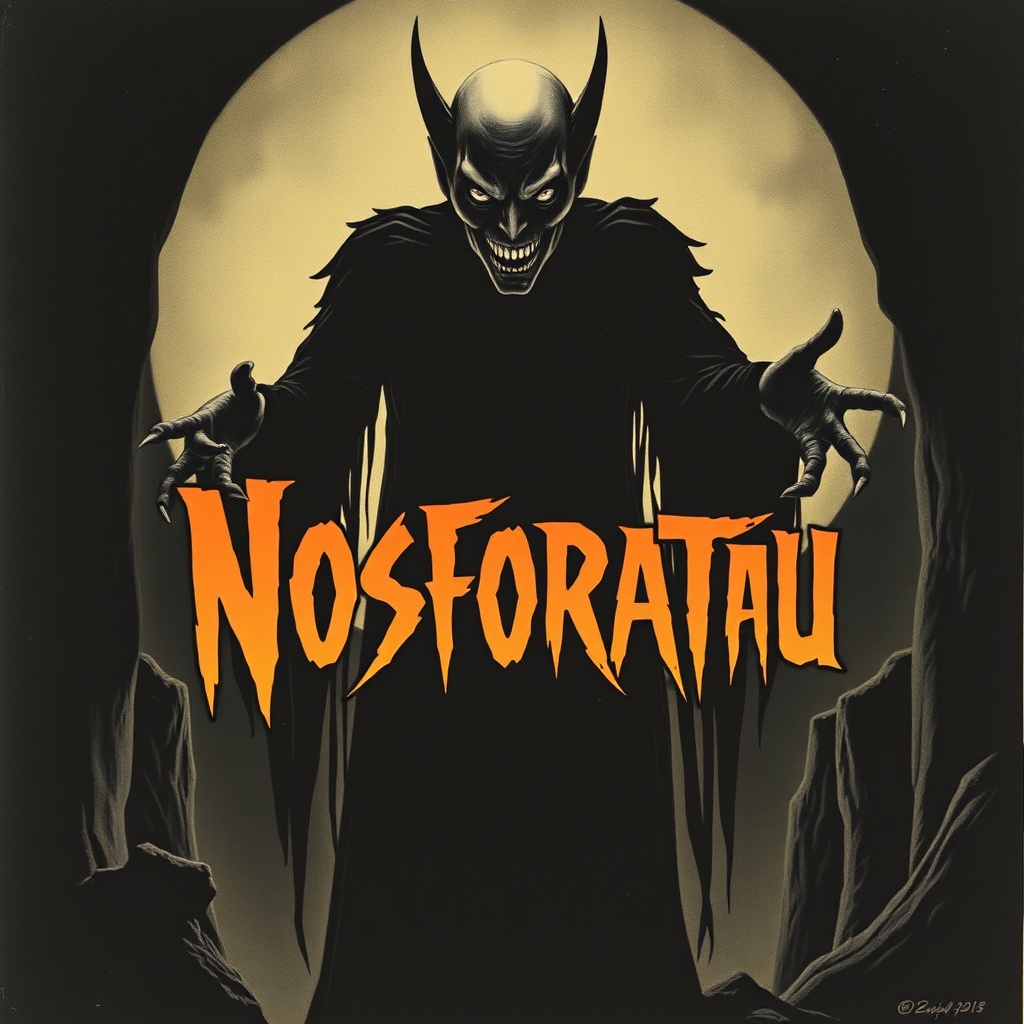
"Nosferatu: A Symphony of Horror" (Nosferatu, eine Symphonie des Grauens), the iconic 1922 German silent film directed by F.W. Murnau, is a seminal work of German Expressionism and an undeniable milestone in the horror genre. Loosely inspired by Bram Stoker's novel "Dracula," this century-old classic redefined the image of the vampire in cinema, transforming the seductive aristocrat into a grotesque and pestilent creature, and left an indelible mark on pop culture and cinematic history.
Analysis and Plot
"Nosferatu" transports the audience to the fictional port city of Wisborg (based on Bremen, Germany) in 1838, a time when the plague was a real and constant threat. The narrative begins with Thomas Hutter (Gustav von Wangenheim), a young and optimistic real estate agent, who receives a mission from his eccentric boss, Knock (Alexander Granach): to travel to the distant Carpathian Mountains to sell a property to the mysterious Count Orlok (Max Schreck). Hutter leaves behind his beloved wife, Ellen (Greta Schröder), and embarks on a journey that will take him to the heart of horror.
Upon arriving at Orlok's castle, Hutter is greeted by a tall, thin figure with pointed ears, a hooked nose, prominent incisors, and long, sharp fingernails – a visual representation that would become iconic and deeply influential for the figure of the vampire in cinema. During his stay, Hutter notices Orlok's bizarre behavior, noting that the Count avoids daylight and sleeps in a coffin. In a disturbing scene, Orlok, mesmerized by a small portrait of Ellen that Hutter had dropped, exclaims: "Your wife has a beautiful neck." Hutter wakes up with two small bite marks on his neck, attributing them to mosquitoes, but soon realizes the terrible truth: Orlok is a vampire.
The Count, who is the manifestation of the plague and death, acquires a house in Wisborg, conveniently located across from Hutter's residence. Orlok travels to the city by ship, carrying with him coffins filled with cursed earth (his homeland, essential for his rest and power) and an infestation of rats, which spreads through the city as the mysterious "plague" begins to claim lives. As the disease advances, Wisborg is gripped by terror and superstition. Knock, Hutter's boss, demonstrates an unsettling loyalty to Orlok, suggesting a pre-existing connection or submission to the vampire's power, and is eventually committed to a sanatorium, where he continues to call out to his "master."
The Ending and Its Meanings
The film's climax unfolds with Ellen Hutter. Deeply disturbed by Orlok's presence and the devastation of the plague, and feeling a psychic connection to the vampire, Ellen finds a book on vampires that describes how to stop Nosferatu: a woman of pure heart must lure the vampire and keep him feeding on her blood until the cock crows, until sunrise, so that he may be destroyed. Determined to save her city and her husband, Ellen sacrifices herself. She invites Orlok into her room, allowing him to feed on her, distracting him from his usual departure before dawn.
Entranced by the young woman's beauty and absorbed in his feast of blood, Orlok loses track of time. With the first ray of sun and the crowing of the rooster, the vampire is surprised by the light, agonizes, and dissolves into smoke or ashes. Hutter and the doctor arrive at Ellen's room, only to see her die in her husband's arms. However, Ellen's sacrifice is not in vain: the death of Nosferatu leads to the end of the plague in the city, freeing its inhabitants from evil.
The ending of "Nosferatu" is laden with symbolism. The figure of Count Orlok is often interpreted as a representation of the bubonic plague itself, an evil that spreads invisibly and inexplicably, leaving a trail of death and despair. His cadaverous, rodent-like, and non-seductive appearance distinguishes him from other incarnations of Dracula, emphasizing his role as a carrier of the plague, the "un-dead" (a possible etymology of the word "Nosferatu"). Ellen's sacrifice, a woman who gives herself to the creature to destroy it, can be seen as a metaphor for the need to confront evil in its very essence, even if it costs one's life. It is an act of pure love that defeats darkness, a recurring theme in Gothic horror. There are also interpretations that link the vampire and the plague to the anxieties of post-World War I Germany, with the figure of the foreigner bringing ruin and social disorder.
Cast and Notable Performances
- Max Schreck as Count Orlok: Max Schreck's performance is, without a doubt, the beating heart of "Nosferatu." His portrayal is legendary, with a disturbing physicality that became synonymous with the character. Schreck embodies Orlok not as a seductive gentleman, but as an animalistic creature, with crawling movements and a truly grotesque appearance – pointed ears, rat-like teeth, and claw-like nails. There is a mystique surrounding his performance, with rumors (fictionalized in the film "Shadow of the Vampire," 2000) that he was a real vampire, such was his immersion in the role. His frightening figure is one of the most terrifying ever portrayed in cinema and established an icon for the conception of vampires.
- Gustav von Wangenheim as Thomas Hutter: Wangenheim plays the naive real estate agent who, optimistically, travels to the Carpathians without imagining the danger that awaits him. His transition from a cheerful man to an tormented and terrified individual is fundamental to the audience's empathy.
- Greta Schröder as Ellen Hutter: Ellen is the film's tragic heroine, whose purity and love become the only hope against Orlok. Schröder conveys the anguish and determination of her character, culminating in her final act of sacrifice.
- Alexander Granach as Knock: Hutter's boss, Knock, is an ambiguous figure, whose loyalty to Orlok and subsequent madness contribute to the atmosphere of despair and corruption that permeates the plot.
Behind-the-Scenes Trivia and Controversies
"Nosferatu" is famous as much for its genius as for its controversies. The film was an unauthorized adaptation of Bram Stoker's novel "Dracula." The production company Prana Film, founded by Albin Grau and Enrico Dieckmann, could not secure the rights to the work, so screenwriter Henrik Galeen and director F.W. Murnau made changes to the characters' names (Dracula became Orlok, Jonathan Harker became Thomas Hutter, Mina became Ellen) and the setting (from London to Wisborg in Germany) in an attempt to avoid plagiarism accusations. However, the film's original credits still acknowledged "Dracula" as its source of inspiration.
Bram Stoker's widow, Florence Balcombe, discovered the unauthorized adaptation and sued Prana Film for copyright infringement. The court ruled in favor of Stoker in 1925 and ordered the destruction of all copies and negatives of the film. This was a devastating blow to Prana Film, which went bankrupt shortly after the lawsuit, with "Nosferatu" as its only project. Fortunately, some copies had already been distributed internationally and survived the purge, resurfacing through second-generation reels in other countries. The film only entered the public domain worldwide in 2019.
Other trivia includes:
- Albin Grau, the producer, reportedly was inspired to create the film after hearing vampire legends while serving in Serbia during World War I. Grau was also an occultist and formed his own religion, Panosophism, which infused the project with mystical elements.
- Many scenes were filmed during the day, and to represent night, restored versions of the film were tinted with a blue tone. Murnau, unlike other expressionists, used real locations, such as Orava Castle in Slovakia for Orlok's castle, lending a dark realism to the fantasy.
- The original soundtrack was composed by Hans Erdmann to be performed live during silent film screenings, with themes that contrasted love and terror.
- The film was banned in Sweden for excessive horror, taking 50 years for the ban to be lifted in 1972.
Reception and Legacy
Although the initial reception and financial return were "cold" at the time of release, with the production company Prana Film going bankrupt shortly thereafter, "Nosferatu" grew exponentially in stature over the decades. Today, it is acclaimed as a masterpiece of cinema and one of the most influential horror films of all time.
The impact of "Nosferatu" on the horror genre is immeasurable. It established many visual and narrative tropes that became pillars of horror, such as the vampire's vulnerability to sunlight – a concept that was not explicitly present in Stoker's "Dracula," but which "Nosferatu" popularized. The image of Count Orlok, with his elongated silhouette and sinister shadows, is one of the most recognizable in cinema. The film is considered one of the first representatives of the horror genre in cinema.
On Rotten Tomatoes, the film boasts an impressive 97% approval rating with a high score of 9.05/10, appearing on countless "Best Films of All Time" lists. Its expressionist aesthetic, with non-realistic sets, plays of light and shadow, and bizarre angles, influenced countless filmmakers, including Alfred Hitchcock and Guillermo del Toro.
The legacy of "Nosferatu" is so potent that it has inspired several remakes and tributes. Werner Herzog directed "Nosferatu the Vampyre" in 1979, with Klaus Kinski in the role of the vampire, and a new adaptation directed by Robert Eggers is scheduled for 2024, attesting to the timelessness and continued relevance of this symphony of horror. "Nosferatu's" ability to translate human anxieties into shadows and explore the fear of the unknown has secured its place as a fundamental pillar of horror cinema.
Researched Sources
- CinePOP - Trivia | 'Nosferatu', classic of German expressionism, turns 100 in 2022!: https://cinepop.com.br/curiosidades-nosferatu-classico-do-expressionismo-alemao-faz-100-anos-em-2022-314041
- Wikipedia - Nosferatu, Eine Symphonie des Grauens: https://pt.wikipedia.org/wiki/Nosferatu,_Eine_Symphonie_des_Grauens
- Canto dos Clássicos - Nosferatu - 1922 (Review): https://cantodosclassicos.wordpress.com/2016/06/20/nosferatu-1922-resenha/
- Instituto Moreira Salles - Nosferatu - A Symphony of Horror: https://ims.com.br/filme/nosferatu-uma-sinfonia-do-horror/
- Wikipedia - Nosferatu: https://en.wikipedia.org/wiki/Nosferatu
- AdoroCinema - Trivia about the film Nosferatu: https://www.adorocinema.com/filmes/filme-46602/curiosidades/
- AdoroCinema - Nosferatu - 1922 Film: https://www.adorocinema.com/filmes/filme-46602/
- Observatório do Cinema - Explaining the shocking ending of Nosferatu: https://observatoriodocinema.uol.com.br/filmes/explicamos-o-final-chocante-de-nosferatu/
- Aventuras na História - Nosferatu: 5 things to know before watching the remake: https://aventurasnahistoria.uol.com.br/noticias/curiosidades/nosferatu-5-coisas-para-saber-antes-de-assistir-ao-remake.phtml
- Mental Floss - 11 Frightful Facts About 'Nosferatu': https://www.mentalfloss.com/article/62274/11-frightful-facts-about-nosferatu
- Britannica - Nosferatu (1922 film): https://www.britannica.com/topic/Nosferatu-film-1922
- MUBI - Nosferatu (1922) - Cast and Crew on MUBI: https://mubi.com/pt/films/nosferatu-eine-symphonie-des-grauens/cast
- Observatório do Cinema - Nosferatu: Explaining the shocking ending of the horror film: https://observatoriodocinema.uol.com.br/listas/nosferatu-explicamos-o-final-chocante-do-filme-de-terror/
- Jovem Nerd - Nosferatu (1922) was almost wiped from history before becoming a cult classic: https://jovemnerd.com.br/nerdnews/filmes/nosferatu-1922-quase-apagado-historia/
- TEGRON - The complete history of "Nosferatu": https://techron.com.br/a-historia-completa-de-nosferatu/
- Bravo! - Understand the film Nosferatu (1922), masterpiece of expressionism by Friedrich Wilhelm Murnau: https://bravo.abril.com.br/memoria/entenda-o-filme-nosferatu-1922-obra-prima-do-expressionismo-de-friedrich-wilhelm-murnau/
- Boca do Inferno - Nosferatu (1922): https://www.bocad inferno.com.br/filmes/criticas-filmes/nosferatu-1922/
- InfoEscola - Nosferatu - Film: https://www.infoescola.com/cinema/nosferatu-filme/
- Atlântida FM - From silent to modern cinema: The eternal legacy of "Nosferatu": https://www.atlantida.com.br/entretenimento/do-cinema-mudo-ao-moderno-o-legado-eterno-de-nosferatu/2026/04/06/378401-do-cinema-mudo-ao-moderno-o-legado-eterno-de-nosferatu.html
- Café História - Nosferatu: a look at the fears of modernity: https://www.cafehistoria.com.br/nosferatu-e-os-medos-da-modernidade/
- Reddit - The true story of how Nosferatu was inspired by Dracula left me stunned: https://www.reddit.com/r/brasil/comments/18gbc1j/a_verdadeira_história_de_como_nosferatu_se/
- YouTube - Nosferatu (1922): Behind the Scenes- Mrs Stoker, Occultism and Romanticism: https://www.youtube.com/watch?v=Ff_uE_L40O0
- Panavision - The Making of Nosferatu | cinematographer Jarin Blaschke: https://www.panavision.com/news-events/2024/the-making-of-nosferatu-cinematographer-jarin-blaschke
- Roger Ebert - Nosferatu movie review & film summary: https://www.rogerebert.com/reviews/great-movie-nosferatu-1922
- Sandbox Environment - A Glimpse Behind The Scenes Of Nosferatu 1922: https://www.sandboxx.us/news/a-glimpse-behind-the-scenes-of-nosferatu-1922/
- YouTube - NOSFERATU (1922): ANALYZING THE CLASSIC!: https://www.youtube.com/watch?v=1n_n3yI948k
- Mental Floss - How Nosferatu Ripped Off Dracula and Became a Plagiarism Success Story: https://www.mentalfloss.com/article/503487/how-nosferatu-ripped-dracula-and-became-plagiarism-success-story
- CineFialho - NOSFERATU - Directed by F. W. Murnau (1922): https://cinefialho.com.br/2020/12/02/nosferatu-direcao-f-w-murnau-1922/
- YouTube - Nosferatu (1922) | Full Silent Vampire Horror | F.W. Murnau | German Expressionist Classic | 4K: https://www.youtube.com/watch?v=2e8L4zJz03U
- Nosso Cinema - “NOSFERATU” (1922) – German Expressionism: https://nossocinema.com.br/2020/06/nosferatu-1922-expressionismo-alemao/
- YouTube - Nosferatu vs. Dracula: here's the REAL story! #dwhistoryandculture #dwrealstoryof: https://www.youtube.com/watch?v=X00S5S0T_7Q
- Reddit - Why do people say Nosferatu and Dracula are the same character?: https://www.reddit.com/r/brasil/comments/17lsgvd/por_que_as_pessoas_falam_que_o_nosferatu_e_o/
- YouTube - Before Watching the New NOSFERATU: The Legacy of the 1922 Film Explained!: https://www.youtube.com/watch?v=689Y-63y_zE
- sobreimpressão - The three lives of Nosferatu: https://sobreimpressao.com.br/2025/01/09/as-tres-vidas-de-nosferatu/
- Fantaspoa - [XVIII Fantaspoa] Nosferatu (1922): a symphony of ancient and current horrors: https://www.fantaspoa.com/2022/04/15/nosferatu-1922-uma-sinfonia-de-horrores-antigos-e-atuais/
- Boca do Inferno - Nosferatu (1922): https://www.bocad inferno.com.br/filmes/criticas-filmes/nosferatu-1922-2/
- BFI - Shadow and substance: F. W. Murnau's Nosferatu: https://www.bfi.org.uk/sight-and-sound/features/shadow-substance-f-w-murnaus-nosferatu
- Reddit - You are interpreting the ending of “Nosferatu” wrong: https://www.reddit.com/r/roberteggers/comments/1923k8p/você_está_interpretando_errado_o_final_de/
- YouTube - Behind the scenes on the origin story of "Nosferatu".: https://www.youtube.com/watch?v=rWj8g-o_UoU
- Review | Nosferatu is a dark and sensual, yet murky look: https://observatoriodocinema.uol.com.br/filmes/critica-nosferatu-e-um-olhar-sombrio-e-sensual-mas-turvo/
- Reddit - Max Schreck relaxing behind the scenes of Nosferatu, 1922 [640x825]: https://www.reddit.com/r/HistoryPorn/comments/qcv36c/max_schreck_relaxing_behind_the_scenes_of/
- WordPress.com - Review: Nosferatu (1922): https://marinaalvarengabotelho.wordpress.com/2016/07/09/critica-nosferatu-1922/





