



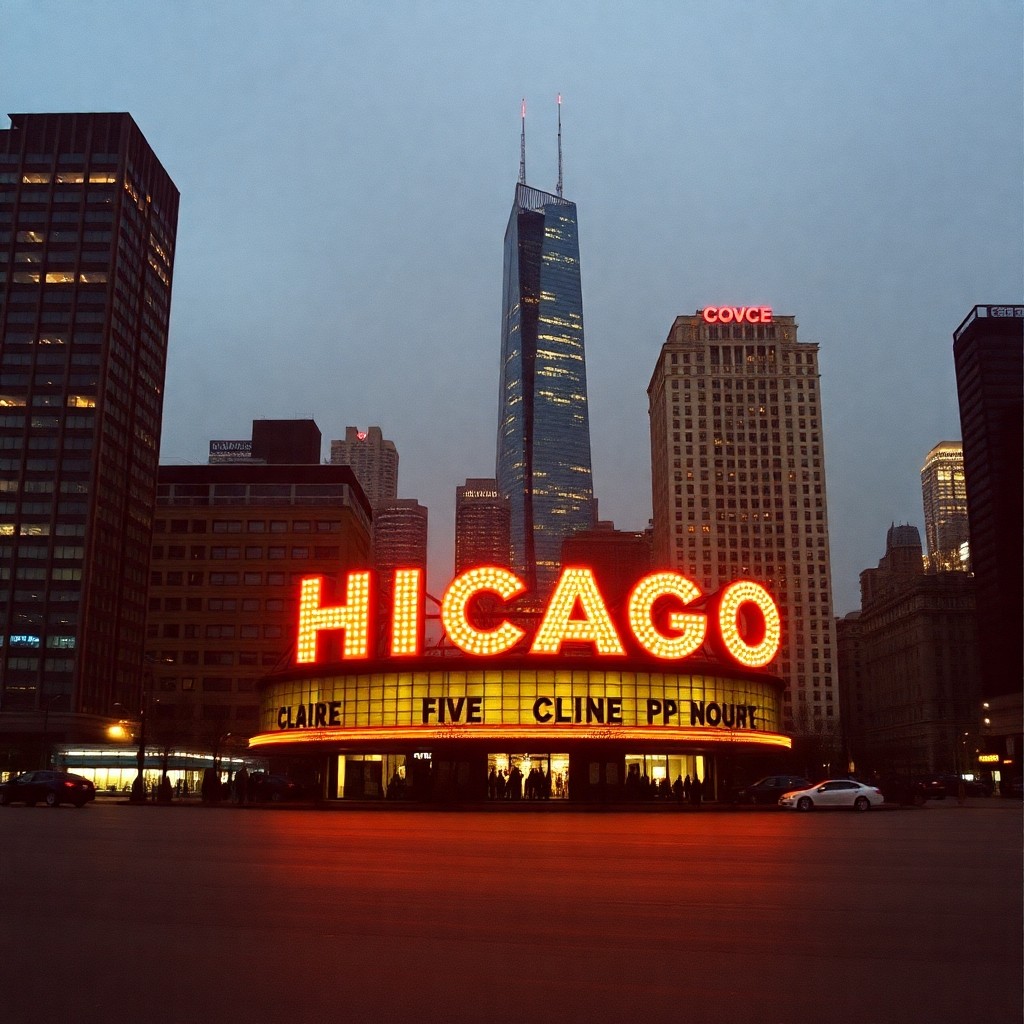
Released in 2002 under the audacious direction of Rob Marshall in his feature film debut, Chicago triumphantly revitalized the musical genre in Hollywood by blending crime, social satire, and plenty of jazz. Adapted from the iconic Broadway show by Bob Fosse, John Kander, and Fred Ebb, the feature film not only won the prestigious Academy Award for Best Picture—a feat the genre had not achieved since 1968 with Oliver!—but also redefined the aesthetic of modern musicals. With a biting narrative about instant fame and the corruption of the judicial system, the film remains an absolute landmark of early 21st-century pop culture.
Analysis and Plot
Set in the effervescent and dangerous Chicago of the 1920s, the film follows the journey of Roxie Hart (Renée Zellweger), a seemingly naive housewife who dreams of becoming a vaudeville star. Roxie is having an extramarital affair with Fred Casely (Dominic West), a salesman who promises to introduce her to the owner of a famous nightclub. When Roxie discovers the promise was merely a lie to get her into bed, she shoots him to death in a fit of rage. Initially, she tries to convince her simple-minded husband, Amos Hart (John C. Reilly), to take the blame, but the truth comes out and she is sent to the women's wing of Cook County Jail.
In prison, Roxie enters a parallel universe dominated by corruption and exhibitionism. She meets the head matron, "Mama" Morton (Queen Latifah), who operates under a philosophy of bribery and mutual favors, and the famous Velma Kelly (Catherine Zeta-Jones), a vaudeville star who murdered her husband and sister after catching them in bed. Velma is the darling of the tabloid press, led by journalist Mary Sunshine (Christine Baranski), and is defended by the city's most cunning and expensive lawyer, Billy Flynn (Richard Gere).
Realizing that public sympathy is the key to acquittal and stardom, Roxie hires Billy Flynn with the help of savings desperately scraped together by her husband. Flynn, a master of media manipulation, turns Roxie's crime into a tragic story of self-defense and moral vulnerability. He quickly shifts the press's attention from Velma to Roxie, sparking a fierce rivalry between the two inmates. The courtroom turns into a circus ring, where the truth is the least important element amidst the theatrical performance of the trial.
The Ending Explained and Hidden Meanings
The climax of Chicago takes place at Roxie Hart's trial. Through a spectacle choreographed by Billy Flynn, in which he manipulates the jurors and the press as if they were puppets (visually portrayed in the brilliant "We Both Reached for the Gun" ventriloquism sequence), Roxie is declared innocent. However, her victory is immediately eclipsed. At the very moment the verdict is announced, a new woman shoots a man outside the courthouse, instantly capturing the attention of reporters hungry for scandal. Roxie is left alone in the empty courtroom, realizing that her ephemeral fame has evaporated in seconds.
The hidden meaning of the ending lies in the cynicism inherent to the "American Dream" presented in the work. Roxie and Velma, now free but individually forgotten by the public, realize that the only way to survive in the entertainment market is to capitalize on their infamy together. They create a vaudeville double act. In the final scene ("Nowadays / Hot Honey Rag"), they perform for a packed and enthusiastic audience, wielding prop machine guns. The audience gives them a standing ovation, not for their artistic talent, but for the fact that they are acquitted murderesses.
The film concludes with a scathing critique that, in modern society, crime and entertainment are indistinguishable. Justice is not blind, but rather a spectator hungry for spectacle. The protagonists' acquittal does not represent justice being served, but rather the definitive triumph of cynicism, where notoriety is the most valuable currency and morality is entirely disposable.
Cast and Standout Performances
The critical and commercial success of Chicago is largely due to its perfectly cast ensemble, who delivered energetic and physically demanding performances:
- Catherine Zeta-Jones (Velma Kelly): With a magnetic and vocally flawless performance, Zeta-Jones steals the show. Her physical stage presence and delivery of complex choreography (such as the opening "All That Jazz" and "I Can't Do It Alone") earned her the Academy Award for Best Supporting Actress. Interestingly, she performed much of her choreography while several months pregnant.
- Renée Zellweger (Roxie Hart): Zellweger perfectly balances Roxie's manipulative fragility and blind ambition. Her transition from a frightened housewife to an ego-driven diva is subtle and expressive, standing out in the solo number "Roxie."
- Richard Gere (Billy Flynn): Moving away from his traditional romantic lead roles, Gere delivers a charming, cynical, and incredibly charismatic Billy Flynn. His tap-dancing performance in "Tap Dance" and the circus-themed "Razzle Dazzle" number demonstrate surprising technical versatility.
- Queen Latifah (Matron Mama Morton) and John C. Reilly (Amos Hart): Both bring soul to the film. Latifah exudes authority and comedic malice in "When You're Good to Mama," while Reilly delivers the most tragic and humanized performance of the film in "Mister Cellophane," representing the invisible and exploited common man.
Behind the Scenes and Trivia
The production of Chicago was surrounded by innovative creative decisions that solved one of the biggest problems in adapting musicals for modern cinema: how to make characters sing without it seeming artificial? Director Rob Marshall and screenwriter Bill Condon created the solution of situating all musical numbers within Roxie Hart's imagination. Thus, the vaudeville stage functions as a mental metaphor for Roxie to process the traumas and events of reality.
Another fascinating fact involves the original cast considered for the film throughout its years of development at Miramax. Names like Madonna, Goldie Hawn, Liza Minnelli, and Charlize Theron were considered for Roxie and Velma. Hugh Jackman was invited to play Billy Flynn but declined, considering himself too young for the role at the time—a regret the actor later admitted publicly.
Catherine Zeta-Jones also demanded that her hair be cut into a short, fixed "bob" so it wouldn't cover her face during fast dances, ensuring the audience knew it was her performing all the dance steps, without body doubles.
Controversies and Debates
The main behind-the-scenes controversy of Chicago involves the aggressive awards campaign method led by producers Harvey and Bob Weinstein, then heads of Miramax. The studio invested millions of dollars in advertising aimed at Academy members, promoting exclusive screenings and lavish dinners. Although the film was widely praised by critics, many film historians point out that Chicago's victory as Best Picture over Roman Polanski's acclaimed war drama The Pianist or Martin Scorsese's epic Gangs of New York was the pinnacle of Hollywood's aggressive "awards lobbying."
Furthermore, the film sparked intense academic debates about the representation of domestic violence and feminism. While some critics argued that the film celebrated female empowerment through subversion and survival in a world dominated by corrupt men, others pointed out that the narrative glamorized murder and legal cynicism, perpetuating the idea that justice can be bought if the defendant is attractive and performative enough.
Reception, Legacy, and Awards
Chicago was a resounding commercial and critical triumph. With an estimated budget of $45 million, the film grossed over $306 million worldwide, proving to Hollywood studios that the musical genre—considered commercially "dead" for decades—was still extremely profitable if adapted with modernity and rhythm.
On the awards circuit, the film was the big winner at the 2003 Oscars, nominated in 13 categories and winning 6 statuettes, including:
- Best Picture
- Best Supporting Actress (Catherine Zeta-Jones)
- Best Art Direction
- Best Costume Design
- Best Film Editing
- Best Sound
The legacy of Chicago opened the doors for a flood of Broadway musical adaptations for cinema in the following years, such as The Phantom of the Opera (2004), Rent (2005), Hairspray (2007), Sweeney Todd (2007), and Les Misérables (2012). The film established a new language of agile editing and fluid visual transitions that deeply influenced music videos and entertainment productions of the following two decades.
Sources Researched
- IMDb: www.imdb.com/title/tt0299658/
- Box Office Mojo: www.boxofficemojo.com/title/tt0299658/
- Rotten Tomatoes: www.rottentomatoes.com/m/chicago
- The Academy Awards Database: awardsdatabase.oscars.org
- Variety - Archives and Reviews: variety.com





