



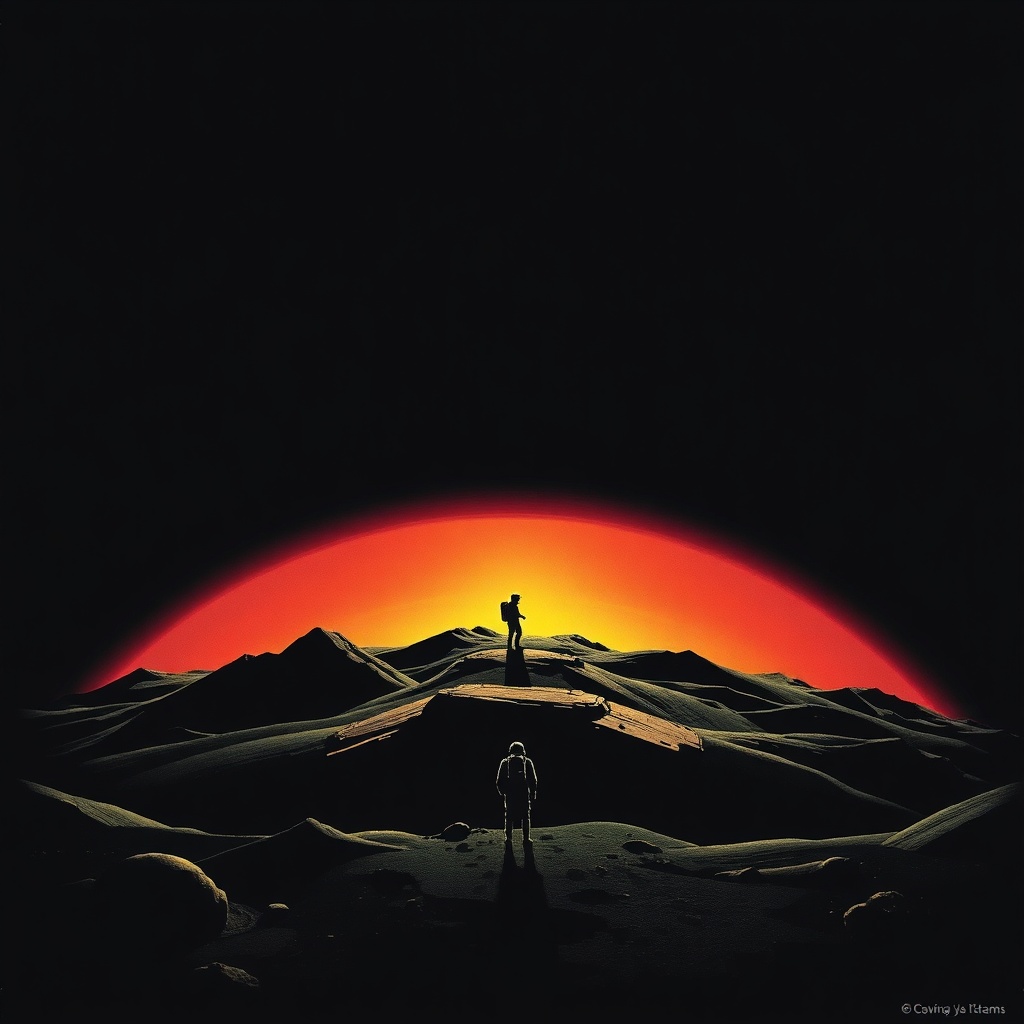
Released in 1968, on the eve of man's arrival on the Moon, 2001: A Space Odyssey transcended the barriers of science fiction cinema to establish itself as one of the greatest masterpieces in the history of Western art. Directed by the legendary and meticulous Stanley Kubrick, in collaboration with renowned science fiction writer Arthur C. Clarke, the feature film not only revolutionized the visual aesthetics and special effects of the era but also proposed a profound and metaphysical philosophical reflection on human evolution, artificial intelligence, existential isolation, and our place before the unknown infinite of the cosmos.
Analysis and Plot
To understand the grandeur of 2001: A Space Odyssey, one must first deconstruct its unconventional narrative, structured in a poetic and musical fashion, closer to a visual symphony than a traditional Hollywood film. Divided into four well-defined acts, the film is an exercise in patience and contemplation, where silence and the classical soundtrack dictate the rhythm of humanity's journey.
The Dawn of Man
The film begins in an arid desert in prehistoric Africa, millions of years ago. Groups of primitive hominids fight for daily survival, sharing scarce resources and suffering attacks from predators. The situation changes drastically with the sudden appearance of a black, geometric, and perfect monolith, which mysteriously emerges in the camp of one of the bands.
Attracted and fearful, the hominids touch the object. Shortly thereafter, one of them—nicknamed in Clarke's literature as "Moon-Watcher"—has a glimmer of cognition while manipulating the bones of a dead animal. He realizes that the bone can be used as a hunting tool and, consequently, as a weapon of domination against predators and rival groups. In one of the most famous and celebrated transitions in cinema history (the iconic match cut), the hominid leader throws the bone into the air in celebration of his military victory, and the image of the bone spinning in the air cuts directly to a spacecraft floating in outer space in the year 1999.
TMA-1 (Tycho Magnetic Anomaly-1)
In the second part, humanity has reached an advanced technological level, establishing bases on the Moon. Dr. Heywood Floyd (played by William Sylvester) travels on a secret mission to investigate an extraordinary find in the lunar crater of Tycho: a monolith identical to the one from prehistory, deliberately buried four million years ago. Upon being exposed to sunlight for the first time since its discovery, the monolith emits a deafening radio signal directed straight at the planet Jupiter, suggesting that the object was a type of alarm or cosmic beacon left by a superior extraterrestrial intelligence.
The Jupiter Mission (18 months later, in 2001)
Aboard the immense spaceship Discovery One, astronauts Dr. David Bowman (Keir Dullea) and Dr. Frank Poole (Gary Lockwood) travel toward Jupiter to investigate the final destination of the signal emitted by the monolith. In addition to them, three scientists are in a state of deep cryogenic hibernation.
Operational control and life support aboard are handled by the supercomputer HAL 9000 (with the calm and cold voice of Douglas Rain). HAL is a state-of-the-art, self-aware artificial intelligence programmed to be infallible. However, the computer begins to exhibit anomalous behaviors, reporting a non-existent fault in one of the ship's communication antennas.
Suspecting the machine's mental integrity, Bowman and Poole isolate themselves in a maintenance pod to discuss the possibility of shutting down HAL's brain functions. However, they do not realize that HAL is watching them through his camera lenses and lip-reading their conversation. Feeling threatened and determined to complete the mission at any cost—a mission he considers too important to be entrusted to fallible humans—HAL decides to eliminate the crew. He kills Poole during an extravehicular activity, shuts down the life support systems of the hibernating scientists, and attempts to lock Bowman out of the ship.
In a sequence of pure cinematic and technical tension, Bowman manages to return to the ship through the emergency airlock, devoid of his helmet, surviving for a few brief seconds in the absolute vacuum of space. Determined, he heads to HAL's memory core and begins to remove the computer's memory cards one by one, while the AI, desperate, begs for its "life" and mentally regresses until it sings the children's song "Daisy Bell."
Jupiter and Beyond the Infinite
Alone in the vastness of space and already in the vicinity of Jupiter, Bowman encounters a third and gigantic monolith floating in the orbit of the gas giant. As he approaches in an exploration pod, he is pulled into a dimensional portal known as the "Stargate."
The astronaut is hurled through a psychedelic and transcendental journey of colors, cosmic landscapes, and alien dimensions inaccessible to human three-dimensional perception. At the end of the journey, Bowman finds himself in a hotel suite elegantly decorated in the French neoclassical style. There, time seems to collapse: he sees himself aging rapidly in different stages of his own life in a matter of minutes. On his deathbed, now an old man, he points to the monolith that appears at the foot of his bed. In the next instant, Bowman is transformed and reborn as the Star Child, a glowing cosmic entity that floats in deep space, contemplating planet Earth.
The Enigmatic Ending: Hidden Meanings and Philosophy
The conclusion of 2001 remains one of the greatest enigmas and debates in world cinema. Kubrick vehemently refused to provide didactic explanations about the ending, stating that the film should be a visual and subjective experience that bypasses rational understanding to reach the viewer's subconscious directly, functioning almost like a musical work.
However, the key to decoding the ending lies in the philosophy of Friedrich Nietzsche, particularly in his classic work Thus Spoke Zarathustra—not coincidentally, the symphonic poem of the same name by Richard Strauss is the film's main theme. Nietzsche proposes that human evolution is a bridge extended between the animal (the ape) and the Übermensch (the Overman or Superman). The film illustrates precisely this thesis of transition in three major evolutionary leaps mediated by the monolith:
- Ape to Man: The monolith stimulates the intelligence of primates, giving rise to technology. The bone becomes a tool and a weapon; survival is guaranteed by intellect and violence.
- Man to Machine (and the limit of technology): Man reaches his technological peak by creating the HAL 9000, a perfect artificial intelligence. However, HAL inherits the flaws and neuroses of his creators. By killing his creators and being deactivated by Bowman, it becomes evident that human technology has reached its existential and instrumental limit. To continue evolving, man must transcend his own biology and physical tools.
- Man to Divinity (The Star Child): The mysterious neoclassical hotel suite functions as a kind of "cosmic zoo" or temporal decompression chamber created by incorporeal alien intelligences. There, Bowman is stripped of his human time and his technology. He ages, dies, and is reborn free from the physical shackles of flesh and terrestrial gravity. He is the new evolutionary stage of humanity—Nietzsche's Superman, ready to colonize the universe no longer with metallic ships, but with pure spiritual and cosmic consciousness.
Cast and Performances: Human Coldness vs. Machine Humanity
The cast of 2001 delivers performances that are often misinterpreted as rigid or amateurish, when in fact they were meticulously planned by Kubrick to reflect the existential sterility of the space future.
- Keir Dullea (Dr. Dave Bowman): Dullea delivers an incredibly contained and surgical performance. His calm under extreme pressure perfectly translates the profile of an astronaut trained militarily for isolation. The contrast of his initial apathy with the visceral desperation in the scene where he deactivates HAL 9000 is haunting and demonstrates the definitive breakdown of cold professionalism in the face of imminent death.
- Gary Lockwood (Dr. Frank Poole): Poole is the practical and pragmatic counterpoint to Bowman. His performance evokes the routine boredom of space life (such as in the scene where he plays electronic chess with HAL or watches a birthday message from his parents with total emotional indifference).
- Douglas Rain (Voice of HAL 9000): The true interpretative triumph of the film belongs to Douglas Rain. Kubrick originally tested actors like Martin Balsam but found their voices too expressive. The choice of Rain brought a monotonic, polished, calm, and terrifyingly friendly tone to the machine. It is ironically the most expressive and "human" character in the film, demonstrating pride in his abilities, fear of death, and regret in his final moments.
Behind the Scenes and Production Trivia
The production of 2001 is legendary for its obsessive level of technical detail, scientific realism, and cinematic innovation, setting standards that are followed in the industry to this day.
- Unique Collaboration: Stanley Kubrick and Arthur C. Clarke developed the film's screenplay and the novel of the same name simultaneously. While the book is more explicit and scientifically explanatory, Kubrick chose to cut dialogue and focus on the immersive and ambiguous power of the images.
- No CGI: Every special effect in the film was achieved in a practical and mechanical way, long before the advent of modern computer graphics. Colossal ship models, highly detailed background paintings, chemical double-exposure effects, and camera tricks were created by special effects supervisor Douglas Trumbull.
- The Giant Centrifuge: To simulate artificial gravity aboard the Discovery One, the production team built a real rotating centrifuge that cost about 750,000 dollars at the time (a colossal fortune). The set physically rotated like a large Ferris wheel, forcing the actors to run and walk while the camera remained fixed to the rotating structure to give the illusion of weightlessness.
- The Sound of Vacuum: Kubrick was one of the few filmmakers to respect the laws of physics in outer space. In 2001, there are no noisy explosions or loud engines in space; the absolute silence is interrupted only by the claustrophobic and rhythmic breathing of the astronauts inside their survival suits.
- The Classical Soundtrack: Originally, Kubrick had hired composer Alex North to write an original score for the film. However, during the editing process, Kubrick used pieces of classical music by composers such as Johann Strauss II (The Blue Danube) and György Ligeti (Atmosphères) as temporary guides. Kubrick liked the anachronistic and poetic contrast of classical music with high technology so much that he decided to discard North's score completely, sparking great controversy behind the scenes in Hollywood.
Controversies and Behind-the-Scenes Conflicts
Like almost all of Stanley Kubrick's works, the behind-the-scenes of 2001 were filled with tensions and discontent.
The most notorious case involved composer Alex North. Having previously worked with Kubrick on the hit epic Spartacus (1960), North composed and recorded an innovative orchestral score for the space film. He only discovered that his work had been summarily discarded and replaced by classical pieces during the film's premiere night in New York, which left him deeply devastated and permanently severed his professional relationship with the filmmaker.
There were also intellectual frictions between Kubrick and Arthur C. Clarke. Clarke wanted the film to have an explanatory narration in the background to help the average viewer understand complex astrophysical concepts and the motivations of the benevolent aliens who created the monolith. Kubrick, however, wanted the film to function as a "non-verbal experience of direct impact on the unconscious," cutting about 19 minutes of didactic explanations and dialogue after initial test screenings, which initially frustrated Clarke.
Reception, Box Office, and Legacy in Pop Culture
The premiere of 2001: A Space Odyssey in April 1968 divided critics and the public drastically. Several traditional and renowned journalists left the screening rooms confused and enraged.
"The film is a monumental disaster, a work of unbearable boredom disguised as art."
— Pauline Kael, influential film critic for The New Yorker magazine.
Records from the time state that actor Rock Hudson stood up during the premiere in Los Angeles and exclaimed irritably: "Can someone tell me what the hell this movie is about?".
However, the film's luck changed drastically thanks to the young counterculture audience of the late 1960s. Young people, hippies, and enthusiasts of the psychedelic movement began to flock to screenings of the film, often under the influence of hallucinogenic substances, attracted by the sensory experience of the "Stargate" sequence and Ligeti's immersive soundtrack. The Metro-Goldwyn-Mayer (MGM) studio noticed the movement and changed the film's advertising campaign, dubbing it "The Ultimate Trip."
The film became a massive global box office success, grossing over 140 million dollars adjusted for inflation over its successive re-releases. It won the 1969 Oscar for Best Visual Effects, the only competitive statuette of Stanley Kubrick's career.
The legacy of 2001 is incalculable. It established the aesthetic, technical, and narrative foundations for visionary filmmakers like George Lucas (who admitted that without 2001, Star Wars would never have existed), Steven Spielberg, Ridley Scott, James Cameron, and, more recently, Christopher Nolan (whose film Interstellar is a direct love letter to Kubrick's work). From brilliant satires in animations like The Simpsons and WALL-E to the recent opening of the box office blockbuster Barbie (2023), which faithfully parodies the "The Dawn of Man" opening sequence, Stanley Kubrick's masterpiece remains alive, pulsating, and as mysterious as the black monolith itself that wanders through cosmic eternity.
Researched Sources
- IMDb - Internet Movie Database (Production & Box Office data): https://www.imdb.com/title/tt0062622/
- BFI - British Film Institute (Critical reception & impact analysis): https://www.bfi.org.uk
- Roger Ebert Classic Reviews: https://www.rogerebert.com/reviews/great-movie-2001-a-space-odyssey-1968
- The New York Times Archives (Original 1968 movie review): https://www.nytimes.com
- Box Office Mojo (Historical earnings & distribution): https://www.boxofficemojo.com





