



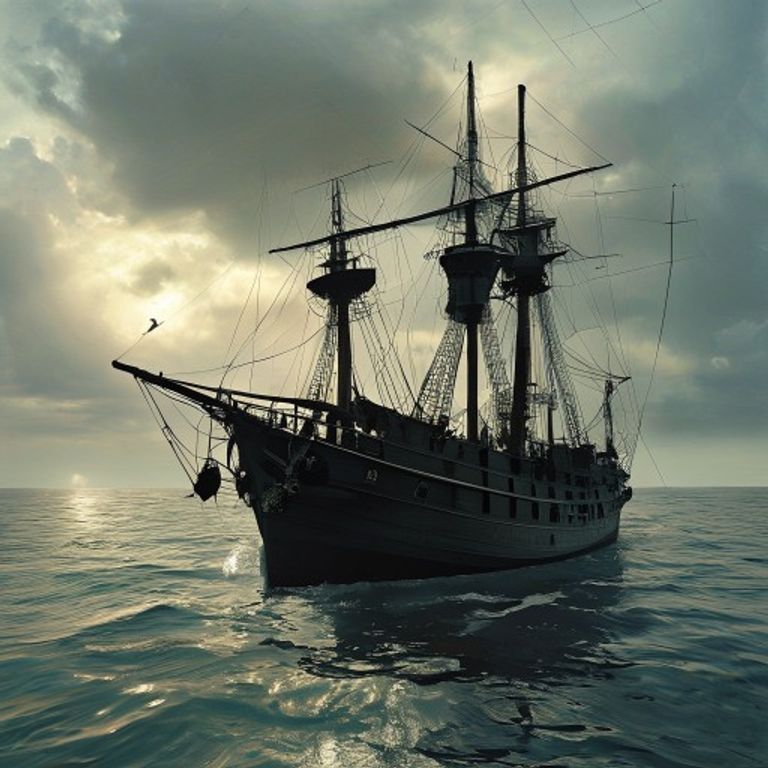
The vessel was found stranded in 1921 in North Carolina with all sails set and food being prepared, but without any crew members or signs of violence.
⚠️ Research conducted with the aid of Deep Research is subject to referential ambiguity.
🖥️ Clean HTML code using a proprietary tool.
👥 Research by Guilherme Felipe, Curation by Sílvio Lôbo
The Mystery of the Ship Carroll A. Deering: A Ghost in the Boreal Sea
In January 1921, one of the most enduring maritime enigmas in history began to unfold. The Carroll A. Deering, a five-masted schooner, disappeared under alarming circumstances, leaving behind only traces that would fuel decades of speculation and fear. This article aims to dissect the known facts, the elaborate theories, and the loose ends that turned the Carroll A. Deering into a ghost in the popular imagination.
1. The Context and the Incident: A Sinister Encounter off the North Carolina Coast
The Carroll A. Deering, under the command of Captain William H. Merritt (though absent at the time of the incident, being replaced by Captain Alexander M. McLean), was a robust freighter, 193 feet long, built in 1919. Its last planned voyage was to transport a cargo of coal from Norfolk, Virginia, to Buenos Aires, Argentina. It was off the coast of North Carolina, near Cape Hatteras—a location historically treacherous for navigation due to its reefs and dangerous currents—that the ship was found in a situation that bordered on the inexplicable.
On January 28, 1921, lighthouse keeper E.E. Vaughan, of the Bodie Island lighthouse, spotted a large schooner stranded on the sandbars near Cape Lookout. The ship appeared abandoned, with its sails hoisted and no sign of life on board. The U.S. Navy sent a tugboat to investigate, and what they found would be the starting point for a mystery that would haunt generations.
2. Timeline of Events: A Rapid Disintegration
The reconstruction of the events that led to the abandonment of the Carroll A. Deering is fragmented, based on later reports and evidence collected at the scene.
- December 1920: The Carroll A. Deering begins its voyage from Norfolk to Buenos Aires.
- Early January 1921: The ship is spotted in Cuban waters, but later reports indicate that Captain McLean had an argument with the ship's owner, G.E. Hinman, regarding navigation conditions, and that McLean had threatened to return the ship.
- January 18, 1921: The Carroll A. Deering, with a new captain (McLean was disgruntled and command was assumed by William Chipman), leaves Norfolk heading south. The full crew consisted of 11 men.
- January 25, 1921: A ship called the S.S. Vance encounters the Carroll A. Deering. The captain of the Vance reports that the Deering appeared to be in difficulty, with the crew looking agitated. He offered help, but it was refused.
- January 28, 1921: The Carroll A. Deering is spotted stranded and abandoned at Cape Lookout, North Carolina.
- January 29, 1921: An official expedition arrives at the ship. They find that the vessel was empty, with food left on the table, beds unmade, and personal belongings scattered. Only the ship's cat, 'Gip', was found on board, hungry and frightened.
3. The Main Theories: A Sea of Possibilities
The lack of bodies and the sudden nature of the abandonment gave rise to a myriad of theories, ranging from the rational to the fantastic.
3.1. Scientific and Police Hypotheses (The Most Likely)
- Modern Pirates: At the time, piracy was still a concern, especially in less patrolled waters. The theory suggests that pirates boarded the ship, stole the cargo (if it were valuable), and possibly murdered or took the crew hostage, abandoning the ship. However, there were no signs of forced entry or struggle, and the coal cargo was not particularly valuable for looting.
- Mutiny on Board: The possibility of a mutiny is frequently raised. Internal disputes, dissatisfaction with leadership, or even the erratic behavior of a crew member could have escalated into a violent conflict, resulting in the abandonment of the ship by the survivors (if there were any) or the death of everyone. The absence of bodies makes it difficult to prove this hypothesis.
- Extreme Weather Conditions: Although there are no records of severe storms in the exact area on the date in question, the North Carolina coast is notorious for its sudden weather changes. An abnormally strong wave or an unexpected gale could have led the crew to abandon the ship in a lifeboat, hoping to reach land, but being swallowed by the sea. The lack of a missing lifeboat, however, is a question mark.
- Voluntary Abandonment in Search of Wealth: Rumors persisted that the crew might have discovered treasure or planned a scheme to get rid of the ship and their responsibilities, perhaps to escape debts or start a new life. The apparent organization of the abandonment (hatches left in sight, for example) could suggest a carefully orchestrated plan.
3.2. Alternative, Conspiracy, or Paranormal Theories
- Submarine Attack (During World War I?): Although World War I ended in 1918, the fear of mines or German submarines still lingered. A less supported hypothesis suggests that the ship could have been hit by an unexploded war artifact or a submarine in clandestine operation. The lack of visible damage to the hull largely refutes this idea.
- Sea Creatures or Alien Abduction: More fantastic theories point to the unknown. The idea that unknown sea creatures or even extraterrestrials could have taken the crew is fueled by the mystery and the absence of conventional explanations. However, there is no scientific evidence to support such claims.
- Paranormal Phenomena or Curse: The sinister atmosphere surrounding the case led some to believe in supernatural forces. The North Carolina region is already shrouded in legends of ghosts and inexplicable events. The Carroll A. Deering could just be another chapter in a sinister folklore.
4. Controversies and Blind Spots: The Failures in the Investigation
The official investigation, conducted by the United States Coast Guard, was criticized for several failures and inconsistencies:
- Lack of Comprehensive Search: The search for the missing crew was considered insufficient. The priority was the recovery of the ship and its cargo.
- Loss of Crucial Evidence: Reports suggest that some important objects on board the Deering, which could have provided clues, were lost or damaged during the salvage and investigation process.
- Conflicting Testimonies: The account of the captain of the S.S. Vance, the last to see the Deering before its disappearance, contained details that seemed contradictory or overly dramatic, raising doubts about his own credibility.
- Distrust Regarding Captain McLean: The tense relationship between Captain McLean and the ship's owners, as well as his apparent reluctance to command the Deering on the final voyage, generated speculation about his involvement or prior knowledge of problems.
- The Missing Logbook: The logbook, where daily activities and any incidents would have been recorded, was never found, which represents a colossal gap in the investigation.
5. Curiosities and Legacy: A Mystery that Sails Through Time
The case of the Carroll A. Deering captured the popular imagination and became an icon of maritime folklore. Its story has been portrayed in books, films, and countless reports.
- The Cat 'Gip': The survival and rescue of the ship's cat added a touch of tragedy and mystery to the event. The fate of 'Gip' after the rescue is uncertain, but its solitary presence on an empty ship highlights the abrupt departure of the crew.
- "The Ghost Ship": The Carroll A. Deering is often referred to as a "ghost ship," fueling the aura of mystery that surrounds it. The sight of the stranded, silent, and deserted schooner evoked images of tragedy and abandonment.
- Current Status: The case of the Carroll A. Deering was officially closed as an unsolved mystery. Despite numerous informal investigations and speculation over the decades, no definitive proof has emerged to clarify the fate of the crew or the circumstances of the ship's abandonment. The files related to the case remain accessible, but without conclusive answers.
The Carroll A. Deering continues to sail in the waters of uncertainty, a poignant reminder that, even in the age of technology and exploration, the vast and relentless ocean still holds deep and inexplicable secrets.





