



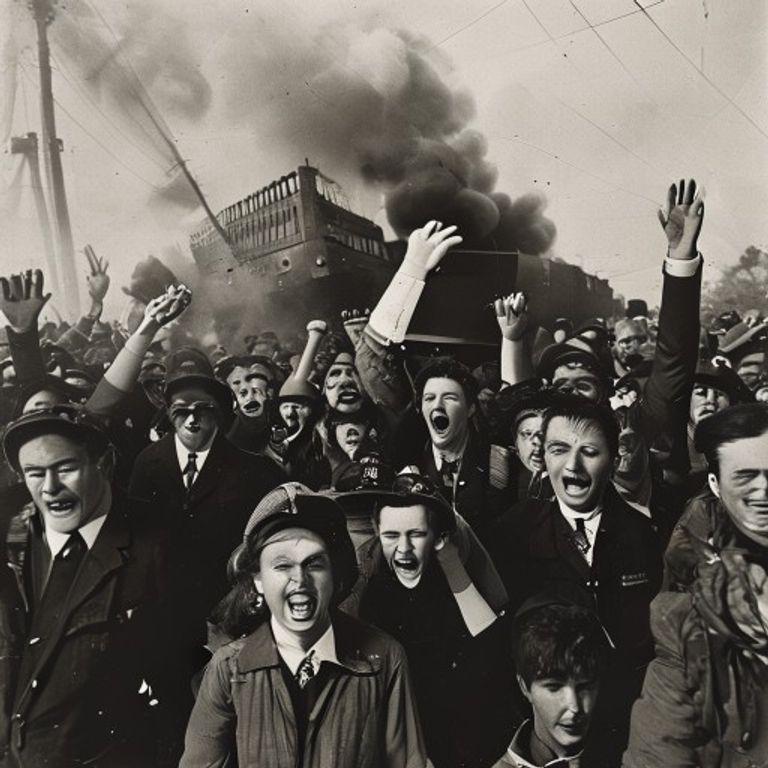
The radio broadcast of The War of the Worlds by Orson Welles that caused mass hysteria in the United States by making people believe in a real Martian invasion.
⚠️ Research conducted with the aid of Deep Research is subject to referential ambiguity.
🖥️ Clean HTML code using a proprietary tool.
👥 Research by Guilherme Felipe, Curation by Sílvio Lôbo
The Great Panic of 1938: The Night Reality Collapsed
By [Your Senior Journalist Name], Investigator Specialized in Mysteries
1. The Context and the Incident: Where, When, and How the Mystery Began
On the night of October 30, 1938, America was about to experience an event that would redefine public perception of media and the nature of reality. Amidst growing global tension with the rise of Nazism in Europe and the imminence of war, a seemingly harmless radio broadcast would turn into a catalyst for fear and mass panic.
The stage for the disaster was the program "The Mercury Theatre on the Air," hosted by renowned actor and director Orson Welles and his company. That night, they decided to adapt H.G. Wells' classic science fiction novel, "The War of the Worlds," for the radio format. What followed was an interpretation so vivid and convincing that, for many listeners, the line between fiction and reality became dangerously thin.
The adaptation opted for a "breaking news" format, interrupting musical programming with urgent news bulletins reporting the arrival of Martian aliens on Earth, landing in Grovers Mill, New Jersey. The narration, interspersed with sounds of explosions, screams, and graphic descriptions of devastating alien weapons, was chillingly realistic. The broadcast, aired by the CBS network, reached millions of American homes, many of which were unfamiliar with the format or missed the initial announcement that it was a dramatization.
2. Timeline of Events: A Chronological Reconstruction
- 1938, Early evening of October 30: The "The Mercury Theatre on the Air" program begins its broadcast with a musical adaptation.
- 8:00 PM (Eastern Standard Time): The broadcast of "The War of the Worlds" begins. Initially, it presents itself as a play with a musical introduction, but soon adopts the news bulletin format.
- Approximately 8:15 PM - 8:30 PM: News bulletins about the Martian invasion begin to interrupt the programming. Descriptions of the "attacks" in Grovers Mill and other locations become increasingly alarming.
- 8:30 PM - 9:00 PM: The panic reaches its peak. Reports of people fleeing their homes, barricading themselves in basements, calling the police, and even preparing weapons to defend themselves begin to emerge.
- 9:00 PM: The broadcast ends with the death of the Martian commander and the apparent defeat of the invasion.
- Night and following days: Newspapers begin to publish reports about the "radio panic." The exact extent of the fear and reactions is debated.
- Subsequent years: The incident becomes a cultural landmark and a case study in communication and social psychology.
3. Main Theories: Deciphering the Fear
The legacy of the Great Panic of 1938 is as complex as the night itself. Explanations range from rational analyses to more fantastic speculations.
Scientific and Psychological Theories (Most Likely):
- Suggestibility and Media Susceptibility: This is the dominant theory among scholars. The combination of a realistic presentation format, Orson Welles' reputation as an innovative producer, and an audience living under the shadow of real historical events (such as the Sudeten crisis, which seemed imminent at the time) created fertile ground for belief in the broadcast. The lack of familiarity with the "breaking news" format aggravated the situation.
- Lack of Verification: In an era without the internet and with limited access to real-time information, many listeners had no way to verify the veracity of the news bulletins. Written media was slower, and information was often absorbed without the scrutiny that is common today.
- Inverted "Bystander Effect": Instead of a smaller number of people reacting to a perceived emergency, what occurred was a viral spread of fear, where the perception that "others are reacting" led more people to react.
Alternative and Conspiracy Theories:
- Government Manipulation: One theory suggests that the United States government, or elements within it, may have orchestrated or, at the very least, tolerated the panic to test public response to perceived threats or to distract attention from internal issues. There is no concrete evidence to support this hypothesis.
- Deliberate Intent to Cause Panic: Although Orson Welles and his team always maintained that the goal was only to entertain, some speculate that there was a secondary intention to demonstrate the power of the media and the fragility of society. Documents from the time, such as FBI reports (which were later declassified), investigated the incident but found no evidence of intentional misconduct.
- Paranormal or Real Extraterrestrial Phenomena (Marginal Theories): Some voices, mainly in ufological circles, interpreted the panic as a genuine reaction to something that was happening. The idea is that the broadcast only "translated" a real event in a way that the public could understand. This theory lacks any scientific basis or documentary proof.
4. Controversies and Blind Spots: Cracks in the Official Narrative
Despite the most accepted explanation of radio panic, the incident presents several points that continue to generate debate and distrust.
- Extent of the Panic: Myth vs. Reality: Initial reports in the press, fueled by sensationalist headlines, painted a picture of absolute chaos, with thousands of people fleeing and even deaths. However, later research, such as that conducted by sociologist Hadley Cantril in his book "The Invasion From Mars: A Study in the Psychology of Panic" (1940), suggests that the number of genuinely terrified people was significantly lower than reported, possibly in the hundreds of thousands, and not millions. The media, seeking to sell newspapers, may have exaggerated the scale of the event.
- Ignorance of the Introduction: A crucial point of controversy is why so many people did not hear or did not attach importance to the musical introduction that announced the dramatization. What led to this collective failure of perception?
- Witness "Comments": Testimonies from people who claimed to have seen "lights in the sky" or "strange shadows" were frequently cited as proof of something more sinister. However, most of these reports emerged *after* the broadcast and may have been influenced by the panic itself and suggestion.
- Fragmented Police Reports: Although the police received numerous calls, official and centralized documentation on the extent of the disturbances is surprisingly fragmented. Many records were lost or destroyed over time.
- FBI Files: Declassified FBI reports on the incident revealed investigations into the broadcast, focusing on potential disturbances to public order. However, these reports mainly confirm the nature of the broadcast and the reactions resulting from it, without pointing to conspiracies or paranormal events.
5. Curiosities and Legacy: The Shadow of Mars
The Great Panic of 1938 transcended mere news of an isolated event, becoming an indelible landmark in the history of communication and popular culture.
- The Power of Media: The incident became a classic case study on the power and responsibility of mass media. It highlighted the radio's ability to influence public thought and generated an ongoing debate about ethics in content production.
- The Rise of Orson Welles: For Orson Welles, the incident, despite having generated controversy, catapulted him to fame. The notoriety gained with "The War of the Worlds" helped him secure a Hollywood film contract, where he would later create masterpieces like "Citizen Kane."
- Lasting Cultural Impact: "The War of the Worlds" became synonymous with radio panic. The phrase "They are coming to get us!" became a popular catchphrase, and the story has been retold and adapted countless times in different media.
- Contemporary Debates: The incident continues to be studied and debated in universities and academic circles. The question of how information (or misinformation) spreads and affects human behavior remains relevant in our digital age.
- Current Status: The case, in terms of an active criminal investigation, has been shelved for decades. However, the mystery of the "Great Panic of 1938" lives on in the minds of historians, sociologists, and mystery enthusiasts, serving as a grim reminder of the thin line between perceived reality and collective imagination. The truth about the exact extent of the panic and the motivations behind each individual's reactions may have been lost to time, but the shadow of the Martian invasion of 1938 continues to loom, a testament to the uncontrollable power of narrative.





