



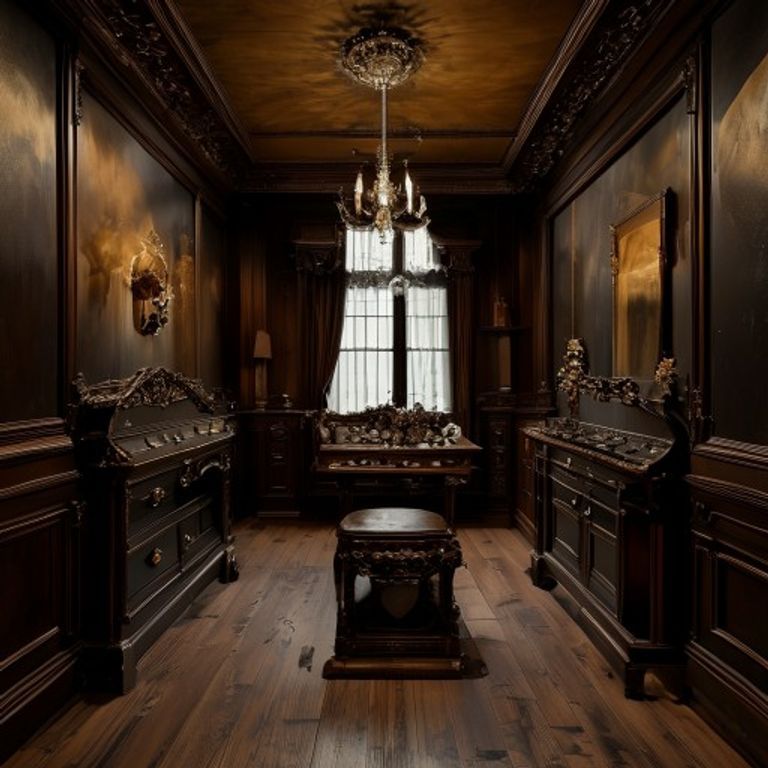
The disappearance of a luxurious Russian chamber during World War II, whose gold and amber panels were never located after the Nazi looting.
⚠️ Research conducted with the aid of Deep Research is subject to referential ambiguity.
🖥️ Clean HTML code using a proprietary tool.
👥 Research by Guilherme Felipe, Curation by Sílvio Lôbo
The Mystery of the Amber Room: The Stolen Treasure That Vanished with Time
The history of the Amber Room is a tapestry woven with threads of opulence, priceless art, and the enigmatic silence of disappearance. More than a simple theft, its loss represents one of the greatest enigmas of World War II, a treasure that evaporated into the chaos of history, fueling decades of speculation and relentless searching.
1. The Context and the Incident: A Royal Gift and a Brutal Conquest
The Amber Room was a masterpiece without parallel. Originally commissioned by King Frederick I of Prussia in 1701, it was designed by the German sculptor Andreas Schlüter and finished by Italian craftsmen Giovanni Battista Pagani and Filippo Juvarra. Composed of more than six tons of amber, adorned with gold leaf, mirrors, and precious stones, the room was a gift to Tsar Peter the Great of Russia in 1716.
For nearly two centuries, the dazzling room adorned the Catherine Palace, on the outskirts of Saint Petersburg, serving as a symbol of the power and wealth of the Russian Empire. However, the splendor turned to tragedy with the rise of the Nazi regime and the subsequent invasion of the Soviet Union in June 1941.
In September 1941, Nazi troops, under the command of General von der Chevallerie, captured the Catherine Palace. What followed was a demonstration of looting and destruction. Instead of destroying the room, the Nazis, impressed by its beauty, meticulously dismantled it – a job that took about 36 hours – and transported it to the city of Königsberg, in East Prussia (today Kaliningrad, Russia). There, the room was reassembled in one of the halls of Königsberg Castle, becoming a trophy of the Nazi conquest.
2. Timeline of Events: From Glory to Disappearance
- 1716: The Amber Room is presented to Tsar Peter the Great and installed in the Winter Palace.
- 1755: The room is moved to the newly built Catherine Palace in Tsarskoye Selo.
- September 1941: Nazi troops occupy the Catherine Palace and begin dismantling the Amber Room.
- October 1941: The Amber Room is sent to Königsberg and displayed in the Castle.
- 1944-1945: With the advance of Allied troops, Königsberg suffers intense bombing. Reports indicate that the Nazis attempted to hide the castle's treasures.
- April 1945: Königsberg is captured by the Red Army. Königsberg Castle is largely destroyed by fire. The Amber Room disappears.
3. The Main Theories: Trying to Unravel the Enigma
The disappearance of the Amber Room gave rise to a myriad of theories, some anchored in facts, others floating in the realm of speculation and myth.
3.1. Theories Based on Facts and Historical Evidence
- Destruction in Königsberg: The most accepted, and perhaps the bleakest, theory suggests that the Amber Room was destroyed during the intense Allied bombing of Königsberg in 1944 and 1945, or during the fire that consumed Königsberg Castle in April 1945. Soviet archives and eyewitness accounts from the time suggest that the Nazis, in a panic, may have tried to hide the valuable artifacts, but the action resulted in their irreparable loss. Forensic examinations and excavations at the castle site have not found significant traces of the room.
- Hidden in Underground Bunkers: A variation of the destruction theory suggests that the room was dismantled and hidden in underground bunkers or mines near Königsberg, protected from the bombing. The idea is that the Nazis planned to recover it after the war, but their rapid defeat prevented them. However, extensive searches in these areas have not yielded conclusive results.
- Transported to Another Location: There are reports and fragmentary evidence that the Amber Room may have been dismantled and transported to other locations by Nazi Germany as the war neared its end. Some suggest it could be in salt mines, castles, or other hideouts. The difficulty lies in the immense amount of material and the secrecy imposed by the Nazis.
3.2. Alternative, Conspiracy, or Paranormal Theories
- Sunk on a Ship: A popular theory, but without concrete proof, points to the sinking of the ship MV Wilhelm Gustloff, which sank in the Baltic Sea in January 1945, carrying refugees and valuable goods. Some believe the Amber Room was on board. However, the ship's known cargo manifest does not mention the room, and the scale of the treasure would hardly be transported so discreetly.
- Nazi Gold and the Fifth Reich: Some conspiracy theories link the disappearance of the Amber Room to secret Nazi operations for hiding gold and artifacts, with the goal of financing a future "Fifth Reich." These theories often involve secret organizations and elaborate plans but lack any corroborating evidence.
- Paranormal or Supernatural Theories: In more esoteric niches, speculations arise that the Amber Room could have been "taken" by inexplicable forces, such as a dimensional portal or supernatural phenomena. These ideas, while intriguing, belong to the realm of fiction and not journalistic investigation.
4. Controversies and Blind Spots: Gaps in the Investigation
The investigation into the whereabouts of the Amber Room, both by the Soviets and by later teams, was marked by inconsistencies and significant blind spots:
- Destroyed and Missing Evidence: The partial destruction of Königsberg and, subsequently, the Castle, resulted in the loss of many crucial documents and testimonies. What remained was often fragmented or manipulated by political interests.
- Soviet Silence and Lack of Transparency: For decades, the Soviet Union maintained a veil of secrecy over its investigations. Official reports were scarce and often contradictory, fueling suspicions that important information was being hidden.
- Disappearance of Key Witnesses: Several important witnesses, both Nazi soldiers who were in Königsberg and local inhabitants, disappeared or died under mysterious circumstances over the years, which raises the possibility of silencing.
- False Sightings and Red Herrings: The intense search for the Amber Room attracted countless scammers and treasure hunters, who disseminated false information or led authorities on wild goose chases, hindering serious investigation.
- Insufficient Forensic Analysis at the Castle: Although excavations and analyses took place at Königsberg Castle after the war, many argue that the methodology used was not sufficiently exhaustive or technically advanced to definitively rule out the presence of fragments of the room in deep rubble or in hard-to-reach areas.
5. Curiosities and Legacy: A Treasure That Lives in the Imagination
The mystery of the Amber Room has transcended time and become a cultural icon:
- The Legacy of Reproduction: The fascination with the room led to the creation of a meticulous reproduction, begun in 1972 and completed in 2003, which now adorns the Catherine Palace, offering a glimpse of what was lost. The reconstruction was a monumental effort, employing artisanal techniques and materials similar to the originals.
- Inspiration for Popular Culture: The story of the Amber Room has inspired countless books, films, documentaries, and even video games. Its aura of mystery and the relentless search for a lost treasure continue to captivate the public's imagination.
- Current Status: Officially, the case of the Amber Room is considered one of the great unsolved mysteries of World War II. Despite countless expeditions and research over the decades, no conclusive evidence regarding its whereabouts has been presented. Most historians and experts believe the room was destroyed, but the absence of definitive proof keeps hope and speculation alive. The mystery endures, a grim reminder of the devastation of war and the fragility of the most precious treasures.





