



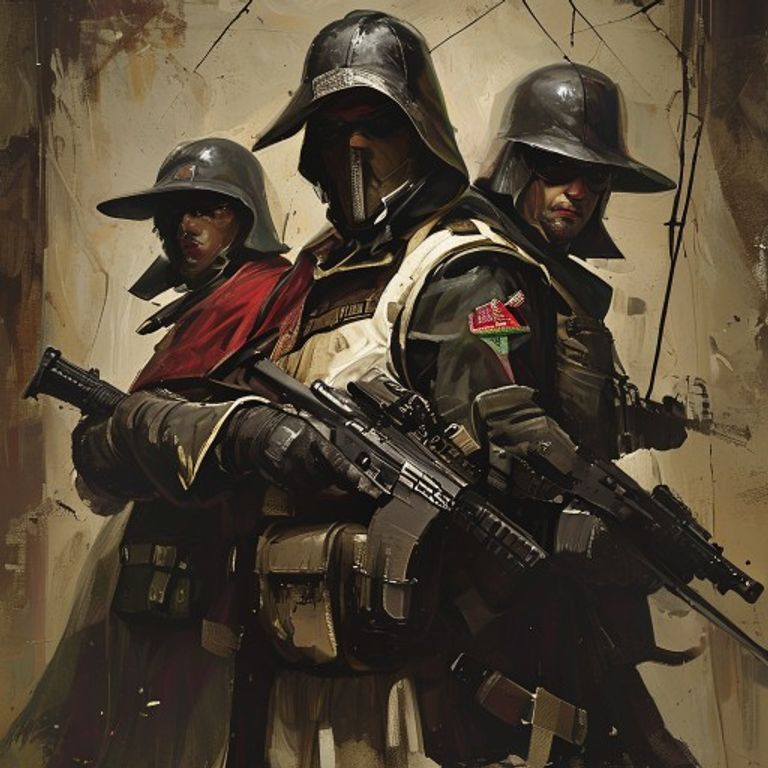
A series of violent attacks on supermarkets in Belgium in the eighties by a never-identified group, resulting in twenty-eight inexplicable deaths.
⚠️ Research prepared with the aid of Deep Research is subject to referential ambiguity.
🖥️ Clean HTML code using a proprietary tool.
👥 Research by Guilherme Felipe, Curation by Sílvio Lôbo
The Brabant Killers: An Inexplicable Terror Haunting Belgium
For decades, Belgium has been haunted by one of the most disturbing criminal mysteries of modern Europe: the attacks by the so-called "Brabant Killers." Between 1982 and 1985, a series of violent robberies and brutal murders at rural properties and supermarkets terrorized the province of Brabant and surrounding areas. What began as a wave of audacious crimes quickly turned into an unsolved enigma, fueled by confusing clues, controversial investigations, and a constant fear that those responsible were still at large.
1. The Context and the Incident: Where, When, and How the Mystery Began
The province of Brabant, a central and densely populated region of Belgium, served as the stage for a series of crimes that initially seemed to have no clear pattern. The first incident of violence that would come to be associated with this group occurred on January 15, 1982, when a couple was murdered in their home in Grange, Waterloo. From then on, a series of similar attacks, characterized by brutal invasions, robberies, and the murder of innocent victims, unfolded at an alarming pace. The audacity and brutality of the criminals, who often acted with disproportionate violence, soon gained media attention and the nickname "Brabant Killers" or "Nivelles Gang" (a nearby city where several incidents occurred).
2. Timeline of Key Events
- January 15, 1982: The first double homicide in Grange, Waterloo. The couple Jean-Claude Van Roy and Françoise Dewolf are murdered.
- 1982-1983: A series of violent robberies and homicides spreads across the region, with an increase in frequency and brutality. Victims include entire families.
- May 9, 1983: The massacre at the Delhaize supermarket in Beersel, where eight people, including two children, are killed. This event marks a turning point in the public perception of terror, increasing pressure on the authorities.
- 1984: The investigation deepens, focusing on possible links to organized crime and paramilitary groups. Police attempt to draw up profiles and identify the modus operandi.
- 1985: The attacks cease abruptly, leaving authorities with more questions than answers. The lack of arrests and the absence of a clear outcome fuel the mystery.
3. The Main Theories
Over the decades, countless theories have emerged, attempting to unravel the identity and motivations behind the Brabant Killers. They range from the most established police hypotheses to darker, conspiratorial speculations.
Police and Scientific Theories:
- The Common Robber Gang: The initial and most direct theory suggested that the criminals were a highly organized and violent gang focused on robbery, but using extreme violence to intimidate and avoid identification. The modus operandi of invading properties and stores, stealing money and valuables, and eliminating witnesses fits this hypothesis. Initial police reports pointed to a group of criminals with experience in robberies.
- Organized Crime Influence: Some investigations suggested links to Belgian and international organized crime networks. The audacity of the attacks and the apparent ability to avoid capture could indicate a level of sophistication and resources that would go beyond a group of common robbers. The possible sale of stolen weapons or the use of insider information could be part of this theory.
- Involvement of Police or Ex-Military: A recurring hypothesis, amplified by some statements and investigations, points to the possibility that members of security forces or individuals with military training were involved. Tactical knowledge, efficiency in executing crimes, and apparent familiarity with weaponry have fueled this line of investigation. Testimonies about the use of specific vehicles and evasion techniques reinforce this idea.
Alternative and Conspiracy Theories:
- Destabilization or Social Control Operation: This theory, often associated with far-right groups or intelligence services, suggests that the attacks could have been orchestrated to create panic and fear in the population, thus justifying stricter social control or serving hidden political agendas. The timing of the attacks, during a period of social and political tension in Belgium, leaves room for this speculation.
- Connections to Paramilitary Groups: There is a possibility that the killers had ties to paramilitary groups active in Belgium during the 80s, which could have had political or ideological motivations. The violence and organization could be seen as a form of show of force or pressure.
- "Ghost" Witnesses and Manipulation: Reports from witnesses who claimed to have seen the killers in other locations, or who were later discredited, fuel the idea that the investigation was, at some point, directed or manipulated. The existence of a "man with the cap" or other suspects who were never formally identified or captured contributes to this narrative.
Paranormal or Supernatural Theories:
Although less supported by concrete evidence, theories about paranormal phenomena or the action of inexplicable entities have also emerged, reflecting the deep mystery and the inability to find rational explanations. However, these are widely considered speculations without factual basis.
4. Controversies and Blind Spots
The investigations into the Brabant Killers were marked by a series of controversies and blind spots that hindered the resolution of the case:
- Destroyed or Missing Evidence: There are reports that some crucial evidence, such as weapons and documents, may have been destroyed or lost over time, both by deliberate action and bureaucratic failures.
- Conflicting Testimonies: Several witnesses presented accounts that, at times, seemed to contradict each other or did not fit completely into the overall picture of the investigations.
- Failures in Police Coordination: Cooperation between different police units and jurisdictions, especially at the beginning of the investigation, was pointed out as flawed in some reports, resulting in the loss of time and crucial opportunities.
- The "Bangue" Case and False Confession: In 1998, Christiaan Bonk, known as "Bangue," confessed to the crimes and implicated Paul Vandemeulebroucke and Christophe Dubois. However, his confession was widely discredited, and the subsequent investigation, dubbed "Operation Callisto," failed to prove his direct participation or that of those he accused. Bonk was a former police officer with a history of mental health issues.
- The "The Giant" Suspect: One of the most persistent suspects, known only as "The Giant," was never identified or located. Reports of his participation were inconsistent, but his figure loomed over the investigation for years.
5. Curiosities and Legacy
The Brabant Killers left an indelible legacy in Belgian and European criminal history. The fear they instilled in the population, the sense of impunity, and the persistence of the mystery shaped the public perception of security and the capacity of the authorities.
- Cultural Impact: The case has inspired books, documentaries, and media speculation, becoming an icon of unsolved crime in Belgium. The lack of answers fuels fascination and debate to this day.
- Persistent Fear: The possibility that the criminals remained free, or that their motivations were more complex than a simple robbery, kept society on alert for many years.
- Current Status: Despite several attempts to reopen the case and new clues emerging sporadically, the Brabant Killers remain unsolved. The case files still contain information that may be declassified in the future, and the hope for a definitive resolution has never completely disappeared. The lack of a definitive confession, irrefutable evidence, and a final trial keeps this dark chapter of Belgian history open, a testament to the persistent nature of evil and the unfathomable complexity of the human mind.





