



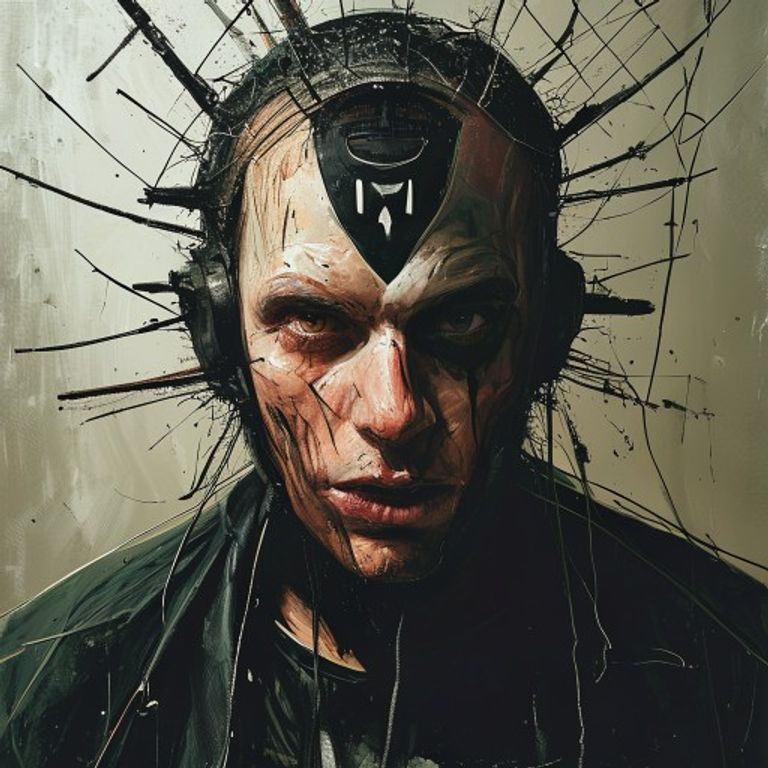
The 1987 incident where the signal of two Chicago TV stations was hijacked by a masked individual who broadcast bizarre and disjointed messages, in a cybercrime that was never solved.
⚠️ Research prepared with the aid of Deep Research is subject to referential ambiguity.
🖥️ Clean HTML code using a proprietary tool.
👥 Research by Guilherme Felipe, Curated by Sílvio Lôbo
The Max Headroom Incident: The Digital Ghost That Haunted Television
On November 22, 1987, a bizarre and disturbing event interrupted television programming in Chicago, United States. For about 90 seconds, the image of a masked man with a sinister smile and a distorted voice invaded the airwaves, replacing the signal of two local stations simultaneously. This episode, known as the "Max Headroom Incident," became one of the most famous and enigmatic unsolved mysteries in television history, fueling conspiracy theories and a fascination with the inexplicable.
The Context and the Incident: Where, When, and How the Mystery Began
The 1980s were a transitional era for television, marked by the rise of pop culture, the proliferation of media, and the increasing sophistication of transmission technologies. Max Headroom, a virtual presenter with a sarcastic personality and a futuristic visual style, had become a cultural icon, popularized by a series of commercials and, later, a science fiction series. It was in this scenario that the intrusion occurred.
On the night of November 22, 1987, the signal of the WGN-TV station in Chicago was suddenly interrupted during the broadcast of the "Spanish Eyes" episode of the series Doctor Who. The image was replaced by a man wearing a Max Headroom mask, dressed in a suit and tie, and sitting in a setting with crumpled metal sheets and flashing lights. The figure gestured awkwardly and uttered disjointed phrases, accompanied by a robotic and distorted voice, with disturbing laughter. The audio was mostly static noise and incomprehensible speech.
The attack was not limited to WGN-TV. About two hours later, on the same day, the signal of the WTTW station, a non-profit public channel, was also invaded by a similar message. This time, the figure introduced himself as "the greatest ambassador of truth," uttering even more incoherent and disturbing words, including comments about rat hygiene and mentions of a children's show called "Clutching at Straws." The invasion lasted approximately 90 seconds in both cases before the original signal was restored.
Timeline of Events
- November 22, 1987 (Night):
- Approximately at 9:00 PM (Chicago local time), WGN-TV programming is interrupted.
- The image of a masked man, imitating Max Headroom, appears on the screen.
- The intruder utters incoherent and disturbing phrases for about 90 seconds.
- The original WGN-TV broadcast resumes.
- Approximately at 11:00 PM (Chicago local time), WTTW programming is also interrupted by the same invasion.
- The original WTTW broadcast resumes after about 90 seconds.
- Days and Weeks Following:
- Chicago police and the FBI begin investigations into the incident.
- Reports and interviews with station employees are collected.
- Media coverage of the event intensifies, generating speculation.
- Subsequent Years:
- The case remains officially unsolved.
- The incident becomes a cultural landmark and a recurring topic in discussions about television mysteries.
- New theories and interpretations continue to emerge.
The Main Theories
The bold and technically sophisticated nature of the intrusion led to the emergence of several theories, ranging from technical and police explanations to more fanciful speculations.
Police and Technical Theories (Most Likely)
- Technical Sabotage and Unauthorized Transmission: The most consensual hypothesis among authorities and transmission experts. The theory suggests that the intruder possessed advanced technical knowledge sufficient to intercept the stations' transmission signal and insert their own content. This could have been done through high-power antennas, the exploitation of vulnerabilities in transmission systems, or even sending a stronger signal that overpowered the original at a specific point in the transmission chain. Police reports indicate that the intrusion occurred at one of the transmission satellites serving the stations, or at one of the relay points. The lack of identification of a specific suspect suggests a planned and discreetly executed operation.
- Connection to "The Max Headroom Show": Although Max Headroom was a fictional character, a television show of the same name, hosted by the character himself, was on the air at the time, produced by Channel 4 in the UK and broadcast in the United States. An initial line of investigation considered the possibility of a deliberate attack by fans or individuals dissatisfied with the show, using the Max Headroom image to draw attention. However, the technical nature of the invasion and the scope of the attack make this hypothesis less likely as the sole explanation.
Alternative and Conspiracy Theories
- Protest or Political/Social Message: Some theorists suggest that the intrusion was an act of protest or an attempt to convey a subversive message. The fragmented and incoherent speech of the intruder, along with the choice of a pop icon like Max Headroom, could be interpreted as a critique of media superficiality, consumer culture, or social issues of the time. However, the absence of a clear message makes this theory difficult to prove.
- Social Experiment or Viral Marketing (Anachronistic): A more modern theory suggests that the intrusion could have been a form of viral marketing or a social experiment, with the goal of generating buzz and attention for something. However, considering the technology available in 1987, such a sophisticated viral marketing plan would be extremely difficult to conceive and execute.
- Concealment of Information: In more elaborate conspiracy lines, it is suggested that the intrusion may have been a deliberate distraction to hide the transmission of confidential information or more important events that were occurring simultaneously on television or in other media. This theory lacks concrete evidence.
Paranormal and Supernatural Theories
- "Digital Ghost" Manifestation: Some more fanciful narratives speculate about the possibility of a paranormal manifestation or a "digital ghost." The idea that an entity or consciousness could have manifested through radio and television waves, using the image of Max Headroom as an avatar, appeals to mystery and the unknown. These theories, while intriguing, lack any scientific or evidentiary basis.
Controversies and Blind Spots
The official investigation into the "Max Headroom Incident" presents several gaps and blind spots that perpetuate the mystery:
- Lack of Identified Suspects: Despite the efforts of the FBI and Chicago police, no suspect was formally identified or charged. The nature of the invasion, which involved the interception and manipulation of transmission signals, would require a level of technical expertise that was not easily traceable.
- Unrecovered Equipment: There are no official reports that any equipment used in the invasion was seized. The lack of physical traces makes it difficult to identify who could have carried out the act.
- Conflicting or Incomplete Testimonies: Although station employees reported the incident, specific details about how the invasion occurred and who might be involved remained obscure. The initial focus was more on the interruption of programming than on identifying the perpetrator.
- Confidential Information and Files: Reports indicate that some of the files related to the investigation were considered confidential for a period, which may have limited public access and independent analysis by researchers or journalists. The declassification of documents, when it occurred, did not bring a definitive outcome.
- The Exact Profile of the Technical Invasion: While there is speculation about signal interception, the exact details of how the signal was inserted into the broadcasts of two different stations simultaneously, or with a short interval, remain technically complex and open to interpretation.
Curiosities and Legacy
The "Max Headroom Incident" transcended the sphere of television to become a cultural phenomenon.
- Impact on Pop Culture: The incident inspired countless articles, documentaries, episodes of TV series (such as The X-Files and Community), songs, and even a video game. The iconic image of the masked intruder became a symbol of the fragility of technology and the possibility of unauthorized voices penetrating our media space.
- Persistent Mystery: The case remains one of the most fascinating unsolved mysteries of the 20th century. The lack of a definitive answer fuels the popular imagination and the search for new clues or explanations.
- Current Status: Officially, the case remains open, without resolution. Although there is no formal reopening with active new investigations, the mystery of the "Max Headroom Incident" is constantly revisited by enthusiasts and researchers, keeping the flame of curiosity alive and the hope that one day the truth may come to light. The digital specter of the masked man continues to haunt the airwaves, an enigmatic reminder of a day when television was silenced by a digital ghost.





