



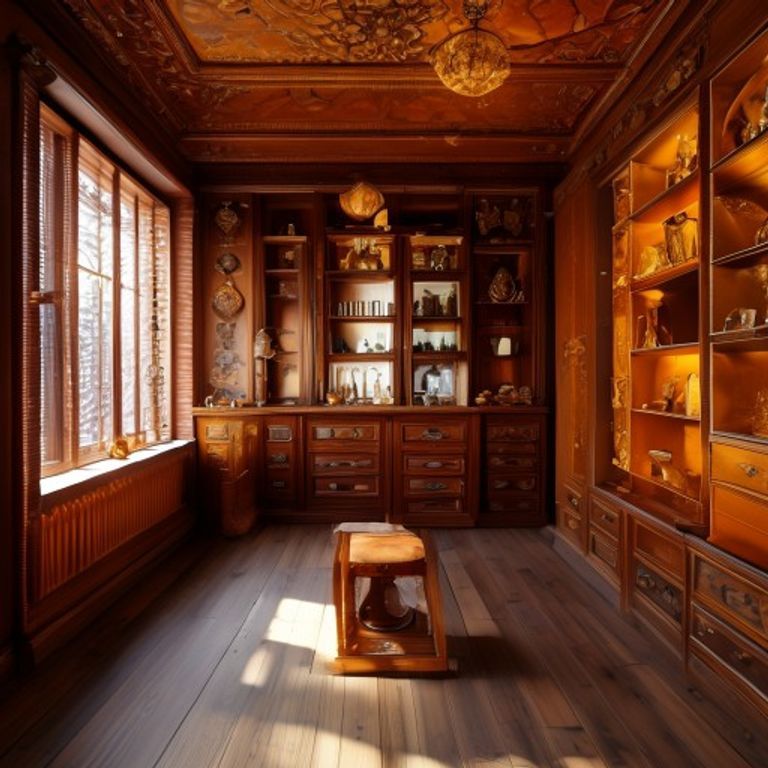
A chamber decorated in gold and amber that was stolen by the Nazis in Russia in 1941 and disappeared without a trace after the end of World War II.
⚠️ Research conducted with the aid of Deep Research is subject to referential ambiguity.
🖥️ Clean HTML code using a proprietary tool.
👥 Research by Guilherme Felipe, Curation by Sílvio Lôbo
The Lost Treasure: Unraveling the Enigma of the Amber Room
The mystery of the Amber Room is one of the most fascinating and frustrating enigmas of the 20th century. A treasure of inestimable value, adorned with amber panels and gold leaf, it disappeared during World War II, leaving behind a trail of speculation, theories, and an eternal quest for its recovery. This documentary article delves into the depths of this case, separating proven facts from persistent legends.
1. The Context and the Incident: Where, When, and How the Mystery Began
The history of the Amber Room begins in the 18th century, when King Frederick William I of Prussia commissioned the construction of a room entirely paneled in amber. The work was completed in 1701 at Charlottenburg Palace in Berlin. Later, in 1716, Tsar Peter the Great of Russia visited Prussia and was so amazed by the beauty of the chamber that King Frederick William I gifted it to the Tsar. The Room was then transported to Saint Petersburg, Russia, and installed in the Catherine Palace at Tsarskoye Selo, with extensions and restorations that made it even more magnificent. For over two centuries, the Amber Room was one of the most dazzling symbols of Russian opulence. The mystery began in 1941. With the invasion of the Soviet Union by Nazi forces, the Soviets attempted to dismantle and protect the treasure. However, the Nazis arrived before the dismantling could be fully completed. In October 1941, soldiers of the 6th Infantry Division of the Wehrmacht, under the command of Brigadier General Alfred Krauss, occupied the Catherine Palace. Reports indicate that the Nazis, impressed by the beauty of the Room, dismantled the panels and packed them into crates, transporting them to Königsberg (now Kaliningrad), in East Prussia. In Königsberg, the Amber Room was exhibited at Königsberg Castle, serving as a symbol of Nazi victory and as an elaborate propaganda center. From that point on, the trail of the treasure was lost forever.
2. Timeline of Events: A Chronological Reconstruction
* 1701: Completion of the original Amber Room at Charlottenburg Palace, Prussia. * 1716: Gifted to Tsar Peter the Great of Russia. * 1755: Restoration and expansion of the Room at the Catherine Palace, Saint Petersburg. * September 1941: Nazi occupation of Tsarskoye Selo and the Catherine Palace. * October 1941: Dismantling and transport of the Amber Room panels to Königsberg, East Prussia. * 1941-1945: The Amber Room is exhibited and stored at Königsberg Castle. * April 1945: After intense Allied bombing of Königsberg, the Nazis begin a campaign of evacuation and destruction of assets. The final fate of the Amber Room becomes uncertain. * April 1945: Königsberg Castle is severely damaged by fire and bombing, supposedly destroying what remained of the Room. * Post-war: Beginning of investigations and speculation regarding the whereabouts of the Amber Room.
3. Main Theories: Hypotheses and Speculations
The uncertainty regarding the fate of the Amber Room has generated a myriad of theories, ranging from the probable to the fantastic. * Theory of Destruction in Königsberg: * Logic: This is the hypothesis most accepted by authorities and historians. It maintains that the Amber Room was destroyed in the fire and bombings that hit Königsberg Castle in April 1945. Military archives and testimonies from Nazi soldiers who served in the area suggest that the castle was the target of fierce attacks, and many valuable items were damaged or lost in the chaos. * Evidence: Reports of extensive damage to Königsberg Castle, testimonies that the castle was in flames and ruins. * Theory of Sinking on Ships: * Logic: A variation of the destruction theory. It suggests that the Room, or parts of it, were being transported on ships that were sunk by Allied forces or by the German navy itself during the evacuation of East Prussia. Ships like the MV Wilhelm Gustloff and the SS General von Steuben sank under similar conditions. * Evidence: Records that many vessels were used to evacuate assets and personnel from East Prussia in 1945, and that some of them were sunk. The heavy and bulky nature of the crates would make maritime transport a plausible option. * Theory of a Secret Hiding Place in Königsberg: * Logic: The idea is that the Nazis, anticipating defeat, hid the Amber Room in secret bunkers, mines, or underground tunnels in the vicinity of Königsberg. The city has an extensive network of tunnels and fortifications. * Evidence: Reports of Nazi activities hiding precious artifacts. However, no concrete evidence of a specific hiding place for the Amber Room has been discovered. * Theory of Transport to Germany: * Logic: Some believe that the Amber Room was effectively transported to Germany and may be hidden in some still-unknown location, possibly in secret warehouses or private properties. * Evidence: Rumors occasionally surface about the discovery of panels or fragments of the Room in locations in Germany. However, the authenticity of these claims is rarely proven. * Alternative and Conspiracy Theories: * The Logic: These theories unfold into several strands: * Soviet Greed and Recovery: The Soviet Union allegedly recovered the Room and kept it secret for themselves. * Dismantling by Private Collectors: Wealthy and powerful individuals allegedly took possession of parts of the Room for private collections. * Hidden by Nazi Officers: A group of Nazi officers allegedly conspired to hide the treasure for future use or for their own benefit. * Paranormal/Occult Theories: Some more extravagant narratives suggest that the Room was taken by unconventional methods or that its whereabouts are linked to secret societies or supernatural forces. * Evidence: Generally based on rumors, assumptions, and interpretations of historical events to fit the theory. Lack of concrete proof.
4. Controversies and Blind Spots
The investigation into the disappearance of the Amber Room is full of inconsistencies and gaps. * Conflicting Reports: There are significant discrepancies between witness accounts and official reports regarding the exact timing of the dismantling, the number of crates, and the method of transport. * Lost or Destroyed Evidence: The post-war chaos and the destruction in Königsberg may have obliterated crucial evidence. Soviet and German archives were lost or deliberately destroyed. * Lack of Key Witnesses: Many of the individuals who could have provided definitive information about the whereabouts of the Room passed away before they could be fully interrogated. * Political Motivations: Both during the Nazi era and the Soviet era, the narrative surrounding the Amber Room was, in part, shaped by propaganda and concealment purposes, making it difficult to obtain impartial information. * The "Goeth Treasure": In 1977, a Soviet report speculated that the Room could have been hidden on an armored train by Otto Skorzeny, a famous SS officer. This theory, while intriguing, lacks concrete proof and is considered speculative by many historians.
5. Curiosities and Legacy
The Amber Room case has transcended the field of history and archaeology to become a pop culture icon. * The Restoration: In 1979, the Soviet government began an ambitious project to restore the Amber Room, which culminated in the reopening of a replica at the Catherine Palace in 2003, funded in part by Germany. This replica, while dazzling, is a reminder of the lost original. * Ongoing Searches: The search for the original Amber Room continues. Expeditionists, treasure hunters, and amateur historians scour the Kaliningrad region and adjacent areas in search of clues that could lead to its location. * Cultural Inspiration: The mystery of the Amber Room has inspired countless books, films, documentaries, and games, fueling public fascination with lost treasures and secrets of World War II. * Current Status: The case remains officially an unsolved mystery. Although the destruction theory is widely accepted, the absence of definitive evidence keeps alive the hope and speculation that the Amber Room may one day be rediscovered, revealing one of the greatest secrets of modern history.





