



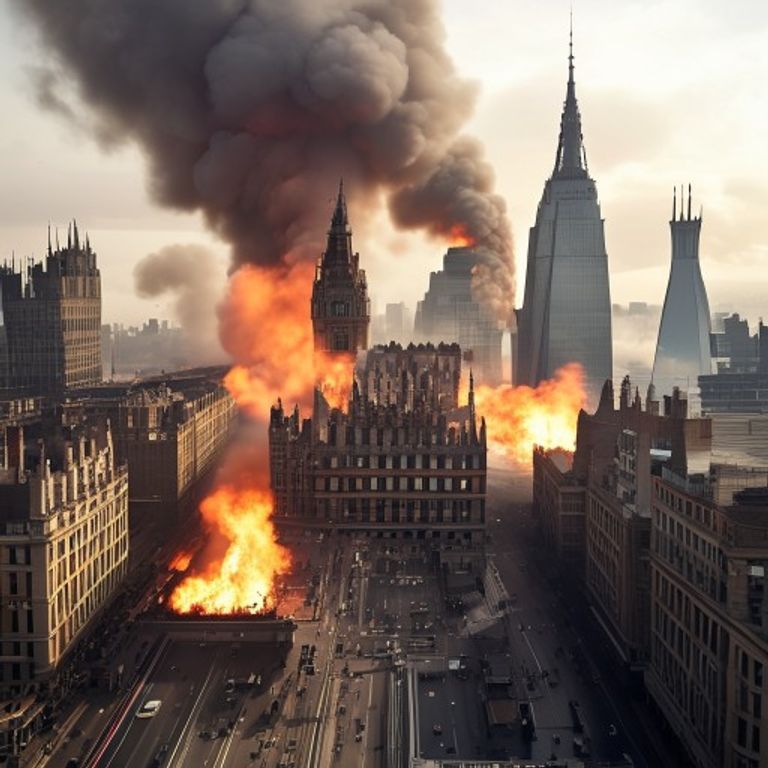
The fire that devastated the city in 1666, destroying most of the medieval buildings and leading to the first major planned urban reconstruction and the creation of modern insurance.
⚠️ Research conducted with the aid of Deep Research is subject to referential ambiguity.
🖥️ Clean HTML code using a proprietary tool.
👥 Research by Guilherme Felipe, Curation by Sílvio Lôbo
The Great Fire of London: Ashes of a Mystery Burned in Time
The night of September 2, 1666, engulfed London in flames, an inferno that would rage for four devastating days, reshaping the city and leaving behind a trail of destruction and a mystery that persists to this day. What began as a small incident in a humble bakery turned into a cataclysm that consumed the beating heart of the English capital. But behind the flames that licked the sky and the smoldering ruins, a persistent question hides: was it just a tragic accident, or did something more sinister ignite on that fateful night?
The Context and the Incident: Where, When, and How the Mystery Began
London in 1666 was a labyrinth of narrow, winding streets, dominated by wooden buildings covered in thatch. A densely populated metropolis where fires were a constant threat, but rarely of such catastrophic magnitude. The epicenter of the tragedy was Thomas Farriner's bakery, located on Pudding Lane, near London Bridge. The official narrative, corroborated by accounts from the time, points to an improperly extinguished oven as the igniter of the disaster. The strong east wind, a constant at the time, acted as a cruel catalyst, spreading sparks and embers throughout the city with frightening speed.
Timeline of Events
The chronological reconstruction of events is crucial to unraveling the complexities of this disaster:
- Early hours of Sunday, September 2, 1666: The fire breaks out at Thomas Farriner's bakery on Pudding Lane. Initially, it is considered a common fire, with few effective attempts to contain it.
- Morning of September 2: The flames spread rapidly. The strong wind and the city's architecture contribute to its voracity. Local authorities seem unprepared for an emergency of this magnitude.
- September 3: The fire reaches its peak. St. Paul's Cathedral, then a medieval structure, is consumed by the flames. The destruction spreads across much of the City of London. King Charles II orders the demolition of houses to create firebreaks, a desperate measure to contain the fire's advance.
- September 4: The wind dies down. Authorities, with the help of explosives to create larger firebreaks, finally manage to control the fire.
- September 5: The fire is declared extinguished, but the damage is incalculable.
The Main Theories
Over the centuries, various theories have attempted to explain the origin and spread of the Great Fire of London, from the most plausible to the most fantastic:
Scientific and Police Theories (Most Likely)
- The Bakery Accident: This is the dominant and widely accepted theory. An improperly extinguished oven at Thomas Farriner's bakery would have left glowing embers that, upon coming into contact with flammable materials, started the fire. The lack of firefighting infrastructure and the architecture of the time facilitated the rapid spread. Reports from the time, such as those by Samuel Pepys, corroborate the lack of organization and the initial spread of the fire.
- Negligence and Communication Failure: The initial response to the fire was marked by hesitation and inefficiency. Authorities were slow to react, and the measures taken were inadequate for the scale of the disaster. The lack of an effective emergency plan and slow communication between different parts of the city worsened the situation.
Alternative and Conspiracy Theories
- Catholic Sabotage: In a London still marked by religious tension and fear of a Catholic conspiracy, accusations arose that the fire was a deliberate act orchestrated by Catholics to weaken Protestant England. A French baker, Robert Hubert, was arrested and confessed to starting the fire, subsequently being executed. However, there are strong doubts about the veracity of his confession, possibly obtained under torture or coercion, and about his ability to have carried out such a feat. Judicial reports and later testimonies question his sanity and the credibility of his confession.
- French or Dutch Action: Amidst military conflicts with France and the Netherlands, speculation arose that the fire could have been an act of war, a way to destabilize England. This theory lacks concrete evidence and is seen more as a reflection of the geopolitical tensions of the time.
Paranormal and Supernatural Theories
- Divine or Demonic Intervention: For some at the time, the fire was interpreted as divine punishment for humanity's sins, or as the work of demonic forces. These interpretations reflect the prevailing religious mindset of the 17th century and are not based on any empirical evidence.
Controversies and Blind Spots
The official investigation into the Great Fire of London, although it pointed to the accident at the bakery, is far from free of controversy and blind spots:
- The Case of Robert Hubert: The confession of Robert Hubert, a man with mental health issues, and his subsequent execution, raise serious questions about the justice of the process. Many modern historians believe he was a convenient scapegoat to appease anti-Catholic hysteria. The report of his confession, although official, is full of inconsistencies.
- Ignored Clues and Missing Evidence: The speed with which the fire spread and the massive destruction made collecting rigorous evidence almost impossible. It is likely that many crucial clues were consumed by the flames or lost in the chaos.
- Conflicting Testimonies: Although many accounts point to the bakery, the chaotic nature of the event and the widespread panic may have led to conflicting or inaccurate testimonies. The search for an immediate culprit may have obscured the objective analysis of the causes.
Curiosities and Legacy
The Great Fire of London, despite its tragedy, left a lasting and fascinating legacy:
- Reconstruction of the City: The fire provided the opportunity to rebuild London with more modern urban planning. Streets were widened, buildings began to be constructed with stone and brick, and a basic sanitation system began to be implemented. Sir Christopher Wren, a renowned architect, was fundamental in this process, designing the new St. Paul's Cathedral and numerous other churches.
- Cultural Impact: The event deeply marked the collective London and English memory, inspiring countless literary and artistic works. Diaries such as those of Samuel Pepys and John Evelyn offer vivid and personal accounts of the devastation.
- Current Status: The case of the Great Fire of London has not been reopened in the traditional sense of a crime to be judged. However, historical and archaeological research continues to deepen the understanding of the event. The official cause of the fire is widely accepted as accidental, but the mystery surrounding possible conspiracies and the execution of Robert Hubert continue to fuel debates and maintain the fascination over the ashes of a flaming past. The Monument to the Great Fire of London, erected on the site where the fire began, remains an imposing reminder of the destructive force of nature and the resilience of a city.





