



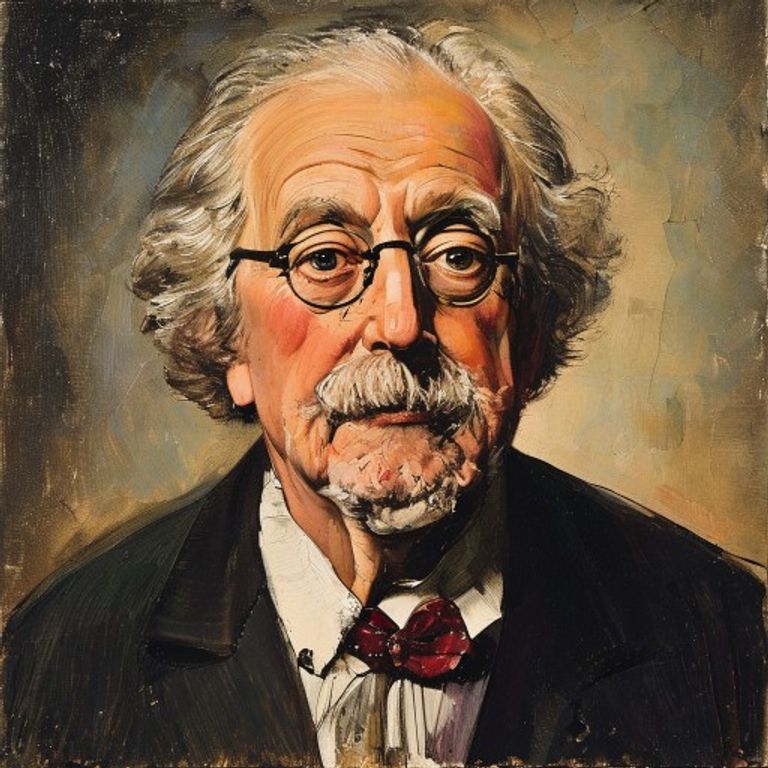
The mountaineer who disappeared on Everest in 1924; his body was found in 1999, but the absence of his wife's photo, which he intended to leave at the summit, suggests he may have reached the top.
⚠️ Research prepared with the aid of Deep Research is subject to referential ambiguity.
🖥️ Clean HTML code using a proprietary tool.
👥 Research by Guilherme Felipe, Curation by Sílvio Lôbo
The Mount Everest Enigma: What Happened to George Mallory?
On June 8, 1924, on the relentless and frozen peak of Mount Everest, two British adventurers, George Mallory and Andrew Irvine, disappeared in their audacious attempt to be the first to conquer the "Roof of the World." Their ascent, fueled by a mix of national glory and exploratory fascination, ended in a sepulchral silence that resonates to this day, fueling one of the most enduring mysteries of alpine exploration and human history. What happened to Mallory and Irvine on that fateful day? The question, in its essence, remains unanswered, encapsulated by the mantle of snow and ice of Earth's highest peak.
The Context and the Incident: The Shadow on Everest
The 1920s were an era of exploratory fervor. Everest, known at the time as the "Third Mountain," was the last great geographical challenge to be overcome. Mallory, a renowned mountaineer and intellectual, had already participated in two previous Everest expeditions in 1921 and 1922, gaining intimate knowledge of the mountain. In the 1924 expedition, led by General Charles Bruce, the strategy was simple: reach the summit using supplemental oxygen, a technological novelty for the time.
Mallory and Irvine departed from Camp VI, located at approximately 7,000 meters of altitude, on the morning of June 8. They were last seen by their expedition companions, Noel Odell and Edward Norton, at a considerable altitude, near the summit. Odell reported seeing the two men moving with agility, "fighting against the wind" on a rocky ridge, before being obscured by a snow cloud. After that, silence. No sign of return, no message. Mallory and Irvine simply vanished into the inhospitable vastness.
Timeline of Events
- 1921: First British expedition to Everest. George Mallory participates, mapping routes.
- 1922: Second British expedition. George Mallory participates, reaching record altitudes for the time.
- June 8, 1924: George Mallory and Andrew Irvine depart from Camp VI for the final climb of Everest, using oxygen.
- June 8, 1924: Witnesses, including Noel Odell and Edward Norton, spot Mallory and Irvine at a high altitude, near the summit.
- June 8, 1924: Mallory and Irvine disappear.
- 1933: The body of a mountaineer (later identified as Andrew Irvine) is found at an altitude of approximately 8,400 meters.
- 1999: The Mallory and Irvine Research Expedition finds the body of George Mallory at an altitude of 8,157 meters.
The Main Theories
The absence of a clear outcome opened the doors to a range of theories, some more plausible than others, but all attempting to fill the void left by the tragedy.
Theory 1: The Summit Reached
This is the most romantic and celebrated hypothesis. The theory suggests that Mallory and Irvine did, in fact, reach the summit of Everest before perishing on the descent. The 1999 discovery of Mallory's body with his belongings, including a photograph he vowed to leave at the summit if successful, strengthened this belief for many. The logic behind this lies in Mallory's fierce determination and the apparent aptitude of Irvine, who possessed more modern and efficient oxygen equipment for the time, which could have allowed for the ascent.
Evidence and Points of Controversy: The main anecdotal evidence is Odell's sighting. The controversy lies in the impossibility of confirming whether the sighting occurred above or below the summit, and the difficulty of assessing the exact speed and direction of both mountaineers in extreme weather conditions. The absence of concrete proof, such as a recovered camera that could contain images of the summit or items intentionally left at the top, keeps this theory in the realm of speculation.
Theory 2: The Accident on the Descent
This is the explanation most accepted by many authorities in mountaineering and alpinism. It postulates that Mallory and Irvine reached a significant altitude, perhaps even the summit, but suffered a fatal accident during the descent process. Falls, extreme exhaustion, hypothermia, or equipment failure are probable causes.
Evidence and Points of Controversy: Mallory's body was found with significant fractures, indicating a fall. The location of Irvine's body, at a higher altitude than Mallory's, suggests he may have fallen after Mallory. The controversy here is whether the fall occurred before or after reaching the top. Official reports of the time did not have the resources for a detailed forensic investigation.
Theory 3: Oxygen Equipment Failure
Oxygen equipment was a relatively new and not entirely reliable technology in the 1920s. A failure in one of these cylinders could have led to rapid exhaustion and the inability to continue.
Evidence and Points of Controversy: Anecdotal evidence suggests that Irvine's equipment was more advanced, but still susceptible to problems. The lack of detailed records on the specific functioning of both mountaineers' equipment makes confirmation difficult. However, it is a real possibility that contributed to the fragility of the expedition.
Alternative and Paranormal Theories
Although less supported by concrete evidence, some theories explore more exotic scenarios:
- Conspiracy Theory (Voluntary Disappearance): Rumors, without any solid factual basis, suggested that Mallory and Irvine could have decided to disappear on purpose for unknown reasons, although this is highly unlikely given the glory the conquest would bring to the British Empire.
- Paranormal/Extraterrestrial Phenomena: At one extreme, speculations about encounters with unknown entities or inexplicable phenomena on the mountain are found in online forums and conspiracy theory circles, without any type of proof.
It is crucial to separate these speculations from the rigorous investigation that the story of Mallory and Irvine deserves.
Controversies and Blind Spots
The initial investigation, given the remote and dangerous nature of the location, was limited. However, some question marks persist:
- Mallory's Kodak Camera: Mallory carried a Kodak camera. If found, it could contain the images that would prove or refute the success of his climb. The fact that it was not found with his body is one of the greatest enigmas. The theory is that Irvine was carrying it and it fell somewhere on the mountain.
- Irvine's Silk Scarf: Irvine wore a silk scarf, which, according to reports, was to be left as a signal if he and Mallory reached the summit. The scarf was never found.
- The Identification of Irvine's Body: The body found in 1933, initially attributed to Irvine, was later questioned by some, although most evidence pointed to him.
- The Silence of the Survivors: Although the survivors reported what they saw, the inability to provide more precise details about the exact whereabouts of Mallory and Irvine, due to extreme conditions, is a natural blind spot.
Curiosities and Legacy
The case of George Mallory and Andrew Irvine transcended the world of mountaineering to become a cultural icon of human perseverance and unsolved mystery. Mallory's determination to "climb the mountain because it is there" became a mantra for explorers and adventurers around the world.
The impact of their story is immense:
- Inspiration for Future Expeditions: The mystery fueled several search expeditions, culminating in the discovery of Mallory's body in 1999, which reopened the debate and generated new global interest.
- Cultural Reference: Mallory's name and the question of his disappearance are frequently cited in books, films, and documentaries, representing the pinnacle of the exploratory spirit and the tragedy inherent in the search for limits.
- Current Status: The case remains officially an incident of disappearance and death on a mountain. There is no formal reopening in a police sense, but the community of explorers and historians continues to investigate and debate the evidence. The hope of finding Irvine's camera and, with it, a definitive answer, persists.
Mount Everest guards its secrets with an impassive silence. And as long as the mountain continues to challenge humanity, the shadow of George Mallory and Andrew Irvine will hover over its frozen peaks, an eternal reminder of human fragility in the face of nature's magnificence and the seduction of the unknown.





