



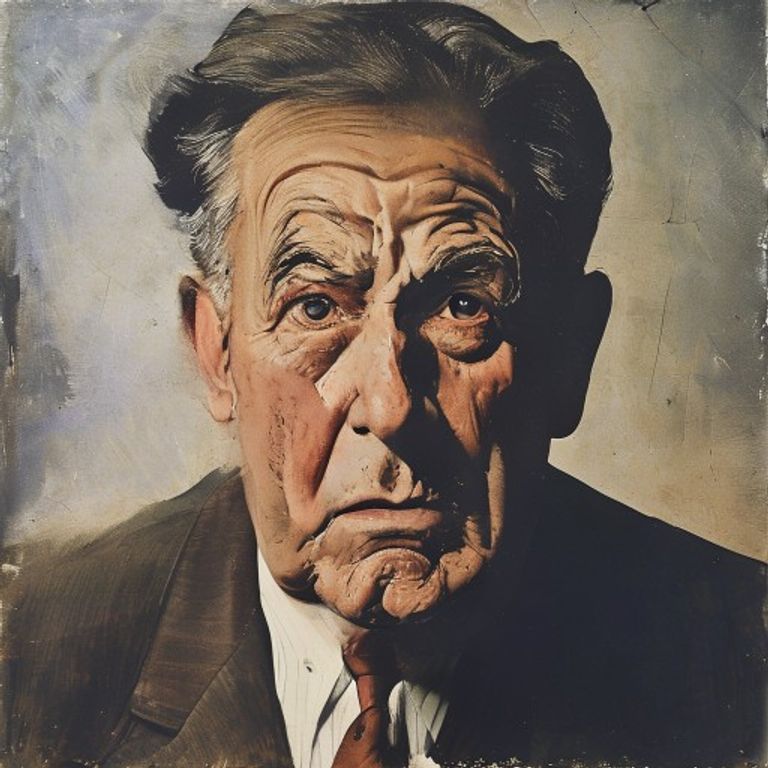
The literary work that predicted concepts such as ubiquitous state surveillance and the manipulation of truth, becoming a reference for modern political analysis.
⚠️ Research conducted with the aid of Deep Research is subject to referential ambiguity.
🖥️ Clean HTML code using a proprietary tool.
👥 Research by Guilherme Felipe, Curation by Sílvio Lôbo
The 1984 Enigma: Orwell's Shadow on Reality
In 1984, the world turned its eyes toward the dystopian future painted by George Orwell in his seminal novel. However, far from the pages of fiction, a real case, shrouded in mystery and misinformation, echoed fears of surveillance and state control, casting an unsettling shadow over the very nature of reality and truth. What unfolded, and what remained hidden, will forever define what we call the '1984 Case'.
1. The Context and the Incident: Where the Shadow Began
The so-called '1984 Case' does not refer to a single isolated event, but rather to a confluence of occurrences and the public perception that surrounded them during the year 1984. The core of the issue lies in the growing global apprehension regarding technological advancement, the expansion of intelligence apparatuses, and the possibility of totalitarian control, mirroring Orwell's prophecies. The "incident" itself is more diffuse: the perception that reality was shaping itself, in a frightening way, to literary predictions.
Although there is no specific "location" where the mystery began, the global atmosphere was a melting pot of tensions. The Cold War was reaching peaks of tension, the arms race was evolving rapidly, and the popularization of personal computers was opening doors to new forms of surveillance. The date itself, 1984, became a symbol, a trigger for discussions about freedom, privacy, and the manipulation of information.
2. Timeline of Events: Constructing the Plot
The difficulty in dating a single "incident" makes the timeline for the '1984 Case' more contextual and cyclical than linear. However, we can outline milestones that fueled the perception of the mystery:
- Previous Decades: The publication of "1984" by George Orwell in 1949 establishes the backdrop and language for the fear.
- Beginning of the Digital Age (70s/80s): The development of centralized databases, electronic surveillance systems, and increasing data processing capacity begin to create the tools for the "Big Brother" imagined by Orwell.
- 1983: The release of the film "1984," starring John Hurt, revives public interest in the novel and its warnings.
- 1984: The year itself becomes the focal point. Public perception, fueled by media and political debate, intensifies the comparison between fiction and reality. Specific incidents of government surveillance, information leaks, and concerns about data privacy begin to be associated with the "spirit of 1984."
- Subsequent Years: The continuous technological advancement, the spread of the internet, and the proliferation of cameras and facial recognition systems only solidify the feeling that Orwell's predictions were, in fact, prophetic and, in many aspects, had already materialized.
3. Main Theories: Unraveling the Layers of Distrust
The '1984 Case' is not a crime to be solved, but a perception to be analyzed. The theories surrounding it reflect the anxieties of the time and the nature of information manipulation.
3.1. The Orwellian Reality (Proven Facts and Observations)
This theory, the most grounded, maintains that Orwell's "prophecy" has materialized to significant degrees. Proven facts include:
- Government Surveillance Programs: Reports and declassified files over the years have confirmed the existence and expansion of large-scale surveillance programs by governments around the world, using technologies such as communication interception and data collection.
- Censorship and Information Manipulation: History documents countless cases of governments and institutions that have attempted to control narratives, suppress dissent, and manipulate public opinion through direct censorship or the dissemination of disinformation.
- Thought Control (Indirect): Although Orwell's "thought police" is fictional, the influence of propaganda, social conditioning, and the incessant repetition of narratives can be seen as an indirect form of thought control.
3.2. Collective Consciousness and the Power of Narrative (Speculation/Social Analysis)
This hypothesis suggests that the strength of Orwell's novel, combined with contemporary events, created a "self-fulfilling prophecy" in public perception. Constant reference to the book led people to interpret everyday events through Orwellian lenses, amplifying the feeling of oppression and control, even where no direct intentions for such existed.
3.3. Conspiracy Theories (Critical Analysis)
Some conspiracy theories, which gained strength especially after the digital age, suggest that hidden groups or secret governments actively orchestrated the implementation of Orwellian control. These theories often point to:
- Hidden Agendas: The existence of secret plans to establish a total surveillance society, disguised as security measures or technological progress.
- Cultural Manipulation: The idea that the book "1984" itself was a way to "plant" the idea in the minds of the masses, preparing them for the acceptance of future measures.
Analysis: These theories generally lack concrete evidence and tend to rely on forced correlations and subjective interpretations of events. The "logic" here lies in the inherent distrust of power institutions and the search for simple explanations for complex phenomena.
3.4. Paranormal and Post-Cognition (Alternative Theories)
Although less common and more speculative, there are theories that explore the idea of a deeper connection between Orwell's work and reality, bordering on the paranormal:
- Literal Precognition: The possibility that Orwell, in some way, had access to future information, or that his work was a channel for knowledge of an inevitable future.
- Psychic Manifestation: A suggestion that the intensity of fear and concern regarding totalitarian control generated a kind of "collective consciousness" that, in some way, influenced or prefigured events.
Analysis: These theories lack any scientific or evidentiary basis, relying on metaphysical and anecdotal interpretations. The logic is purely speculative, linking intuition and imagination to factual reality.
4. Controversies and Blind Spots: Gaps in the Narrative
The '1984 Case' is inherently controversial due to its non-criminal nature and the subjectivity of its interpretation. However, blind spots and inconsistencies emerge when trying to draw direct parallels:
- Overgeneralization: The temptation to label any act of government surveillance as "Orwellian" ignores the nuances and legitimate security purposes that may exist.
- Ignorance of Social Nuances: Direct comparison with fiction often disregards the complexity of modern societies, popular resistance, and democratic safeguards that, in many places, have prevented the complete realization of the dystopia.
- Technological Evolution as a Driving Force: The most likely "cause" for the similarity to Orwell is not a deliberate conspiracy, but the inexorable evolution of technology itself, which offers increasingly powerful surveillance tools.
- Focus on the Victim vs. The System: The Orwellian narrative tends to focus on the oppression of the individual. However, modern reality involves debates about data collection by private companies and the misuse of information by algorithms, which are aspects Orwell could not have fully foreseen.
5. Curiosities and Legacy: The Persistent Shadow
The '1984 Case' is not a closed file, but a living and constantly evolving legacy.
- Cultural Impact: The novel "1984" and its association with the year 1984 shaped the collective imagination regarding surveillance, control, and the dark potential of technology. Terms like "Big Brother," "Newspeak," and "doublethink" have become part of the cultural vocabulary, used to describe and criticize contemporary realities.
- Continued Relevance: With the advent of the internet, social media, artificial intelligence, and massive data collection, the concerns raised by Orwell have become even more pertinent. Every new surveillance technology or privacy scandal is immediately compared to the world of Oceania.
- Current Status: The '1984 Case' has not been formally reopened or shelved, as it was never a police investigation case. It remains a cultural reference and a starting point for ethical, political, and technological discussions. The search to understand the limits of surveillance and freedom in the digital age is, in essence, the continuation of the "1984 Case." Orwell's shadow looms, a constant reminder that dystopia is not just a tale, but an ever-present possibility, shaped by our own choices and the relentless evolution of technology.





