



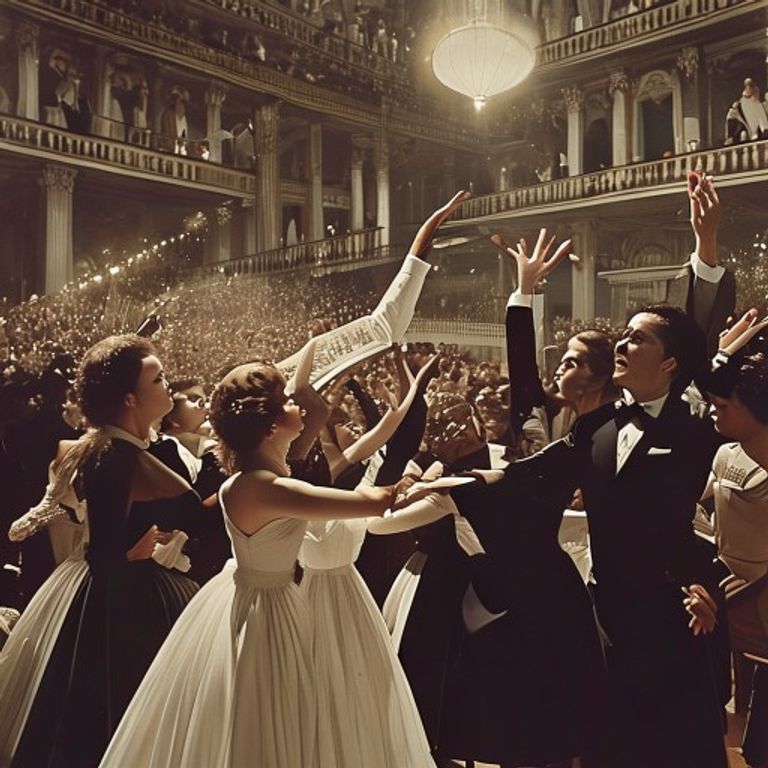
Directed by the master of melodramas and musicals Vincente Minnelli, An American in Paris (1951) transcended the boundaries of post-war entertainment cinema to establish itself as one of the most exuberant visual and auditory celebrations of Hollywood's Golden Age. Starring the tireless Gene Kelly and marking the cinematic debut of the delicate Leslie Caron, this Metro-Goldwyn-Mayer (MGM) masterpiece fuses the musical genius of George Gershwin with a narrative of passion, bohemian life, and artistic reconstruction, forever redefining the role of dance in film narrative structure and winning the coveted Academy Award for Best Picture.
Analysis and Plot
Released at a time when Hollywood was desperately trying to win back audiences migrating to television, An American in Paris presents an idealized, romantic, and deliberately stylized vision of the French capital. The screenplay, written by the brilliant Alan Jay Lerner, follows Jerry Mulligan (Gene Kelly), a World War II veteran who decides to remain in Europe to try his luck as a painter in the bohemian neighborhood of Montmartre.
Jerry shares his routine with the sarcastic and cynical pianist Adam Cook (Oscar Levant), an eternal scholarship student who survives on small gigs, and Henri Baurel (Georges Guétary), a charismatic cabaret singer who is about to get married. The plot thickens when Jerry is discovered by Milo Roberts (Nina Foch), a wealthy American heiress who offers to be his patron—though her real intentions are much more tied to the painter's body than his art. Meanwhile, at a Parisian café, Jerry falls in love at first sight with Lise Bouvier (Leslie Caron), a mysterious young French woman who works at a perfume shop. The central conflict arises when we discover that Lise is Henri's fiancée, to whom she owes immense gratitude for protecting her during the Nazi occupation of France.
What follows is a classic comedy of romantic misunderstandings and kept secrets. Jerry and Henri become friends without knowing they love the same woman. While Milo tries to buy Jerry's affection by promoting an exclusive exhibition for him, Jerry fights to win Lise's heart, as she finds herself torn between her overwhelming passion for the American painter and her moral duty and eternal gratitude toward Henri.
The Visual Climax: The 17-Minute Ballet and the Meaning of the Ending
The conclusion of An American in Paris is one of the boldest milestones in cinema history. After Lise decides she will honor her commitment to Henri, she and Jerry say goodbye at a gala in Montmartre. Devastated, Jerry is left alone on the balcony, looking out at the Parisian nightscape. From a tear in his drawing of the city, the film plunges into a fever-dream sequence, a purely instrumental 17-minute ballet that cost a staggering 500,000 dollars at the time—nearly a third of the film's total budget.
This ballet, choreographed by Gene Kelly himself to George Gershwin's symphonic score, is not a mere aesthetic ornament; it is a psychological journey through Jerry's tormented mind. The choreography transports the lovers through settings inspired by great French Impressionist and Post-Impressionist painters, reflecting the protagonist's state of mind:
- Raoul Dufy: The depiction of the Place de la Concorde evokes the lightness and liveliness of the beginning of the romance.
- Pierre-Auguste Renoir: The flower market reflects the classic romanticism and the blossoming of Jerry's desire for Lise.
- Maurice Utrillo: The gray streets of Montmartre translate the melancholy and urban isolation of the artist.
- Henri Rousseau: The exotic and wild botanical garden symbolizes primitive and instinctive passion.
- Henri de Toulouse-Lautrec: The iconic Moulin Rouge scene, with Jerry dressed as the famous character "Chocolat," exposes the vibrant bohemian life, but also the ephemerality of human connections.
At the end of the ballet, the illusion fades. Jerry is left alone again with his drawing of Paris, which is carried away by the wind. However, reality interferes with the fantasy in a redemptive way. Henri, having heard Lise's involuntary confession of her love for Jerry during their farewell, realizes he cannot bind the young woman to a loveless marriage. In an act of extreme nobility, Henri sets Lise free. The film ends with Lise returning to Jerry's arms, under the benevolent and melancholic gaze of Paris, symbolizing that true art and true love require sacrifice, detachment, and, above all, the courage to set the other free.
The Cast and the Alchemy of Performances
The casting of An American in Paris was crucial to its lasting success. Gene Kelly, at his physical and creative peak, established here the perfect counterpoint to Fred Astaire's aristocratic style. Kelly's dancing is athletic, proletarian, vigorous, and deeply connected to the ground. He does not float like Astaire; he dominates the urban space with muscular energy and magnetic charisma.
The great revelation of the film was the French actress Leslie Caron, discovered by Gene Kelly when she was only 19, dancing at the Ballet des Champs-Élysées. Caron brought a melancholic authenticity and a vibrant innocence that an American actress could never emulate. Her performance in "The Lise Puppet Ballet," where she assumes different personalities according to Henri's description, demonstrates extraordinary physical versatility.
Oscar Levant, a concert pianist in real life and a close friend of George Gershwin, provides the necessary comic relief with his self-deprecating and neurotic humor. His performance playing Gershwin's Concerto in F—where, in a fantasy, he plays the pianist, the conductor, all members of the orchestra, and even the audience—is a masterpiece of metalinguistics and satirical egocentrism. Nina Foch delivers a nuanced performance as Milo Roberts, preventing the character from falling into the cliché of the possessive villain, revealing the loneliness of a wealthy woman who tries to buy the beauty she cannot create herself.
Behind the Scenes, Tensions, and the Hays Code Censorship
Behind the vibrant colors of three-strip Technicolor and the rehearsed smiles, the production of An American in Paris faced several technical and political obstacles. Producer Arthur Freed had to fight Homeric battles with MGM executives to secure the budget for the final ballet. The studio bosses considered it commercial suicide to spend so much money on a sequence without dialogue.
Leslie Caron also faced serious health problems during filming. Having grown up in occupied France during World War II, she suffered from chronic malnutrition and severe anemia, which prevented her from keeping up with Gene Kelly's exhausting rehearsal pace, known for his tyrannical perfectionism. Caron could only work every other day, forcing Minnelli to adapt the filming schedule.
Another point of tension was the censorship imposed by the restrictive Hays Code. Censors closely monitored the relationship between Jerry and his patron Milo, demanding it be made explicit that Jerry was not a "gigolo" and that the two did not share the same bedroom. Furthermore, parts of the sensual choreography between Kelly and Caron by the Seine, during the song "Our Love Is Here to Stay," were considered "excessively provocative" and had to be softened in the edit to avoid the film being banned in certain American states.
Reception, Oscar Controversies, and the Lasting Legacy
An American in Paris was a resounding box-office success, grossing over 8 million dollars worldwide, an astronomical figure for 1951. However, its ultimate consecration came at the 24th Academy Awards, where it received eight nominations and took home six statuettes, including Best Picture, Best Motion Picture Story and Screenplay, and Best Color Cinematography.
This victory sparked one of the greatest controversies in Academy history. Many critics of the time—and contemporary film historians—considered it a historical injustice that the musical defeated masterpieces with strong dramatic content and social realism, such as A Streetcar Named Desire and A Place in the Sun. It was argued that the victory of An American in Paris was a reflection of Hollywood's escapism amidst the tensions of the Cold War.
Despite the political criticism, the aesthetic legacy of An American in Paris is unquestionable. The film elevated production design and art direction to new heights of expressionism. It proved that a cinematic musical did not just need to justify its songs on a theater stage, but that the camera and the set themselves could dance in perfect symbiosis with the actors. In 1993, the work was selected for preservation in the United States Library of Congress's National Film Registry for its "cultural, historical, or aesthetic" significance. Decades after its release, the film remains the definitive monument to romance, modern art, and the immaculate magic of classic cinema.
Sources Researched
- American Film Institute (AFI) Catalog: https://catalog.afi.com
- The Hollywood Reporter Archives (1951 Reviews): https://www.hollywoodreporter.com
- Oscars.org - Academy Awards Database: https://awardsdatabase.oscars.org
- Rotten Tomatoes (Classic Section): https://www.rottentomatoes.com
- Box Office Mojo (Historical Data): https://www.boxofficemojo.com





