



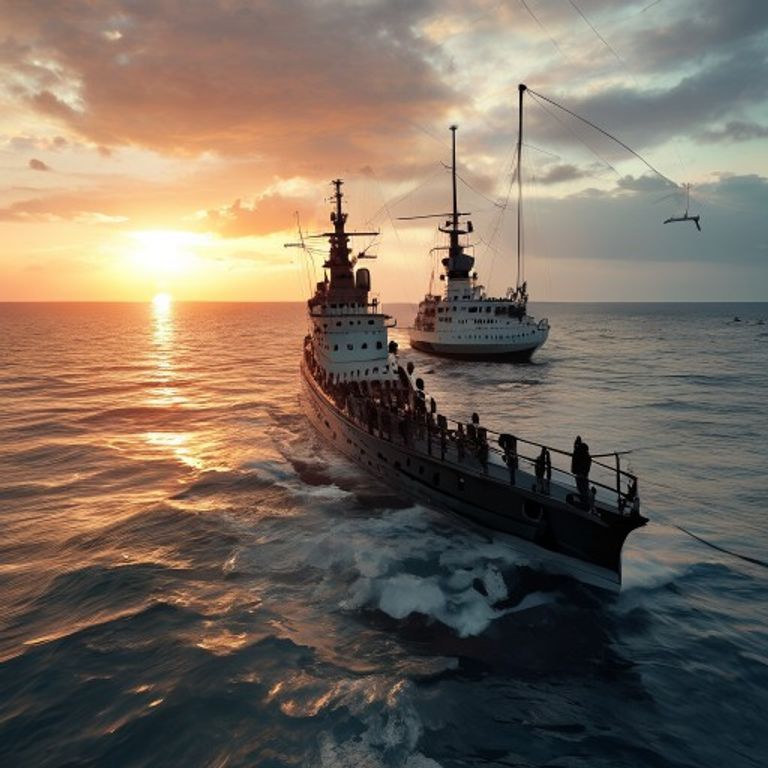
The vessel found adrift in the Pacific in 1955 with no one on board, its radio tuned to a distress signal and instruments damaged, yet showing no signs of shipwreck.
⚠️ Research prepared with the aid of Deep Research is subject to referential ambiguity.
🖥️ Clean HTML code using a proprietary tool.
👥 Research by Guilherme Felipe, Curation by Sílvio Lôbo
The Disappearance of the MV Joyita: A Tragedy in Mysterious Waters
The year 1955 marked the disappearance of a ship that would become one of the most persistent enigmas in maritime navigation. The MV Joyita, a small steam-powered merchant vessel, vanished under inexplicable circumstances in the vast and treacherous Pacific Ocean, leaving behind a trail of unanswered questions and theories bordering on the fantastic. This article dives into the depths of this mystery, separating proven facts from the speculations that still haunt these waters.
1. The Context and the Incident: Where, When, and How the Mystery Began
The MV Joyita was a 69-foot (approximately 21-meter) cargo ship operating in the Fiji Islands region. Its typical route involved transporting goods and passengers between the islands and the mainland. On its fateful voyage, the ship departed from Tavuki, in Kadavu, heading toward Suva, the capital of Fiji, on the night of October 3, 1955. On board were Captain Alfred William Simpson, his wife Genevieve, five crew members, and 10 passengers.
The trip, which would normally take about 26 hours, was expected to be routine. However, the Joyita never reached its destination. Communication with the ship was lost shortly after its departure. Bad weather, common in the region, was initially considered the likely cause. But as days passed and no news arrived, concern grew, leading to an intense search that would become the beginning of one of the greatest nautical mysteries.
2. Timeline of Events
- October 3, 1955, night: The MV Joyita departs from Tavuki, Kadavu, with 16 people on board.
- October 4, 1955: The ship does not appear in Suva. Fiji authorities are notified.
- October 4-5, 1955: Official search begins. Aircraft and vessels scour the expected route area.
- October 6, 1955: The MV Joyita is spotted. The ship is adrift, listing to one side, about 65 nautical miles northeast of Suva.
- October 6, 1955, afternoon: A rescue team aboard the patrol vessel HMNZS Tamure reaches the Joyita.
- October 6, 1955, night: The rescue team finds the ship empty. No sign of the 16 occupants. Personal items and belongings are scattered across the deck and cabins.
- October 7, 1955: The MV Joyita is towed to the port of Suva.
- November 1955: Investigation reports are concluded but offer no definitive explanation.
3. Main Theories: Hypotheses and Speculations
The absence of bodies and the apparent flight or abandonment of the ship gave rise to a myriad of theories, some more plausible than others, but all attempting to unravel the fate of the Joyita's occupants.
Scientific and Police Theories (Most Likely):
- Sabotage or Planned Theft: The theory suggests that the crew or passengers could have planned a robbery or escape, perhaps involving the smuggling of valuable goods or an attempt to flee with the crew's money. The fact that personal belongings were scattered could indicate a hasty departure. The absence of signs of a struggle, however, weakens this hypothesis.
- Modern Pirates or Cargo Theft: In a region with intense maritime activity, the possibility that pirates attacked the ship to steal its cargo (or what they believed to be valuable) cannot be ruled out. However, there are no records of similar pirate activity in the area at that time, and the Joyita was not carrying high-value cargo.
- Navigation Accident Followed by Abandonment: A sudden mechanical failure, such as a fire or a rudder problem, could have forced the abandonment of the ship. The fact that the ship was found adrift and listing may support this idea, but it does not explain the disappearance of all the people.
- Sudden and Violent Storm: Although bad weather is common, an exceptional and unpredictable storm could have caused the ship to capsize or sink rapidly, sweeping everyone on board into the sea. However, the ship was found relatively intact, showing no typical signs of severe storm damage.
Alternative, Conspiracy, or Paranormal Theories:
- Mysterious and Dangerous Cargo: Speculation circulates that the Joyita was carrying secret and dangerous cargo, possibly drugs or illegal weaponry. Its sudden abandonment could have been an attempt to avoid seizure or a consequence of an accident involving this unknown cargo. This theory is fueled by the lack of a detailed cargo manifest.
- Alien Abduction: One of the most fantastic theories suggests that the occupants were abducted by extraterrestrial beings. The absence of bodies and the inexplicable nature of the disappearance fuel these speculations, although there is no concrete evidence to support it.
- Disappearance in a Pacific Bermuda Triangle: Some mystery enthusiasts compare the case to events in the Bermuda Triangle, suggesting the existence of geographical or energetic anomalies in the region that could be responsible for swallowing ships and aircraft.
- Captain Simpson Disappeared Voluntarily: There is speculation that the captain, Alfred William Simpson, could have orchestrated the disappearance of the ship and everyone on board to escape debts or flee a personal situation, but this theory does not explain the fate of the passengers.
4. Controversies and Blind Spots
Official investigations, conducted by the authorities of Fiji and the United Kingdom (at the time, Fiji was a British territory), were widely criticized for their superficiality and lack of rigor. Several points raised doubts:
- The Incomplete Cargo Manifest: The official cargo manifest listed generic items like supplies and construction materials but offered no specific details. This fueled theories about secret cargo.
- Missing or Ignored Evidence: Reports indicate that some crucial belongings and evidence may have been lost or discarded during the rescue and towing of the ship. The rescue team mentioned finding scattered objects, but there was no detailed forensic examination at the scene.
- Conflicting or Absent Testimonies: The lack of survivors to report what happened prevents a clear narrative. The few available accounts, usually from other vessels that saw the Joyita before the disappearance, are fragmented.
- The State of the Ship: The fact that the Joyita was found adrift, listing, but not sunk, with the drain valves open (possibly to relieve the weight of accumulated water), suggests it was not the victim of a violent impact. The absence of significant structural damage is also an intriguing point.
- The Official Report: The official investigation report was inconclusive, listing shipwreck as the most likely cause but without presenting concrete evidence. Many believe the investigation was closed prematurely.
5. Curiosities and Legacy
The MV Joyita case transcended newspaper headlines and became a landmark in popular culture, inspiring books, documentaries, and articles about maritime mysteries. The ship, after being recovered and briefly restored, suffered further incidents and was eventually abandoned, becoming a kind of "ghost ship" itself.
The mystery of the Joyita remains without a definitive solution. The absence of a clear outcome for the fate of the 16 occupants continues to fascinate and intrigue researchers and enthusiasts of unsolved cases. Declassified official reports and new cross-referencing of information rarely bring significant revelations, keeping the MV Joyita firmly anchored in the pantheon of great nautical enigmas.
To this day, the Pacific waters around Fiji hold the secret of what really happened on that night in October 1955, a grim reminder of how fragile we are in the face of the vastness and mysteries of the ocean.





