



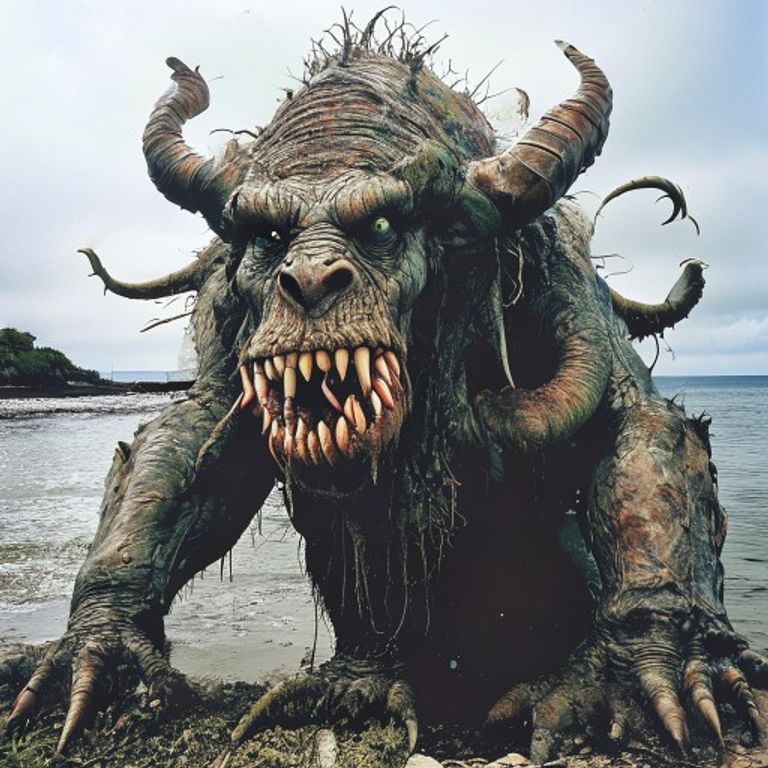
The discovery of bizarre marine creature carcasses on the English coast in the fifties, which featured webbed feet and reddish skin, defying immediate biological identification.
⚠️ Research conducted with the aid of Deep Research is subject to referential ambiguity.
🖥️ Clean HTML code using a proprietary tool.
👥 Research by Guilherme Felipe, Curation by Sílvio Lôbo
The Canvey Island Monster Case: An Unshakable Seaside Enigma
By [Your Senior Journalist Name], Unsolved Cases Researcher
1. The Context and the Incident: Where, When, and How the Mystery Began
Canvey Island, a relatively peaceful refuge in the Thames Estuary, England, was suddenly thrust into the annals of the inexplicable in 1953. The apparent calm of the coastal community was brutally interrupted by a series of disturbing discoveries that, to this day, echo with a mixture of fascination and apprehension. The starting point for the infamous "Canvey Island Monster Case" was not a direct attack, but the macabre encounter with an unknown body—possibly a marine creature or something even stranger—which launched an investigation that would quickly turn into one of the United Kingdom's greatest unsolved mysteries.
The first significant report emerged in August 1953. Local residents, working on the construction of a seawall in the Yantlet Creek area, found the remains of a bizarre creature. The descriptions were varied and terrifying: a body about 1.2 meters long, with no visible skeleton, a vaguely humanoid shape, but with grotesque features, including a long nose, large eyes with no apparent pupils, and thick, sticky skin. Most disturbing was the lack of evidence of any known marine animal that fit such a description. The creature was in an advanced state of decomposition, which greatly complicated identification and forensic analysis.
2. Timeline of Events
- July/August 1953: Initial reports of sightings of a strange creature in the waters and on the shores of Canvey Island. These were mostly anecdotal and informal in nature.
- August 1953: The crucial discovery. Workers in the Yantlet Creek area, while performing engineering work, find the remains of an unidentified creature. The body is described as having humanoid characteristics but with unknown biological traits.
- August 1953: Local authorities and police are alerted. A preliminary investigation is initiated, but the lack of expertise in cryptozoology or extreme marine biology hinders the proper collection and analysis of evidence.
- September 1953: The island is stirred by new sightings and reports of missing pets, increasing local hysteria. The press begins to cover the case with growing interest.
- October 1953: A second incident is reported. A similar body, or perhaps the same one, is found in Jeroboam Creek. Again, the creature is described as bizarre and unidentifiable. It is believed that this second body was better preserved, allowing for some analysis.
- Late 1953 / Early 1954: The case reaches the peak of public attention. The tabloid press coins the term "Canvey Island Monster." The police, under pressure, intensify searches and investigations, but without conclusive results.
- Subsequent Decades: The case enters a period of relative silence but continues to be cited in lists of unexplained mysteries, with new interpretations and theories emerging periodically.
- 2000s onwards: Re-evaluations of the case, with access to older archives and the application of new analytical technologies (though limited by the nature of the evidence).
3. Main Theories
The enigmatic nature of the Canvey Island Monster gave rise to a myriad of theories, each attempting to shed light on what really happened on that English coast. The lack of conclusive physical evidence and contradictory reports fueled both scientific investigation and rampant speculation.
Scientific and Police Hypotheses (Most Likely)
- Unknown or Misidentified Marine Creature: This is the most skeptical and potentially logical explanation. It could have been a rare fish specimen, a mutant seal, or even a deep-sea animal washed ashore by unusual currents. The difficulty lies in reconciling the descriptions, especially the vaguely humanoid traits, with any known marine animal. Official reports, when available, tend to lean toward this explanation but admit the difficulty of definitive identification.
- Advanced Biological Speculation: Given the era (post-World War II), some theories speculate about secret biological experiments, perhaps conducted by military or governmental institutions in the area, which could have resulted in the creation or release of a genetically modified creature. However, there is no concrete evidence to support this hypothesis.
- Hoax or Rumor: In cases of great public hysteria, the possibility of an elaborate hoax or simply a rumor that grew out of control cannot be ruled out. However, the consistency and detail of some key witness accounts make this explanation difficult to accept on its own.
Alternative, Conspiracy, or Paranormal Theories
- Extraterrestrial or Interdimensional Beings: A more fantastic line of thought suggests that the monster could be an entity from another planet or a parallel dimension that somehow manifested on Earth, leaving behind unusual biological remains. This theory is purely speculative and lacks any empirical basis.
- Mythological or Folkloric Creatures: Some enthusiasts of the occult and folklore speculate that the monster could be the physical manifestation of ancient legends or mythical creatures that inhabit the sea, such as mermaids or other unknown aquatic entities.
- Amphibious Aliens: A branch of the extraterrestrial theory suggests the existence of amphibious aliens that could have been responsible for the appearance, perhaps on a reconnaissance mission or due to an accident.
4. Controversies and Blind Spots
The Canvey Island Monster Case is full of inconsistencies and dark areas that continue to fuel debate and the frustration of investigators. The way the evidence was handled and the nature of the official investigation left many questions unanswered.
- Limited and Missing Physical Evidence: The biggest controversy lies in the scarcity and, possibly, the disappearance of crucial physical evidence. The remains found, even what may have been the best-preserved one, were in advanced decomposition. There are reports that parts of the body were collected for analysis, but the detailed results of these examinations were never widely released or, if they were, they are ambiguous. The lack of DNA samples or a complete skeleton makes definitive comparisons impossible.
- Conflicting Testimonies and Sensationalism: The press of the time, in its eagerness for news, often sensationalized the reports, which may have led to distortions and exaggerations in witness statements. Distinguishing between genuine observations and exaggerations became a significant challenge.
- Superficial Police Investigation: Critics point out that the police investigation, although conducted, may have been superficial, given the lack of resources and expertise to deal with such an unusual phenomenon. The priority may have been maintaining public order and dissipating panic, rather than an in-depth scientific investigation.
- Ambiguous Official Reports: Police and military reports from the time, when declassified or made public, tend to be vague and suggest provisional explanations without ever reaching a definitive conclusion. The absence of an official "verdict" contributes to the aura of mystery.
- Loss of Archives and Documentation: Over the decades, it is plausible that some files and documentation related to the case have been lost or destroyed, as happens with many old cases, hindering future analysis.
5. Curiosities and Legacy
The Canvey Island Monster transcended newspaper headlines to become a lasting urban legend and a landmark in the folklore of the British inexplicable.
- Cultural Impact: The case inspired countless articles, books, documentaries, and even comic books. The image of the "monster" became a pop culture icon, often associated with nature's mysteries and unknown marine creatures. Canvey Island itself gained an aura of mystery, attracting paranormal enthusiasts and the curious over the years.
- The So-Called "Largs Monster": In 1954, a similar incident occurred in Largs, Scotland, where a bizarre body, described as "monstrous," was found. Although the circumstances were slightly different, the similarity in the reports reignited interest in the Canvey Island case and fueled the idea that there could be more than one incident of a similar nature.
- Current Status: The case remains officially unsolved. There are no active investigations underway by police authorities. However, public and academic interest in the Canvey Island Monster persists. Declassified files and new analyses of old reports continue to emerge periodically, but so far no definitive revelation has emerged to dispel the shadows that hang over this coastal enigma. The Canvey Island Monster remains, for all intents and purposes, one of Great Britain's great unsolved mysteries, a silent reminder of the vastness of things we still do not understand about our own planet.





