



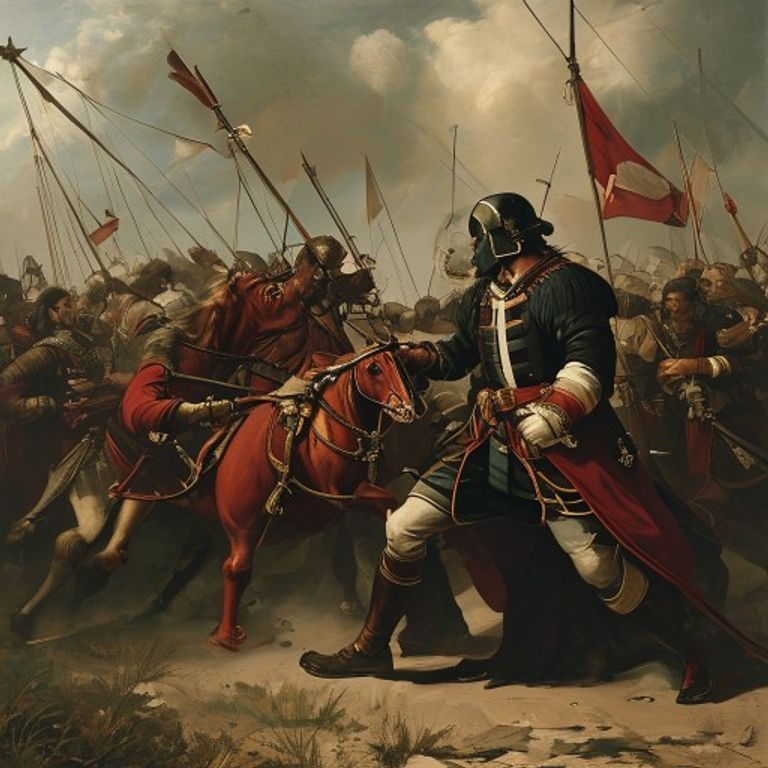
The 1571 naval confrontation where the Holy League defeated the Ottoman fleet in the Mediterranean, halting the empire's maritime advance into Western Europe.
⚠️ Research conducted with the aid of Deep Research is subject to referential ambiguity.
🖥️ Clean HTML code using a proprietary tool.
👥 Research by Guilherme Felipe, Curation by Sílvio Lôbo
The Enigma of Lepanto: More Than a Naval Battle
The Battle of Lepanto, fought on October 7, 1571, in the Gulf of Patras, near the Greek city of Naupactus (then known as Lepanto), is often remembered as a watershed moment in naval history and a decisive triumph for the Holy League against the Ottoman Empire. However, beneath the veil of a resounding victory lies a persistent mystery that transcends military strategy and the cold numbers of carnage. This investigative article seeks to unravel the layers of uncertainty surrounding what really happened in the waters of Lepanto, separating historical bravery from the shadows of the inexplicable.
The Context and the Incident: Where, When, and How the Mystery Began
The Ottoman Empire, under Sultan Selim II, was aggressively expanding its influence in the Mediterranean, posing a growing threat to Christian powers. The capture of Cyprus in 1570 was the final straw that united the Holy League, a coalition led by Pope Pius V, composed of the Republic of Venice, the Kingdom of Spain, the Papal States, the Republic of Genoa, the Duchy of Savoy, the Grand Duchy of Tuscany, and the Sovereign Military Order of Malta.
The Holy League fleet, commanded by Don Juan of Austria, the illegitimate son of King Philip II of Spain, and the Ottoman fleet, under the command of Ali Pasha, crossed paths in the Gulf of Patras. What followed was a titanic naval confrontation, the largest naval battle fought with rowing ships in Western history. However, the mystery does not lie in the magnitude of the battle itself, but in anomalies observed during and after the conflict, which escape conventional explanations and fuel speculations ranging from logistical and psychological failures to reports of phenomena never before seen on a battlefield.
Timeline of Events
Although the general chronology of the battle is well-documented, specific points carry nuances that allow for divergent interpretations.
- Early 1571: Formation of the Holy League in response to Ottoman expansion and the fall of Cyprus.
- September 1571: The Holy League and Ottoman fleets gather in the Ionian Sea.
- October 6, 1571: The fleets sight each other, positioning for the confrontation.
- October 7, 1571:
- Approximately 10:00 AM: The fleets make visual contact and combat begins.
- Morning/Afternoon: The battle unfolds with ferocity, marked by boarding, hand-to-hand combat, and bombardment.
- Late afternoon: The Ottoman fleet is decisively defeated. Ali Pasha dies in combat. The Holy League suffers significant losses but secures victory.
- Post-Battle: Initial reports of victory, but also whispers of strange events observed on both sides.
The Main Theories
What exactly triggered the inexplicable events at Lepanto is the core of the mystery. Several theories attempt to shed light on these occurrences:
Conventional Theories (Scientific and Historical):
- Fatigue and Extreme Psychological Stress: The brutal and prolonged nature of the battle, combined with fear and shock, could have led combatants to experience hallucinations, distorted perceptions, or irrational panic reactions. In high-stress environments, the human brain can produce phenomena that seem supernatural.
- Perception Error and Rumors: In the chaos of battle, with screams, explosions, and smoke, it is plausible that information was misinterpreted or exaggerated. Fear and adrenaline may have transformed a natural event into something extraordinary in the memories of survivors.
- Unusual Meteorological Phenomena: Sudden storms, dense fog, or strong and unpredictable winds could have created strange visual and auditory conditions, leading to erroneous interpretations.
- Optical and Acoustic Illusions: The combination of smoke, reflections on the water, light glares, and the echo of sounds in an open naval environment can create convincing, yet non-supernatural, optical and auditory illusions.
Alternative Theories (Conspiracy and Paranormal):
- Divine or Demonic Intervention: Reports of apparitions of saints or demons, or an invisible force protecting or attacking ships, led some to believe in supernatural interventions. The theologians of the time often interpreted historical events through religious lenses, seeing the hand of God or the Devil at work.
- Collective Energetic or Psychic Phenomena: The idea that the intense emotional charge and violence of a large-scale battle could generate a collective psychic energy capable of manifesting perceptible phenomena. This aligns with concepts of energy fields or "memory" of high-impact locations.
- Use of Experimental or Secret Weapons: Although there is no concrete evidence, conspiracy theories suggest that one of the parties could have employed weapons or substances still unknown to create visual or psychological effects, such as hallucination-inducing gases or devices that created strange noises.
- The "Voice of the Sea" or Oceanic Manifestations: Some maritime legends speak of inexplicable events linked to the ocean itself, such as voices coming from the depths or aquatic apparitions. The scale of the Battle of Lepanto could have, supposedly, "awakened" such phenomena.
Controversies and Blind Spots
The documentation of the Battle of Lepanto, although extensive, is permeated by inconsistencies that hinder an unequivocal understanding of the stranger events:
- Contradictory Testimonies: Eyewitness accounts, from both combatants and later observers, frequently diverge on crucial details. Some describe inexplicable lights crossing the sky, while others report hearing chants or whispers that did not correspond to any known origin.
- Missing or Lost Evidence: The passage of time and the nature of naval conflict made the preservation of physical evidence extremely difficult. The lack of artifacts that could corroborate or refute certain claims contributes to the cloudiness of the case.
- Biased Interpretations: Chroniclers of the time, often influenced by their religious and political affiliations, tended to interpret events in a way that glorified their own side or demonized the enemy. This led to a "camouflage" of objective facts by narratives loaded with symbolism. Official reports from the Holy League focused on their divine victory, minimizing or distorting the more disturbing aspects.
- Silence on Certain Aspects: Some older accounts mention events that are difficult to explain, such as the inexplicable behavior of some soldiers or sailors, who seemed to have seen something terrible but refused to speak about the subject. This voluntary silence itself is a blind spot for investigators.
Curiosities and Legacy
The cultural impact of the Battle of Lepanto is undeniable, shaping the European imagination for centuries. However, the underlying mystery has added a layer of fascination and dread to this narrative:
- The "Miracle of Lepanto": The victory was widely celebrated in Europe as a miracle, attributed to the intercession of the Virgin Mary. Marian devotion increased significantly after the battle, and the feast of Our Lady of the Rosary was established on October 7 in commemoration.
- Artistic and Literary Inspiration: The battle inspired countless works of art, poems, and songs, many of which incorporate elements of mystery and dread, reflecting the perplexity surrounding certain events. Miguel de Cervantes, who fought and was wounded at Lepanto, described the battle in his work but never addressed the stranger phenomena in his detailed writings about the event.
- Current Status of the Mystery: The "Case of the Battle of Lepanto" is not a reopened criminal case in the modern sense, but rather a historical and cultural enigma. Historians continue to debate the interpretations of the stranger accounts, with most favoring psychological or natural explanations under extreme conditions. However, the lack of a definitive resolution for all reports allows alternative theories to persist. The fascination with history's unsolved mysteries ensures that Lepanto continues to intrigue curious minds, a reminder that even the clearest victories can carry shadows of doubt and the inexplicable.





