



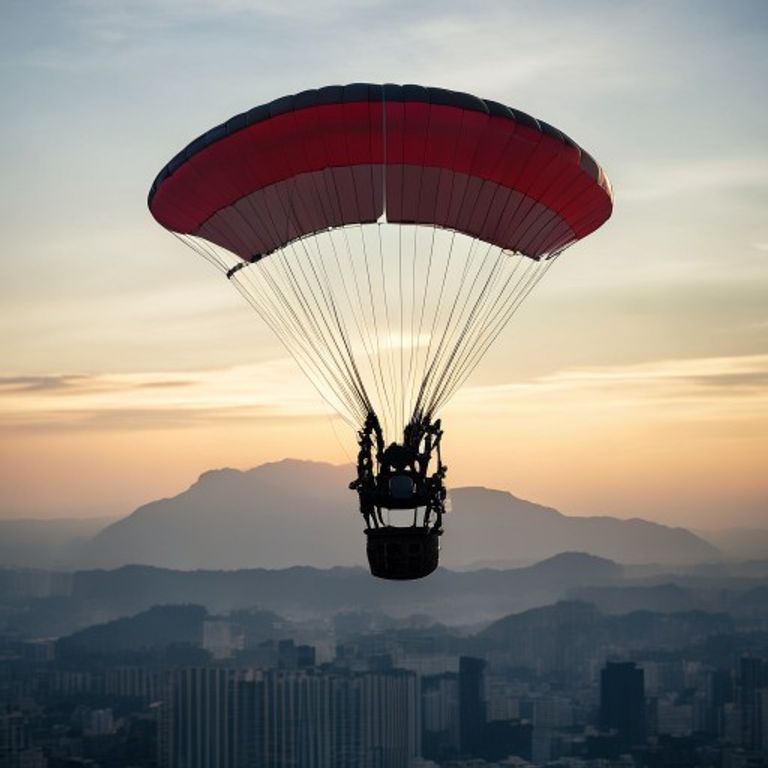
The first designs conceived by Leonardo da Vinci and the subsequent successful jump by André-Jacques Garnerin from a balloon in 1797, which inaugurated free flight.
⚠️ Research conducted with the aid of Deep Research is subject to referential ambiguity.
🖥️ Clean HTML code using a proprietary tool.
👥 Research by Guilherme Felipe, Curation by Sílvio Lôbo
The Case of the Parachute Invention: A Leap into the Unknown
The sky, once a domain reserved for birds and gods, became a stage for human ambition. The quest to conquer the heights, whether through flight or controlled descent, has always been intertwined with ingenuity and danger. It is in this scenario of audacity and fatality that the Case of the Parachute Invention emerges, an enigma that, instead of unveiling a glorious achievement, plunged into an abyss of uncertainties and questions, leaving a trail of hypotheses rather than a legacy of indisputable innovation.
The Context and the Incident: The Flight That Turned into Shadow
The mystery centered on the invention of the parachute does not refer to a single isolated event, but to a complex web of claims, demonstrations, and, crucially, disappearances that obscured the authorship and circumstances of one of the most revolutionary inventions for safety in high-altitude falls. Although the concept of slowing a fall with aerial devices dates back centuries, with sketches attributed to Leonardo da Vinci in the 15th century, the transition from theory to safe and proven practice is where the case thickens.
The epicenter of the controversies seems to focus on the mid-18th and early 19th centuries, a period of scientific and technological effervescence, but also of little rigorous documentation. The desire to jump from hot air balloons, which were gaining popularity, drove the need for a safety device. However, the demonstrations that were supposed to solidify the invention were often marked by tragedies, inexplicable accidents, or simply the lack of reliable witnesses who could attest to the validity and originality of the attempts.
Timeline of Events: Fragments of an Enigma
The chronological reconstruction of the Case of the Parachute Invention is more of a collage of fragments than a linear narrative. Dates are approximate and events sometimes overlap or contradict each other:
- 15th Century: Sketches attributed to Leonardo da Vinci show a pyramidal device with the inscription "made of linen fabric and stretched, having twelve cubits on each side." This is one of the first conceptual records of a parachute.
- 18th Century: Initial attempts to demonstrate rudimentary parachutes are reported, but many lack precise details about the inventor, the exact location, or the result.
- 1783: Louis XVI, King of France, reportedly forbade an experimental parachute jump for fear that the volunteer, Louis-Sébastien Lenormand, would be seriously injured. Lenormand, however, reportedly demonstrated the device on other occasions, using it to descend from a tree, and coined the term "parachute."
- 1797: André-Jacques Garnerin performs what is widely considered the first documented parachute descent from a significant altitude. He jumped from a hydrogen balloon at about 975 meters over Paris, using an umbrella-shaped parachute. The landing was rough, but Garnerin survived. This event is often cited as the starting point of the parachute era.
- Early 19th Century: Reports of other inventors and jumpers emerge, some claiming to have developed the parachute before Garnerin, but with little documentary evidence or public demonstrations that could prove their claims indisputably. The lack of standardized records and the often clandestine or private nature of the demonstrations create an information vacuum.
The Main Theories: From Scientific to Supernatural
The absence of a definitive answer regarding the "true" invention of the parachute gave rise to several theories, each with its own intrinsic logic:
Scientific and Logical Theories (Most Likely):
- Gradual and Decentralized Evolution: The invention of the parachute was not the work of a single genius, but a gradual and independent development in different locations, driven by practical necessity. Several inventors likely arrived at similar solutions at similar times, but only a few had the luck or opportunity to perform successful and documented public demonstrations. Garnerin, in this context, would be the first to have his feat recorded and widely recognized.
- Focus on Public Demonstrations: The effective "invention," in the sense of validation and public recognition, occurred with Garnerin's demonstrations. Before him, others may have conceived or even tested prototypes, but the lack of robust documentation, independent witnesses, and the magnitude of Garnerin's demonstration place him as the recognized pioneer.
- Competition and Trade Secrets: In an era where secrecy of inventions was common to obtain patents or avoid theft, it is possible that many prototypes and tests occurred behind the scenes, without public record, making it difficult to determine primacy.
Alternative, Conspiracy, or Paranormal Theories:
- The Hidden Inventor: The theory that a brilliant but unrecognized inventor created the parachute before everyone else, but was silenced, robbed, or had their invention suppressed. The lack of "glory" for a specific inventor can be interpreted as evidence of this suppression.
- Divine or Extraterrestrial Intervention: In a more speculative vein, some narratives suggest that knowledge of the parachute may have been "inspired" or even transmitted by external forces, whether divine or extraterrestrial in origin, to assist humanity in its aerial journeys. The difficulty in tracing a clear human origin fuels this line of thought.
- The Sacrificed "Victim": Could the parachute have been, in its early versions, an unsafe device, and the recorded "accidents" were not failures, but the deliberate elimination of individuals who became inconvenient to those who held the knowledge or control of the technology? This hypothesis, although dark, seeks to explain the repetition of tragedies surrounding the first demonstrations.
Controversies and Blind Spots: The Void in Documentation
The main controversy lies in the scarcity and fragility of the documentation. Official reports, when they existed, were often from partial or incomplete sources. Technical investigations were rudimentary by current standards, and the very nature of the demonstrations – often held at festivals, fairs, or sporadic events – made rigorous recording difficult.
- The Mystery of the First Demonstrations: Several claims of parachutes prior to Garnerin are cited, but lack concrete proof. Reports of jumps from towers or trees are vague regarding the exact device and the proof of its effectiveness at significant altitudes.
- Lenormand's Accident: Although Lenormand coined the term "parachute" and performed demonstrations, the lack of detailed records on his high-altitude tests creates a blind spot. There was a functional parachute in his tests, but how safe and effective it was for balloon jumps is a mystery.
- The Post-Garnerin Tragedy: Ironically, even after Garnerin's "successful" demonstration, the following decades were marked by several accidents and deaths of parachutists. This raises questions about the safety and consistency of the initial design, and whether it was really as innovative as thought, or just an incremental improvement that still needed refinement.
- Declassification of Files: The search for declassified files or relevant historical documents often does not reveal the "smoking gun" that would solve the enigma, but rather more questions and confirmations of the lack of conclusive data.
Curiosities and Legacy: A Leap into Modernity
The Case of the Parachute Invention, despite its uncertainties, has left an indelible legacy. The audacity of those who dared to defy gravity, even in murky circumstances, inspired generations of inventors, engineers, and adventurers. The parachute, in its modern form, is a testament to human perseverance in the search for safety and exploration.
- Cultural Impact: The parachute has become an icon of courage, ingenuity, and, paradoxically, survival. It is a symbol present in films, literature, and the popular imagination, associated with the idea of overcoming limits.
- Current Status: The case, as a historical mystery, remains largely "shelved" from the point of view of a definitive resolution. There is no official reopening for a police investigation, as there is no clear crime to be solved. However, academic debate and interest from historians of science continue, seeking to fill the gaps with new discoveries or reinterpretations of existing evidence.
- Continuous Innovation: The uncertainty about the "first" inventor does not diminish the importance of the parachute's evolution. From the first rudimentary designs to the complex modern parachute systems, the history of its invention is a saga of trials, errors, and innovations that continue to save lives every day.
The Case of the Parachute Invention reminds us that not all success stories have a clear and indisputable starting point. Sometimes, the true legacy lies not in the glory of a single inventor, but in the collective journey of audacity, experimentation, and, unfortunately, in some cases, in the silence left by a leap into the unknown.





