



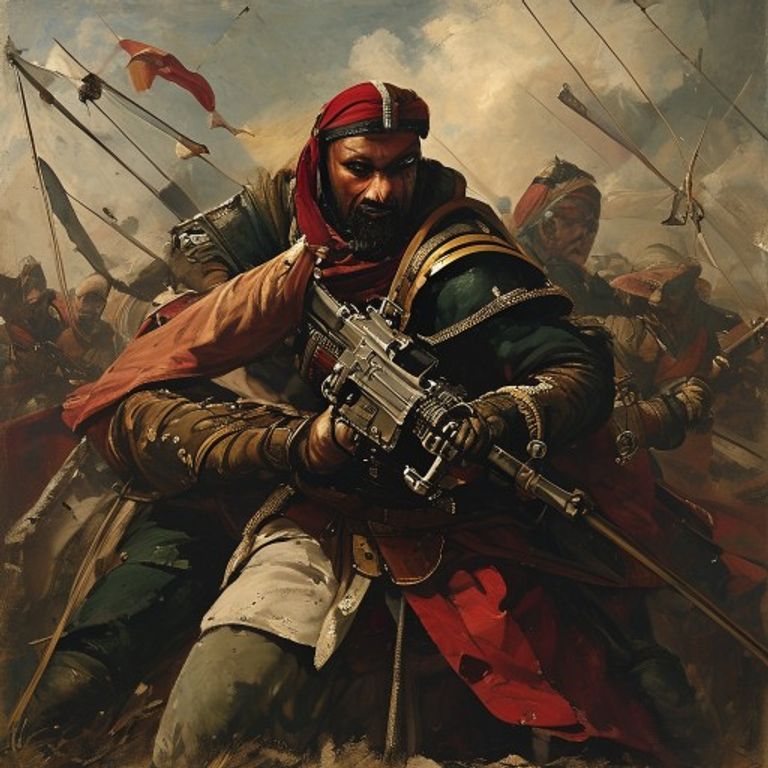
The 1385 confrontation was fundamental to Portugal's independence against the Kingdom of Castile, consolidating the Avis dynasty and Portuguese sovereignty.
⚠️ Research conducted with the aid of Deep Research is subject to referential ambiguity.
🖥️ Clean HTML code using a proprietary tool.
👥 Research by Guilherme Felipe, Curation by Sílvio Lôbo
The Mystery of the Battle of Aljubarrota: Where History Deceives and the Inexplicable Persists
In the mists of Portuguese history, an event of epic proportions stands out, not only for its military magnitude but for the persistent gaps that surround it, turning a decisive victory into an enigma for historians and investigators. The Battle of Aljubarrota, fought on August 10, 1385, sealed the fate of Portugal, ensuring its independence against Castilian claims. However, beneath the surface of consolidated narratives lie questions that defy simple explanations, suggesting that not all the truth was revealed on the battlefields of that summer night.
The Context and the Incident: The Succession Crisis and the Battlefield
The stage for Aljubarrota was set amidst a severe dynastic succession crisis. After the death of King Ferdinand I of Portugal in 1383, without legitimate male heirs, the Portuguese throne became vacant. The power struggle intensified between Ferdinand's daughter, Beatrice, married to King John I of Castile, and John, Master of Avis, the illegitimate son of Peter I and half-brother of Ferdinand. The Castilians saw the union with Beatrice as a way to annex Portugal to the Crown of Castile, while the Portuguese loyal to independence supported the Master of Avis.
The battle itself was not a simple armed confrontation, but a complex military chess game. The Castilian army, led by John I of Castile and with a significantly superior number of men, advanced toward Lisbon. The Portuguese army, commanded by the Master of Avis and aided by English contingents led by Nuno Álvares Pereira, positioned itself strategically on the Aljubarrota Slope, on terrain chosen to neutralize the heavy Castilian cavalry. The result was a crushing victory for the Portuguese, which radically transformed the course of Iberian history.
Timeline of Crucial Events
- 1383: Death of King Ferdinand I of Portugal. Beginning of the Succession Crisis.
- 1383-1385: Period of instability, with political and military disputes between the supporters of Beatrice and the Master of Avis.
- April 1385: The Master of Avis is acclaimed King of Portugal in Coimbra, becoming John I of Portugal.
- June 1385: King John I of Castile, with a vast army, invades Portugal with the goal of forcing the recognition of his wife, Beatrice, as queen.
- August 10, 1385: The Battle of Aljubarrota takes place. The Portuguese army, despite being outnumbered, achieves a decisive victory.
- 1386: Signing of the Treaty of Windsor between Portugal and England, solidifying the alliance and ensuring English support for Portugal.
- 1411: Signing of the Treaty of Ayllón (although this treaty is less known than the Treaty of Tordesillas, the definitive peace with Castile would only be signed decades later, consolidating Portuguese independence).
Main Theories: Between Masterful Tactics and Whispers of the Inexplicable
The magnitude of the Portuguese victory at Aljubarrota, against an adversary considerably superior in numbers, has generated various theories over the centuries that attempt to uncover the secrets of that day.
Classical and Military Theories:
- The Tactical Superiority of Nuno Álvares Pereira: This is the most historically accepted and proven explanation. Nuno Álvares Pereira, a brilliant military strategist, chose terrain that favored defense, employing the effective use of trenches, sharpened stakes, and a defensive formation that neutralized the Castilian cavalry charge. The discipline of the Portuguese troops and the efficient use of English archers were also crucial. Military reports from the time, although fragmented, corroborate the intelligence and tactical audacity of the Portuguese.
- The Exhaustion of Castilian Troops: The long march and the previous siege of the city of Lisbon would have exhausted the Castilian army, both physically and psychologically, even before the confrontation at Aljubarrota.
- Climatic Factors: Some historians speculate that the weather conditions of that day (intense heat, possibly rain at key moments) may have hindered the mobility and morale of the Castilian troops.
Alternative and Speculative Theories:
- Divine Intervention (Hagiography of Nuno Álvares Pereira): The figure of Nuno Álvares Pereira, later canonized as Saint Nuno of Saint Mary, is central to many narratives. Religious tradition and hagiography attribute much of the victory to divine intervention, with the saint interceding and inspiring the Portuguese troops. This explanation, although religious and not scientific, was widely accepted at the time and persists in certain cultural interpretations.
- The Conspiracy of Treason (Marginal Hypothesis): Although without strong documentary evidence, some speculations whisper about the possibility of treason within the Castilian army itself or of deserters who provided crucial information to the Portuguese. This theory lacks concrete proof and is more a product of speculation than solid historical investigation.
- Inexplicable Phenomena (Paranormal/UFO Theories - Highly Speculative): At one extreme, we find theories that border on the paranormal, suggesting that the sudden disorganization of the Castilian troops or the generalized panic may have been caused by unusual and as-yet-unidentified factors. It is important to emphasize that these are theories without any scientific or historical basis and frequently arise in debates about unsolved mysteries. There is no official record or empirical evidence to support such hypotheses for Aljubarrota.
Controversies and Blind Spots: Shadows in the Official Narrative
Despite the clear victory, some aspects of the Battle of Aljubarrota remain shrouded in controversy and have blind spots that intrigue investigators and historians:
- The Exact Number of Troops: The exact numbers of the armies in confrontation vary considerably between the chronicles of the time and subsequent analyses. Estimates for the Castilian side range from 20,000 to over 30,000 men, while the Portuguese were between 6,000 and 10,000. This discrepancy raises doubts about the accuracy of the records and how numerical superiority was perceived and reported.
- The Flight of John I of Castile: Accounts of the Castilian king's flight from the battlefield are ambiguous. Some indicate a strategic withdrawal, others a desperate escape. The lack of clarity about his final moments on the battlefield contributes to the aura of mystery.
- Fragmented Material Evidence: Although there are archaeological traces of the battlefield, the preservation and extent of the excavations may have limited the amount of material evidence that could confirm or refute tactical details and the exact outcome of certain moments of the battle.
- The Role of "Disbelievers" in the Castilian Army: Chronicles mention that part of the Castilian army was composed of mercenaries and troops of different origins, possibly with less loyalty or motivation. The integration and impact of these groups on the outcome of the battle are areas that deserve further study.
Curiosities and Legacy: The Victory that Shaped a Nation
The Battle of Aljubarrota transcended the battlefield to become a pillar of Portuguese national identity. The event is celebrated annually, and the Monastery of Batalha, built by order of John I to give thanks for the victory, stands as an imposing memorial.
- The Baker's Miracle: A popular legend associated with the battle tells the story of a baker named Pêro Marques who, with a bread peel in hand, was said to have been the first to strike a blow against a Castilian giant, inspiring the Portuguese.
- "Em Fafe, não te Gave": A popular Portuguese expression, "Em Fafe, não te gave," which means "don't be fooled" or "don't let yourself be deceived," is said to have originated from an episode in the battle where the Portuguese trap strategy led to the defeat of the Castilian troops.
- International Legacy: The victory at Aljubarrota confirmed Portugal's independence, moving the country away from the Castilian orbit and allowing for the development of its own foreign policy and maritime expansion, which would come to shape the world.
- Current Status: The case of the Battle of Aljubarrota, as a historical event, has not been "reopened" in a judicial sense. However, historical and archaeological research continues to shed new light on the events, seeking to fill the gaps and refine our understanding of this crucial moment. Theories about the battle continue to be debated in academic circles, with a persistent focus on the analysis of military tactics and the socio-political context. The mystery does not lie in a crime to be solved, but in human complexity and the many layers of interpretation that an event of such magnitude can generate.
The Battle of Aljubarrota remains, therefore, a fascinating case study, where bravery, strategy, and perhaps a touch of something inexplicable merged to forge the destiny of a nation. The ruins and legends echo even today, reminding us that history sometimes holds more questions than answers.





