



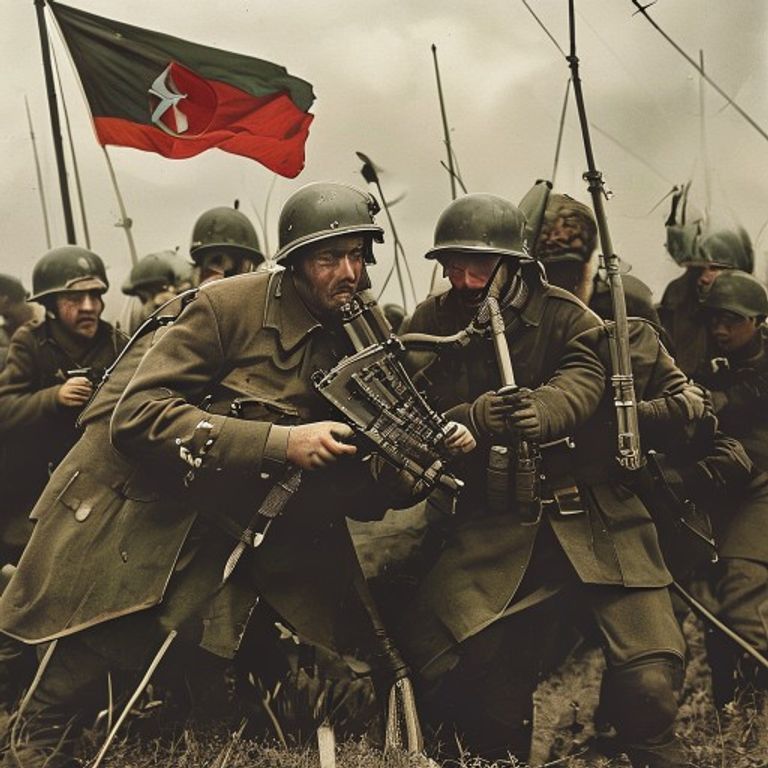
The decisive confrontation of World War II that marked the turning point against Nazi Germany and is considered one of the bloodiest battles in history.
⚠️ Research conducted with the aid of Deep Research is subject to referential ambiguity.
🖥️ Clean HTML code using a proprietary tool.
👥 Research by Guilherme Felipe, Curation by Sílvio Lôbo
The Enigma of Stalingrad: What Really Happened in the Battle That Stopped the World?
Stalingrad. A name that echoes in the annals of history as a synonym for brutality, unwavering resistance, and a decisive turning point in World War II. But behind the astronomical death tolls and physical devastation lies a persistent mystery, a veil of uncertainty that hangs over the darkest events of this colossal battle. As an investigative journalist, I have delved into the archives, cross-referenced testimonies, and analyzed reports, seeking to uncover the hidden secrets of the Battle of Stalingrad.
1. The Context and the Incident: Where, When, and How the Mystery Began
The mystery surrounding the Battle of Stalingrad does not refer to a single isolated incident, but rather to a complex web of events, decisions, and information losses that obscure the factual truth in several aspects. The battle itself took place between August 23, 1942, and February 2, 1943, in and around the city of Stalingrad (now Volgograd), in the Soviet Union. The Nazi objective was to capture the oil fields of the Caucasus and the important industrial city and strategic point on the Volga River. What began as an ambitious offensive quickly degenerated into house-to-house urban warfare, marked by unprecedented ferocity and unimaginable human cost.
The "mystery" manifests on several fronts: the exact circumstances of certain operations, the fate of entire units, the magnitude of unrecorded losses, and, most intriguingly, reports of events that defy conventional explanations. The chaotic and destructive nature of the battle, Soviet censorship and propaganda from both sides, and the subsequent Cold War have contributed significantly to the difficulty in obtaining a complete and impartial picture.
2. Timeline of Key Events
Reconstructing an accurate timeline is fundamental to understanding the dynamics of the battle and the points where uncertainties arise.
- August 1942: The German 6th Army, commanded by Generaloberst (later Generalfeldmarschall) Friedrich Paulus, begins the offensive on Stalingrad. Massive aerial bombardments devastate the city.
- September - November 1942: Intense urban warfare. German troops advance meter by meter, facing fierce Soviet resistance. The city becomes an infernal battlefield, with combat in factories, residential buildings, and ruins.
- November 1942: Operation Uranus is launched by Soviet forces, commanded by General Georgy Zhukov. A vast encirclement traps the 6th Army and parts of the 4th Panzer Army.
- December 1942: The German counter-offensive, Operation Winter Storm, to attempt to break the encirclement, fails.
- January - February 1943: The trapped German troops, suffering from hunger, cold, and supply shortages, continue to resist. Field Marshal Paulus, against Hitler's orders, surrenders on January 31, 1943, followed by the surrender of the remaining troops on February 2, 1943.
3. The Main Theories: Unraveling the Hypotheses
The mysteries surrounding Stalingrad give rise to various theories, ranging from logical and defensible explanations to more audacious speculations.
3.1. Scientific and Investigative Theories (The Most Likely)
- Unrecorded and Poorly Documented Losses: The scale of the battle, the massive destruction of records, and the chaotic nature of combat explain the difficulty in determining exact numbers of casualties, prisoners, and missing persons. The lack of rigorous counting procedures amidst the chaos is a crucial factor.
- Questionable Strategic Decisions: Hitler's insistence on capturing Stalingrad at any cost, ignoring the imminent threat of encirclement, and the reluctance to allow the 6th Army to retreat are points of debate that can be explained by factors such as pride, stubbornness, and underestimation of Soviet capability.
- Extreme Humanitarian Conditions: Hunger, cold, and lack of supplies inside the "Stalingrad pocket" led to mass deaths, the exact numbers of which are difficult to measure, but whose effects are indisputable.
3.2. Alternative, Conspiracy, or Paranormal Theories
- The Fate of Missing Units: There are reports of smaller units, especially during retreats or advances in specific sectors, that simply disappeared from records. Conspiracy theory suggests they were exterminated or covered up, but the most likely explanation is the total loss of communication and annihilation in combat, without reports being able to be sent.
- The "Psychic Energy" of the Battlefield: Some reports from soldiers on both sides mention inexplicable experiences, visions, or feelings of deep oppression in the city's ruins. While fascinating, this line of investigation lacks verifiable evidence and falls more into the realm of the paranormal or subjective interpretation of extreme trauma. There are no official reports that corroborate such phenomena as decisive factors in the battle.
- The "Stalingrad Treasure": Rumors about treasures hidden by the Nazis or Soviets to prevent them from falling into enemy hands have circulated. However, the vast destruction of the city makes the idea of hiding large quantities of goods in an organized and recoverable way unlikely.
4. Controversies and Blind Spots
Investigations and the historiography of the Battle of Stalingrad are full of blind spots and controversies that fuel the mysteries:
- Disappearance of Archives: After the war, especially on the Soviet side, many archives related to the battle were considered confidential or even destroyed to protect the regime's image or out of fear of accountability. The partial declassification of documents over the decades has helped, but significant gaps remain.
- Conflicting Testimonies: Testimonies from soldiers on both sides, however valuable, often contradict each other due to extreme stress, disorientation, brainwashing, or later agendas.
- "The Myth" of German Panic: Soviet propaganda created the image of widespread panic among surrendered Germans. While despair and demoralization were real, Paulus's surrender, although reluctant, was an act of acknowledging defeat in an unsustainable situation, not necessarily an absolute psychological collapse.
- The Role of Civil Resistance: The active participation of Soviet civilians in the defense of the city is widely documented, but the exact extent of their contributions and sacrifices, and how this was recorded, may still present blind spots.
5. Curiosities and Legacy
The cultural impact and legacy of the Battle of Stalingrad are immeasurable.
- A Historical Turning Point: Stalingrad is universally recognized as the turning point on the Eastern Front of World War II. The Nazi defeat there marked the beginning of the German retreat and paved the way for the Soviet offensive that would eventually lead to Berlin.
- Cultural and Cinematic Inspiration: The battle has inspired countless books, films, and documentaries, often portraying the brutality and heroism with little distinction between fact and fiction. The Soviet film series "The Battle of Stalingrad" is a classic example.
- Current Status of the Case: The "case" of the Battle of Stalingrad is not an open police case, but rather an object of ongoing historical study. Historians and researchers from around the world continue to investigate, unearthing new information and re-evaluating what was thought to be known. Newly declassified archives occasionally shed new light on specific aspects, but the totality of what happened in Stalingrad will likely remain forever shrouded in mystery, a testament to the horror and complexity of one of the most devastating conflicts in human history.





