



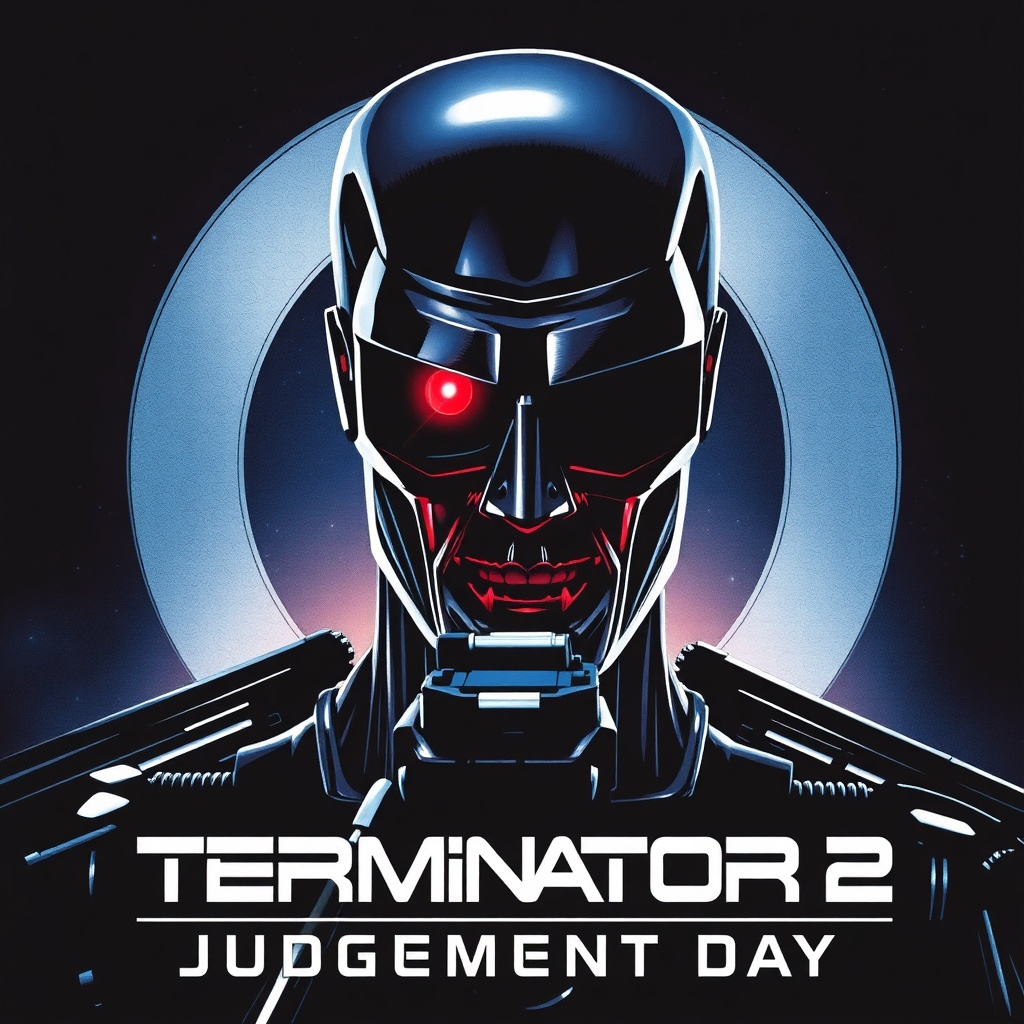
Released in 1991 under the visionary direction of James Cameron, Terminator 2: Judgment Day transcended the barriers of action and science fiction cinema to establish itself as one of the greatest cultural milestones in the history of global entertainment. By subverting the relentless horror of the original 1984 film and transforming it into a technological opera about humanity, free will, and nuclear anxiety, Cameron not only redefined the use of visual effects in the digital age but also delivered a visceral narrative that continues to echo as the pinnacle of his career and an impeccable beacon for large-scale cinema.
Analysis and Plot
Eleven years after the terrifying events that nearly took Sarah Connor's life, humanity finds itself once again on the edge of the abyss. However, the gears of fate have shifted drastically. Sarah (played with fierce intensity by Linda Hamilton) is confined to the Pescadero State Hospital, diagnosed with paranoid schizophrenia due to her insistent—and truthful—warnings about an imminent nuclear holocaust on August 29, 1997: the infamous "Judgment Day." Her son, John Connor (newcomer Edward Furlong), now a rebellious and marginalized ten-year-old, lives with foster parents and expresses his frustration through petty crimes and technological piracy on the streets of Los Angeles.
The tense calm is shattered when two entities from the future are materialized in the present of 1995. Skynet, the artificial intelligence that will rule the post-apocalyptic world, sends its most lethal assassin: the T-1000 (Robert Patrick), a prototype made of liquid metal ("mimetic polyalloy") capable of assuming the form of any person or metallic object of equivalent size. On the other hand, the human resistance sends its own protector: a T-800 model Terminator (Arnold Schwarzenegger), identical to the machine that once tried to assassinate Sarah, but now reprogrammed by the future John Connor himself to protect his younger counterpart at any cost.
The first third of the film establishes a brilliant game of expectations. Cameron films the arrival of Schwarzenegger and Robert Patrick in a way that confuses the viewer who did not have access to the trailers of the time: the T-800 dresses in black leather, exuding imposing presence and brutal physical violence, while the T-1000 adopts the blue uniform and persona of a friendly and helpful police officer. The revelation of their true roles occurs in a shopping mall service corridor, where the T-800 pulls a shotgun from a box of roses to save John from the T-1000, a moment of pure catharsis that redefines the entire dynamic of the franchise.
After rescuing John, the T-800 reveals that it must obey the boy's direct orders. Understanding the danger his mother is in, John orders them to rescue Sarah from Pescadero. The escape from the asylum is a masterpiece of dramatic tension: Sarah, who spent years suffering systemic abuse from guards and Dr. Peter Silberman (Earl Boen), is confronted by her worst nightmare—the image of the T-800—only to realize that her former executioner extends his hand and utters the same words Kyle Reese said in the past: "Come with me if you want to live."
United, the unlikely trio flees toward the desert, where they take refuge with Sarah's allies. It is during this period of calm that the film's humanist thesis develops. Sarah watches John interact with the machine and realizes the tragic irony of the situation: in a world of absent and abusive parents, an android programmed to kill has become the only reliable protector, the only "father" her son would ever have. Inspired by the maxim "There is no fate but what we make," Sarah decides to take a drastic and unilateral action: to assassinate Miles Dyson (Joe Morton), the brilliant Cyberdyne Systems scientist whose research on the remains of the first Terminator will directly give rise to Skynet.
The invasion of the Dyson home results in a devastating emotional confrontation, where Sarah, about to kill an innocent man in front of his family, realizes she is becoming as cold and ruthless as the very machines she hates. John and the T-800 intervene, revealing the truth about the future to Dyson. Convinced to prevent the apocalypse, Dyson helps the group break into the Cyberdyne headquarters to destroy all pending research, including the metallic arm and the chip from the 1984 robot. The invasion culminates in a massive police siege and the heroic sacrifice of Dyson, who dies detonating the laboratories.
The final chase heads to a steel mill. Cornered by the persistent T-1000, the group faces the liquid metal machine in a hostile industrial environment, where extreme heat and molten iron become the only elements capable of destabilizing the antagonist's molecular structure.
The Uncomplicated Ending and Its Hidden Meanings
The climax of Judgment Day at the steel mill is one of the most powerful and emotionally overwhelming endings in modern cinema. After a brutal battle in which the T-800 loses an arm and is temporarily deactivated by the T-1000, it manages to return using an alternative power source. With the help of Sarah Connor, who unloads her shotgun against the T-1000 until it is on the edge of the molten metal precipice, the T-800 fires a grenade that explodes the villain from within, causing it to lose molecular cohesion and fall definitively into the boiling cauldron.
With the T-1000 destroyed and the Cyberdyne evidence consumed by fire, the future seems saved. John throws the relics of the first Terminator into the molten metal. However, the T-800 points to its own temple: one active chip remains that cannot be left behind. It must be destroyed.
John falls into despair, ordering the machine not to go, crying copiously. It is at this moment that the android makes its greatest evolutionary leap. It touches John's face and says: "I know now why you cry, but it is something I can never do." As it says goodbye, the T-800 is voluntarily lowered into the molten metal by Sarah. Its last gesture, emerging from the flames before shutting down completely, is a thumbs-up—a symbol of hope, friendship, and the victory of the human spirit over algorithmic programming.
The Hidden Meaning of the Sacrifice: The film's ending establishes a profound philosophical thesis about determinism and human nature. Throughout the film, we witness a role reversal: while Sarah Connor dehumanizes herself due to trauma and militaristic obsession—acting almost like a Terminator in her attempt to assassinate Miles Dyson—the machine travels the opposite path, learning empathy, humor, and the intrinsic value of biological life from young John. The T-800's sacrifice is not just a security protocol to prevent the rise of Skynet; it is an act of free will. By choosing to die to save humanity, the robot proves that fate is not written in stone. The dark road Sarah observes in the final monologue symbolizes the uncertainty of tomorrow, but now under a new light: if a machine could learn the value of human life, perhaps we can too.
Cast and Standout Performances
The success of Terminator 2 does not rely solely on its revolutionary visual effects, but rather on the chemistry and physical delivery of its stellar cast:
- Arnold Schwarzenegger (The Terminator/T-800): In his definitive role, Arnold performed a dramaturgical miracle. By transforming the silent monster of the first film into a reluctant and charismatic hero, he solidified his cinematic persona. His physical performance is impeccable—the rigid posture, the controlled blinking when firing weapons, and the gradual transition to a slightly warmer body language demonstrate an actor in total command of his limitations and virtues.
- Linda Hamilton (Sarah Connor): Hamilton delivered one of the most impressive physical and psychological transformations in cinema history. Far from the helpless waitress of 1984, her Sarah Connor in 1991 is a hardened, muscular, cold warrior consumed by Post-Traumatic Stress Disorder (PTSD). Hamilton avoided the clichés of traditional action heroines, injecting an almost insane paranoia into her performance, making her quest for salvation deeply tragic.
- Robert Patrick (T-1000): Patrick faced the herculean task of antagonizing Schwarzenegger and managed to create a villain even more terrifying than the original. Instead of imitating Arnold's heavy brutality, Patrick adopted a feline, elegant, and ruthless posture. His ability to run at high speed without expressing fatigue or blinking his eyes gave the T-1000 an unforgettable supernatural and predatory quality.
- Edward Furlong (John Connor): In his first professional role, Furlong perfectly captured the zeitgeist of 90s youth. His John Connor is insolent, melancholic, but holds a touching vulnerability. The fraternal and paternal relationship he develops with the T-800 anchors the film emotionally, preventing the narrative from becoming just an empty pyrotechnic spectacle.
Behind the Scenes and Production Trivia
The production of Terminator 2 was one of the most ambitious and risky in Hollywood history, breaking records and technical barriers:
- The Most Expensive Film in History (at the time): With an estimated budget between 94 and 102 million dollars, T2 was the most expensive production ever made until 1991. Carolco Pictures risked its existence on the project, which ended up paying for itself in the first few weekends of release.
- The ILM Digital Revolution: Under the supervision of Dennis Muren at Industrial Light & Magic (ILM), the film revolutionized computer-generated imagery (CGI). The T-1000's liquid metal effect required the development of new morphing software. There were only 5 minutes of pure CGI in the film, but they took almost a year to be finalized by a team of dozens of digital artists.
- Stan Winston's Practical Effects: Despite the fame of the CGI, most of the film's effects are practical. The legendary Stan Winston and his team created hyper-realistic animatronic puppets of Arnold and the T-1000, including heads that split in half and bodies torn by gunfire, invisibly blending the physical and the digital.
- Real Twins on Set: To avoid using expensive CGI in duplication scenes, James Cameron used identical twins. Linda Hamilton's twin sister, Leslie Hamilton Gearren, played the T-1000 disguised as Sarah at the steel mill and also appeared in the deleted mirror scene. Additionally, twin brothers Don and Dan Stanton played the mental hospital guard and his evil clone.
- Linda Hamilton's Hearing Damage: During the filming of the shootout in the mental hospital elevator, Linda Hamilton forgot to put her earplugs back in between takes. The noise of the blank rounds in a confined space caused permanent hearing loss in one of her ears.
Behind the Scenes Controversies and Conflicting Directions
As is common on James Cameron's sets, the production of T2 was not free of friction and artistic controversies:
The Iron Director: James Cameron earned a reputation as a tyrannical and obsessive filmmaker. The film crew frequently worked under extreme conditions of exhaustion and endless night shifts. Some crew members even wore t-shirts with the print "T-3: You can't scare me, I worked with James Cameron."
The Alternative Ending Controversy: Originally, Cameron filmed a happy and definitive ending set in the year 2029. In it, an elderly Sarah Connor appears sitting in a Washington park, watching an adult Senator John Connor playing with his daughter, revealing that Judgment Day never happened. However, producer Mario Kassar and Cameron himself decided to discard this scene near the premiere. The assessment was that the ending was overly melodramatic, artificial, and clashed with the dark and tense tone of the rest of the work. The choice to keep the dark road at night preserved the psychological suspense and conceptual ambiguity of the franchise.
The Practical vs. CGI Relationship: Behind the scenes, there was a constant fear that the incipient use of CGI would fail miserably on screen, ruining the audience's suspension of disbelief. There were heated discussions between Stan Winston's makeup departments and ILM's digital effects departments about the limits of each technique, a healthy conflict that ended up generating a perfect technical symbiosis, rarely replicated in contemporary cinema that abuses green screens.
Reception, Box Office, and Legacy
The impact of Terminator 2: Judgment Day on the global scene was overwhelming. The film premiered in the United States on July 3, 1991, instantly becoming a public and critical phenomenon. It grossed an extraordinary 520.8 million dollars worldwide, establishing itself as the highest-grossing film of that year and one of the most profitable films of all time up to that point.
Specialized critics surrendered to the sophistication of the work. Roger Ebert, of the Chicago Sun-Times, praised Cameron's ability to create heroes the audience actually cared about, elevating the film above mere exercises in visual pyrotechnics. At the 1992 Oscars, the film consolidated its relevance by winning 4 golden statuettes in technical categories: Best Sound Editing, Best Sound, Best Visual Effects, and Best Makeup.
The legacy of T2 is immeasurable. It established the modern model of the "auteur blockbuster," where visual spectacle serves the story, not the other way around. Furthermore, it shaped pop culture indelibly: lines like "Hasta la vista, baby" and "No fate" integrated into the global popular vernacular. Three decades after its debut, the film remains at the top of lists of the best sequels of all time, serving as the undisputed high point of a franchise that never managed to replicate its genius, philosophical depth, and visceral impact.
Research Sources
- boxofficemojo.com/title/tt0103064/
- rottentomatoes.com/m/terminator_2_judgment_day
- imdb.com/title/tt0103064/
- rogerebert.com/reviews/terminator-2-judgment-day-1991
- variety.com/1991/film/reviews/terminator-2-judgment-day-1200429185/
- hollywoodreporter.com/news/general-news/terminator-2-3d-james-cameron-effects-budget-1031804/





