



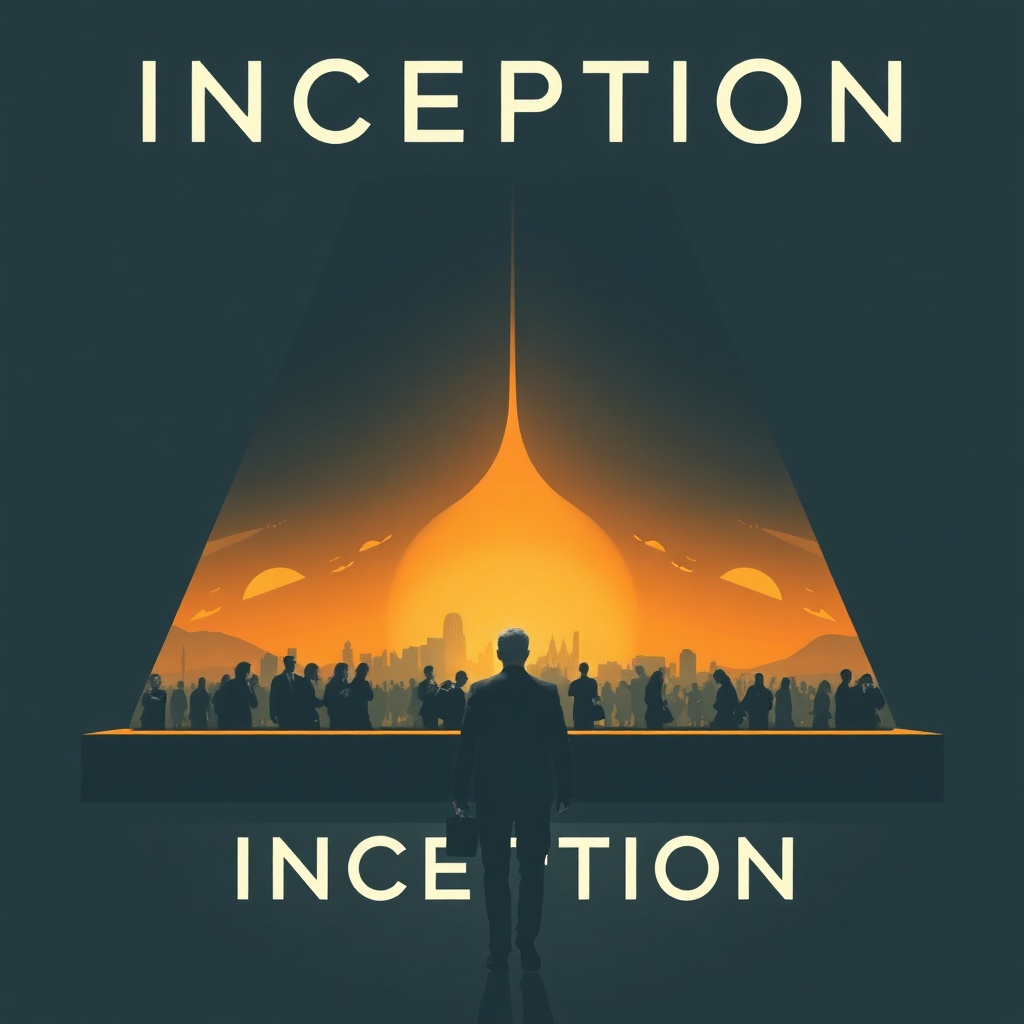
Directed by visionary filmmaker Christopher Nolan, "Inception" (2010) is a science fiction action epic that delves into the complexities of the human subconscious. The film challenges the boundaries between dream and reality, presenting an ingenious premise of stealing and planting ideas within dreamscapes, cementing itself as one of the most impactful and discussed works of contemporary cinema.
Analysis and Plot
"Inception" introduces Dom Cobb (Leonardo DiCaprio), a skilled "extractor" who specializes in invading people's dreams to steal valuable secrets from their subconscious while they sleep. His rare ability has made him an international fugitive, preventing him from returning to the United States and, consequently, from reuniting with his children. The plot deepens when Cobb receives one last, high-stakes mission from Saito (Ken Watanabe), a powerful Japanese businessman: instead of extracting an idea, he must perform the near-impossible "inception" – planting an idea in the subconscious of Robert Fischer (Cillian Murphy), the heir to a business empire, to force him to dissolve his father's corporation.
To accomplish this complex task, Cobb assembles a team of specialists: Arthur (Joseph Gordon-Levitt), the "point man," responsible for logistics and ensuring everything goes according to plan; Ariadne (Elliot Page), a brilliant architecture student recruited as the "architect," tasked with designing the intricate dream landscapes; Eames (Tom Hardy), the "forger," capable of assuming the appearance of others within dreams to manipulate the target; and Yusuf (Dileep Rao), the "chemist," who formulates the potent sedatives needed to sustain multiple dream levels.
The team embarks on a journey through increasingly deep layers of dreams, where time dilates exponentially at each level. In the first level, a rainy city and a van kidnapping serve as a pretext. In the second, a hotel with zero gravity due to the movement of the van in the level above. In the third, a fortress on a snow-covered mountain. However, the mission is constantly threatened by Mal (Marion Cotillard), Cobb's deceased wife, who manifests as a powerful and malevolent projection of his guilt, sabotaging the plans and forcing Cobb to confront his own trauma.
Mal's projection is a manifestation of Cobb's guilt over her suicide, which occurred after he had inadvertently planted the idea in her mind that reality was a dream and that she needed to "wake up." This guilt haunts him and prevents him from fully controlling his subconscious, creating a constant risk of being trapped in Limbo, a deep and chaotic dream level where time barely exists and the mind can be lost forever.
The Ending: Reality or Dream?
The ending of "Inception" is undoubtedly one of the most debated and ambiguous in cinema history. In the final scene, after the successful completion of the inception mission on Fischer, Cobb finally manages to return to the United States. He passes through immigration and rushes home, where his children are waiting for him in the garden. Before joining them, he spins his totem, a top, on a table. Cobb's totem, as he explains in the film, serves so that each extractor can differentiate dream from reality: in a dream, the top would spin indefinitely; in reality, it would fall.
However, the camera cuts abruptly before the audience sees if the top stops spinning, leaving the question open: did Cobb really return to reality, or is he still trapped in one of his own dreams? This ambiguity has generated countless theories over the years.
Conflicting Interpretations:
- Reality: Many viewers believe that Cobb does, in fact, return to reality. Evidence supporting this theory includes the fact that Cobb is not wearing his wedding ring in the final scene, a detail he only displays in dreams. Furthermore, the actors playing his children in the final scene are slightly different and their clothes are also different, indicating they have aged, unlike the static projections in his dreams. Michael Caine, who plays Cobb's father-in-law, Miles, revealed in 2018 that Christopher Nolan told him that the scenes in which his character appeared were reality, and Miles appears at the end to pick up Cobb at the airport. It is also argued that Cobb, at the beginning of the film, explains that in dreams we never remember the beginning, and in the final scene, he remembers perfectly how he got home.
- The Continuous Dream: Another strong theory suggests that Cobb never left the dream, or perhaps became trapped in Limbo. The main evidence is the top that continues to spin. Some argue that Cobb himself no longer cares whether it is reality or not; he just wants to be with his children, and the film closes the character's emotional arc regardless of the objective state of reality. Christopher Nolan has, on several occasions, reinforced the intention of the ambiguity, stating that the main question is not whether the top falls, but that Cobb no longer cares. The ambiguity is intellectual for the audience, not emotional for the character.
Cast and Notable Performances
The stellar cast of "Inception" is one of the pillars of its success. Leonardo DiCaprio delivers a captivating performance as Dom Cobb, a man tormented by his past and driven by the desire to reunite with his children. His performance brings the emotional depth necessary to anchor the complex narrative.
Elliot Page (credited as Ellen Page at the time of the film) shines as Ariadne, the audience's gateway to the rules of the dream universe. Joseph Gordon-Levitt, as Arthur, impresses with his zero-gravity action sequences, standing out for his precision and physicality. Marion Cotillard, in the role of Mal, is haunting and moving, personifying Cobb's guilt and grief. Rounding out the team are Ken Watanabe as Saito, the enigmatic employer, Cillian Murphy as the target Robert Fischer, and Tom Hardy, who steals the show as the charismatic forger Eames.
Michael Caine also has a crucial role as Miles, Cobb's mentor and Mal's father, adding an extra layer of personal connection to the protagonist.
Behind the Scenes and Production Trivia
Christopher Nolan conceived the idea for "Inception" at age 16, developing the script for about eight years before producing it. He wanted more experience with big-budget films before tackling the magnitude and complexity of "Inception," working on projects like "Batman Begins" and "The Dark Knight" in the interim.
The film is notable for its extensive use of practical effects instead of CGI, which contributes to the sense of reality in the most surreal scenes. Examples include the rotating hallway for Arthur's zero-gravity fight, which took weeks to build and film, and the exploding café in Paris. Filming took place in six countries on four continents: Japan, Morocco, France, England, Canada, and the United States, giving the production a global scale.
Hans Zimmer's innovative soundtrack, with the famous "vuvuzela sound" (a prolonged metallic roar), and the adaptation of Edith Piaf's "Non, je ne regrette rien," are crucial elements that define the film's emotional and tense tone. A fun fact is that the first letters of the main characters' names (Dom, Robert, Eames, Arthur, Mal, and Saito) form the word "DREAMS."
Nolan also explained that the team's roles in the film were based on those of a film production: Cobb as the director, Arthur as the producer, Ariadne as the production designer, Eames as the actor, Saito as the studio, and Fischer as the audience.
Reception and Legacy
"Inception" was widely acclaimed by critics and audiences, becoming a massive commercial success, grossing over $839 million worldwide against a $160 million budget. It received eight Oscar nominations, including Best Picture, and won in four technical categories: Best Cinematography, Best Visual Effects, Best Sound Editing, and Best Sound Mixing.
Critics praised Nolan's complex and intelligent script, his masterful direction, the themes explored, the cast's performances, and the innovative visual effects. The film was described as a work that blends the real and the imaginary, with a well-crafted narrative and intelligent elements.
"Inception" established itself as a landmark of contemporary cinema, influencing a growing trend of films and series that address themes such as consciousness, time, and manipulated memories. The philosophical debate about the totem, lucid dreams, and the nature of reality continues to intrigue viewers and academics. Nolan's ability to create a blockbuster that treats its audience with intelligence and respect was widely praised. Nolan's work with "Inception" is often compared to classics like "The Matrix" and "Blade Runner" for its ability to open up new worlds and define a cinematic era.
Controversies and Debates
The main "controversy" surrounding "Inception" lies, without a doubt, in the ambiguity of its ending. The debate over whether Cobb's top stops or continues to spin persists to this day, with fans and critics offering various interpretations. Although Nolan has stated that the "correct answer" is that Cobb no longer cares about reality, the discussion about the totem remains alive, ensuring the work's longevity in pop culture.
Other points of discussion include certain "plot holes" pointed out by some critics, such as the ease with which Ariadne, a newcomer, accepts the job and solves complex problems, or the logic of the totems themselves. There are also those who criticize Nolan's tendency to "over-explain" the rules of the universe, sometimes through characters who serve as mouthpieces for the audience. However, many argue that these "explanations" are necessary for the understanding of such an intricate plot.
Research Sources
- https://www.tecmundo.com.br/minha-serie/270428-origem-entenda-final-filme-christopher-nolan.htm
- https://www.adorocinema.com/filmes/filme-143651/curiosidades/
- https://www.planocritico.com/critica-a-origem/
- https://terra.com.br/diversao/cinema/dez-fatos-curiosos-sobre-o-filme-a-origem,004ee9e553fc4210cf1bfb3b3a3219c0b02y3390.html
- https://mubi.com/pt/films/inception/cast
- https://pt.wikipedia.org/wiki/A_Origem
- https://www.adorocinema.com/filmes/filme-143651/elenco/
- https://revistaoeste.com/geral/15-anos-depois-a-origem-ainda-bagunca-a-cabeca-de-todo-mundo/
- https://cinepop.com.br/curiosidades-11-anos-de-a-origem-elogiado-sci-fi-dirigido-por-christopher-nolan-321303
- https://chippu.com.br/noticias/christopher-nolan-final-a-origem-inception
- https://cinealerta.com.br/critica-a-origem/
- https://eaicinefilocadevoce.com/2014/04/critica-origem-2010.html
- https://www.adorocinema.com/series/serie-21948/elenco/
- https://mundoemtela.com.br/final-explicado-de-a-origem/
- https://portallos.com.br/2010/07/22/critica-a-origem-inception/
- https://www.cinemacomrapadura.com.br/criticas/2010/08/05/a-origem-2010-nao-e-todo-dia-que-se-assiste-a-um-filme-assim/
- https://www.youtube.com/watch?v=R_l-uFhD-4A
- https://paginadois.wordpress.com/2010/08/26/a-origem-inception-christopher-nolan-2010/
- https://pplware.sapo.pt/cinema/finalmente-christopher-nolan-explicou-o-final-de-inception-a-origem/
- https://pt.wikipedia.org/wiki/From
- https://www.youtube.com/watch?v=0xKqTzV-2o0
- https://www.pausadramatica.com.br/2020/07/13/10-curiosidades-para-comemorar-10-anos-de-a-origem/
- https://piaui.folha.uol.com.br/materia/a-origem-intrincado-atestado-de-limite-do-cinema/
- https://www.pipocacombo.com.br/2015/01/porque-o-filme-a-origem-inception-nao-e.html
- https://www.adorocinema.com/noticias/filmes/noticia-155419/
- https://www.reddit.com/r/movies/comments/1y93c0/explanations_for_some_of_inceptions_biggest_plot/
- https://thegoldentake.com/2020/07/02/inception-a-realidade-de-um-sonho/
- https://www.youtube.com/watch?v=gS-q_x1QdC8
- https://www.omelete.com.br/filmes/critica-origem
- https://problemasfilosoficos.wordpress.com/2015/05/31/a-origem-inception-problemas-filosoficos/
- https://genialmentelouco.com.br/entendendo-o-filme-a-origem-inception/
- https://www.bemparana.com.br/noticia/a-origem-impressiona-pela-ousadia-e-engenhosidade
- https://veja.abril.com.br/cultura/a-ciencia-por-tras-do-filme-a-origem





