



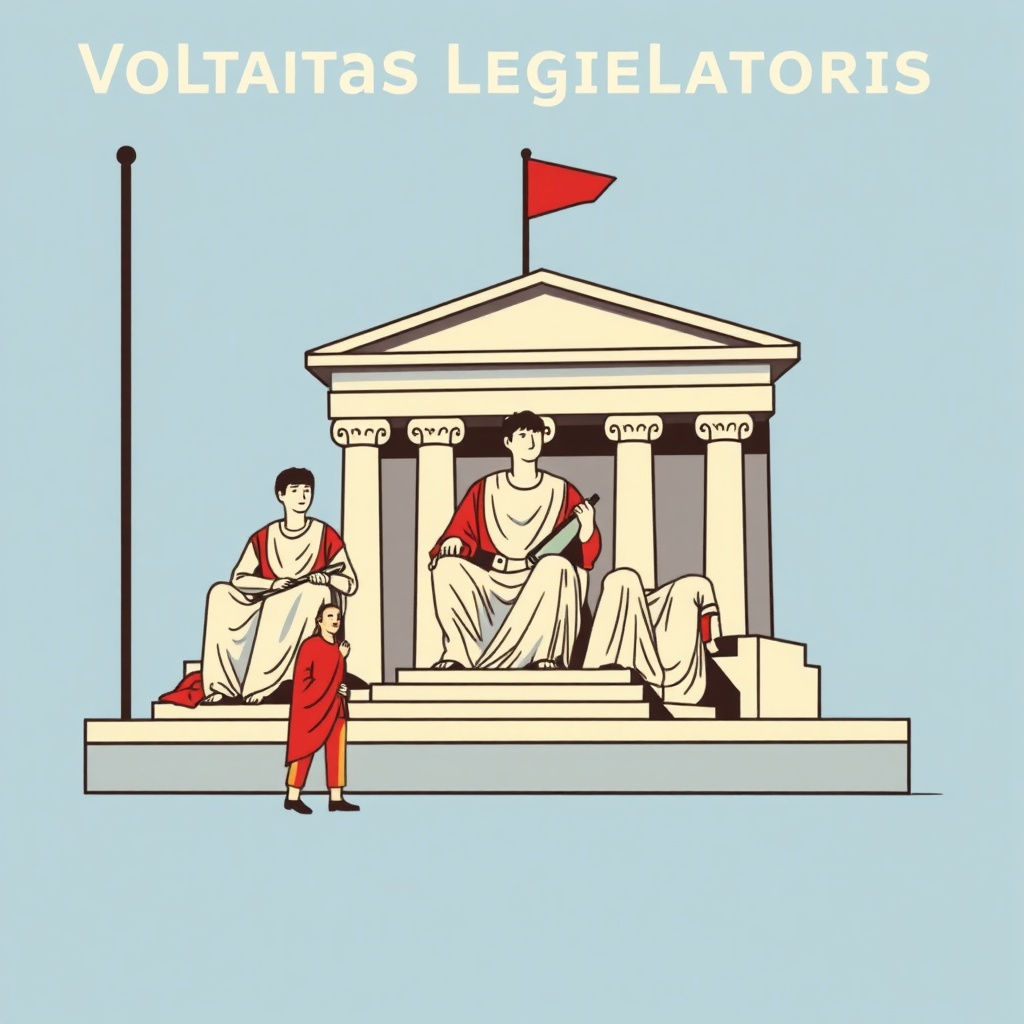
The Latin expression voluntas legislatoris (will of the legislator) designates the subjective-historical method of legal interpretation, through which the exegete seeks to reconstruct the thought and real intention of lawmakers at the moment of the norm's creation. Essential for Legal Hermeneutics and applicable transversally to the branches of Constitutional, Civil, and Criminal Law, this institute aims to provide legal certainty by linking the application of the law to the original purpose intended by the Legislative Power, serving as a counterpoint to the purely objective interpretation of the norm (voluntas legis).
1. Definition, Concept, and Legal Nature
The voluntas legislatoris, or mens legislatoris, represents the subjective element of legal interpretation. It involves the search for the psychic, political, and social intention of the authors of the legal norm at the moment of its genesis. It differs from voluntas legis (will of the law), which focuses on the objective and autonomous meaning that the text acquires after entering into force, regardless of the motivations of its creators.
The legal nature of this institute is that of an interpretative hermeneutic criterion. It is based on the premise that the law is an act of political will and, therefore, its meaning must be extracted from the purposes pursued by the law-making body. On a dogmatic level, voluntas legislatoris is the pillar of the School of Exegesis, arguing that the interpreter must be the "slave of the law" and of the sovereign's will represented in Parliament.
2. Historical Origin and Evolution
Historically, the primacy of voluntas legislatoris was consolidated in the 19th century with the advent of the Napoleonic Code (1804). The School of Exegesis in France and the Jurisprudence of Concepts in Germany (in its initial phase) preached that the law was complete and that any ambiguity should be resolved by resorting to preparatory works (travaux préparatoires).
In Brazilian Law, the Romano-Germanic tradition has always given weight to the legislator's intention. However, with the evolution toward post-positivism and the recognition of the normative force of the Constitution, voluntas legislatoris began to coexist—and often give way—to teleological and axiological interpretation. The transition from the Legal State to the Democratic State of Law shifted the focus from the subjective will of the parliamentarian to the social purpose of the norm and its compliance with fundamental rights.
3. Legal Provision and Normative Foundation
The Brazilian legal system does not expressly use the Latin term, but it codifies its application in several fundamental statutes:
- Law of Introduction to the Norms of Brazilian Law (LINDB - Decree-Law No. 4,657/1942): Art. 5 provides that "in the application of the law, the judge shall attend to the social ends to which it is directed and to the requirements of the common good." Although it mentions "social ends" (teleological criterion), the search for these ends often traces back to the voluntas legislatoris expressed in the explanatory memoranda.
- National Tax Code (CTN): Art. 112 establishes that tax law defining infractions or imposing penalties must be interpreted in the manner most favorable to the accused, which sometimes requires scrutinizing the legislator's intention regarding the gravity of the conduct.
- Civil Code and Code of Civil Procedure: The interpretation of legal transactions (Art. 112 of the CC) favors the intention of the parties over the literal meaning, a principle that is projected by analogy to the interpretation of laws when seeking the mens legislatoris.
4. Practical Application and Jurisprudential Understanding
The jurisprudence of the Superior Courts (STF and STJ) uses voluntas legislatoris in a subsidiary and integrative manner, especially when the legal text presents gaps or polysemy. The use of the Explanatory Memorandum is the primary instrument for assessing this will.
Supreme Federal Court (STF)
The STF frequently resorts to the will of the original constituent to delimit the scope of unamendable clauses (cláusulas pétreas). In the judgment of ADC 41 (Constitutionality of quotas in public tenders), the Court analyzed the legislator's intention to promote material equality. More recently, in debates regarding the Administrative Improbity Law (Law 14.230/2021), the STF emphasized that the clear will of the legislator was to restrict punishability only to intentional acts, excluding the negligent modality (ARE 1.127.542/SP - Theme 1.199).
Superior Court of Justice (STJ)
The STJ has consolidated the understanding that, although mens legis prevails over mens legislatoris in contexts of social evolution, the legislator's intention is crucial for defining the scope of technical norms. In Súmula 506, when dealing with the responsibility of the CEF for the FGTS, and in repetitive appeals regarding consumer law, the Court uses parliamentary debates to clarify open concepts.
5. Correlated Principles and Doctrinal Divergences
Contemporary doctrinal debate is divided between:
- Subjectivist Theory: Argues that the law is the crystallized will of the legislator. The interpreter must be faithful to the moment of creation (Originalism).
- Objectivist Theory: Maintains that, once promulgated, the law detaches itself from its creator and takes on a life of its own, and must be interpreted according to the current social context (Living Law).
Correlated principles include the Principle of Legality (Art. 5, II, CF), which requires that the legislator's will be formally expressed, and the Principle of Separation of Powers, which prevents the Judiciary from acting as a "positive legislator" under the pretext of interpreting the will of the law.
6. Contemporary Relevance and Practical Impacts
Voluntas legislatoris has regained prominence in the current legal scenario as a mechanism to contain so-called "judicial activism." By invoking the legislator's will, legal practitioners seek to limit extensive interpretations that might disfigure the political commitment made in Parliament.
In the scope of Criminal Law, the principle of taxativity requires that the legislator's will be strictly respected to avoid in malam partem analogies. In Administrative Law, recent changes to the LINDB (by Law No. 13.655/2018) reinforce the need to consider the real difficulties of the manager and the normative intentions, mitigating purely abstract interpretations.
Legal and Jurisprudential References
- BRAZIL. Constitution of the Federative Republic of Brazil of 1988.
- BRAZIL. Decree-Law No. 4,657, of September 4, 1942 (Law of Introduction to the Norms of Brazilian Law).
- BRAZIL. Law No. 14,230, of October 25, 2021 (Reform of the Administrative Improbity Law).
- STF. ARE 1.127.542/SP (Theme 1.199). Rel. Min. Alexandre de Moraes. Judgment on 08/18/2022.
- STJ. REsp 1.699.528/MG. Rel. Min. Herman Benjamin. Second Panel. Jurisprudence Bulletin No. 0612.
- MAXIMILIANO, Carlos. Hermenêutica e Aplicação do Direito. 21st ed. Rio de Janeiro: Forense, 2017.





