



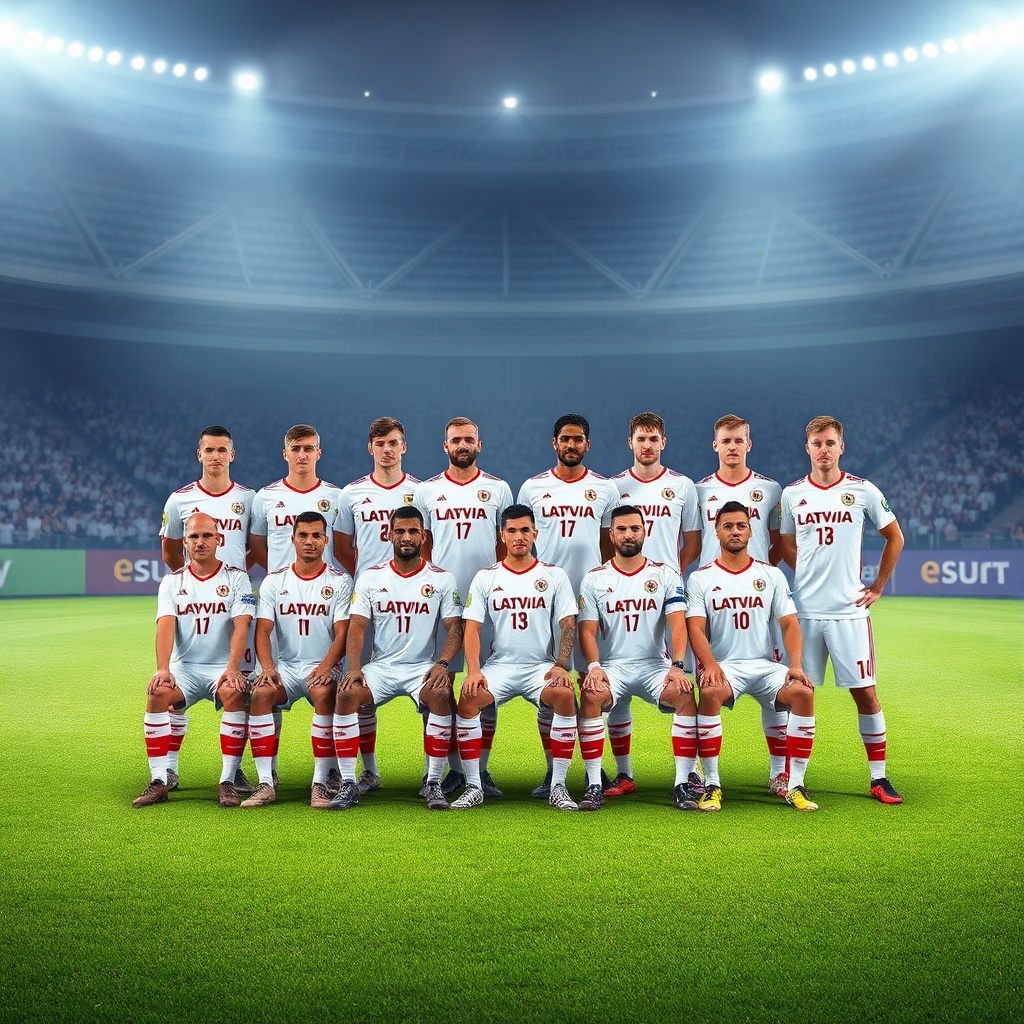
On the periphery of European football, where harsh winters shape the character of men and the shadows of the Soviet past still loom over sports institutions, the Latvian national football team survives as a historical enigma. To the casual observer, the "Sarkanbaltsarkanie" (The Red-White-Reds) represent just another team from the lower echelons of UEFA, a frequent inhabitant of the lower divisions of the Nations League and a supporting act in qualifying cycles. However, for those who understand the geopolitics of the game, Latvia holds the distinction of being the only Baltic nation to have played in a European Championship final tournament, in 2004 — a feat that defied the laws of sporting probability and which today, paradoxically, acts as a nostalgic shadow that stifles the present. This dossier delves into the guts of a football culture that oscillates between the Spartan heritage of its golden era and the harsh realities of a tactical, financial, and structural reconstruction in the midst of the 21st century.
1. Origins and Formation of National Identity
Football arrived on the banks of the Daugava River in the early 20th century, brought by British sailors and German merchants who frequented the cosmopolitan port of Riga. In a Latvia that was still seeking its emancipation from the Russian Empire, the British sport quickly became a vehicle for identity affirmation. The founding of the Latvian Football Federation (LFF) in 1921, shortly after the country's declaration of independence in 1918, marked the formal birth of a national team that, in its early years, reflected the cultural mosaic of the capital. The first official match, a 1-1 draw against neighboring Estonia in 1922, inaugurated not only a sporting trajectory but the oldest and fiercest regional rivalry in Northern Europe: the Baltic Cup.
During the interwar period, Latvia established itself as the primary footballing force in the region. Under the command of foreign coaches, mostly Austrians and Hungarians who brought the influence of the refined "Danubian School," the Latvians developed a style of play that combined the natural physical vigor of their athletes with an incipient tactical organization. Participation in the 1924 Paris Olympic Games, although resulting in a 7-0 defeat to the powerful French side, served as the baptism of fire necessary for a generation that would dominate the regional scene in the 1930s.
The peak of this first historical cycle occurred during the 1938 World Cup Qualifiers. The Latvian team, led by legendary striker Fricis Kaņeps and refined midfielder Jānis Rozītis, overcame Lithuania with two categorical victories (4-2 in Riga and 5-1 in Kaunas) and was one step away from securing a spot in the World Cup in France. The final obstacle was Austria, which won the decisive clash in Vienna 2-1. However, with the subsequent annexation of Austria by Nazi Germany (the Anschluss), the theoretical spot should have gone to Latvia. Due to political reasons and controversial administrative decisions by FIFA, the invitation was never formalized, depriving that talented generation of debuting on the biggest stage of world football.
World War II and the subsequent occupation and annexation of Latvia by the Soviet Union in 1940 abruptly interrupted the development of independent national football. The Latvian team was dissolved, and the country's main clubs, such as ASK and RFK Rīga, were extinguished to make way for associations controlled by the Soviet state apparatus. During the fifty years of Soviet domination, Latvian football was integrated into the complex Moscow sports system. Daugava Rīga became the main ambassador of the Baltic republic's football in the Soviet league, oscillating between the first and second national divisions.
During this period of silencing its flag, Latvia continued to produce talents who, by force of circumstances, wore the red shirt of the USSR or shone on the fields of the Soviet championship. Names like Georgijs Smirnovs, a skillful left-winger who enchanted Daugava fans in the 1950s and 1960s, and later Jānis Gilis and Aleksandrs Starkovs, kept the technical flame of Latvian football alive. Starkovs, in particular, stood out as a prolific striker at Daugava Rīga, scoring over a hundred goals and paving the way for what would be the most important tactical figure in the country's history after the restoration of independence in 1991.
2. Golden Era, Great Campaigns, and Eternal Idols
The reconquest of independence in 1991 brought with it the herculean challenge of rebuilding a national team from scratch. Without the support infrastructure of the Soviet state and facing a severe economic crisis of transition to capitalism, Latvia had to rely on the raw talent of a generation raised under the rigid discipline of Soviet sports schools, but now free to play in the major centers of European football. Under the technical leadership of Jānis Gilis and, later, the Georgian Revaz Dzodzuashvili, the national team began to show signs of competitiveness, but it was the arrival of Aleksandrs Starkovs as head coach in 2001 that triggered the most glorious era of Latvian sport.
Starkovs, a pragmatic strategist and deep connoisseur of the Baltic athlete's psychology, designed a game model based on Spartan defensive organization, ultra-fast offensive transitions, and an unbreakable team spirit. The qualifying campaign for Euro 2004, hosted in Portugal, remains one of the greatest fairy tales in the history of modern European football. Drawn into a difficult group alongside Sweden, Poland, Hungary, and San Marino, Latvia was seen as a mere extra. However, surprising away victories against Poland (1-0, goal by Juris Laizāns) and Sweden (1-0, goal by Māris Verpakovskis) secured the Latvians second place in the group and the right to play in the playoffs.
The draw placed Turkey, then third-place finishers in the 2002 World Cup, as the final obstacle between Latvia and glory. What followed in November 2003 was a two-part epic. In the first leg, under freezing temperatures at the cramped Skonto Stadium in Riga, Māris Verpakovskis scored an anthological goal, lobbing goalkeeper Rüştü Reçber after an individual play of pure speed and technique. The 1-0 victory gave them a minimal advantage for the return trip to the cauldron of Istanbul. At the BJK İnönü Stadium, the Turks went up 2-0 with goals from Ilhan Mansiz and Hakan Şükür, a scoreline that would eliminate the visitors. That was when Latvian resilience made itself felt: Juris Laizāns scored from a free kick in the 64th minute, and in the 78th, Verpakovskis took advantage of a long goal kick from goalkeeper Aleksandrs Koļinko to beat the Turkish defense with speed and score past Rüştü. The 2-2 draw sealed Latvia's historic qualification for Euro 2004 with a 3-2 aggregate score.
In Portugal, Latvia was drawn into the "Group of Death" alongside Germany, the Netherlands, and the Czech Republic. Far from being humiliated, Starkovs' team competed with spectacular dignity. In the opener against the Czechs, Verpakovskis opened the scoring late in the first half, and Latvia held the lead until the final minutes, when pressure from Nedvěd, Baroš, and Heinz resulted in a 2-1 comeback. In the second round, the Latvians snatched a historic 0-0 draw against three-time world champions Germany, withstanding monumental pressure thanks to miraculous saves by Koļinko and the leadership of defender Igors Stepanovs. Elimination came with a 3-0 defeat to the Netherlands, but the delegation returned to Riga to the applause of national heroes.
The names from that campaign became immortal in the country's sporting folklore:
- Vitālijs Astafjevs: The tireless captain, a combative midfielder who held the record for most appearances for a European national team (167 caps) for years, serving as the team's beating heart.
- Māris Verpakovskis: The greatest striker in the country's history, whose speed and goal-scoring instinct at Euro 2004 earned him a transfer to Dynamo Kyiv and the status of a living legend (29 goals for the national team).
- Marians Pahars: The "Baltic Michael Owen," a striker of refined technique who shone in the English Premier League wearing the Southampton shirt, although injuries limited his impact in the final phase of the Euro.
- Aleksandrs Koļinko: A goalkeeper with spectacular reflexes, whose secure performances in Russia and England provided defensive stability to the national team for over a decade.
- Igors Stepanovs: An imposing defender who even played for Arsène Wenger's Arsenal, serving as the rock upon which Starkovs' defensive fortress was built.
3. Rivalries, Crises, and Behind-the-Scenes Power
Beyond the pitch, Latvian football is deeply influenced by its complex geopolitical web and by serious administrative crises that compromised its development post-Euro 2004. Latvia's main rivalry is of a regional and historical nature: the dispute against Estonia and Lithuania for supremacy in the Baltics. The Baltic Cup, played intermittently since 1928, is a tournament loaded with nationalist symbolism. Winning the regional cup is a matter of honor that transcends mere sporting value, serving as a barometer of national pride for the three republics that share a past of resistance and reconstruction.
However, the biggest battles of Latvian football in recent decades have been fought behind the scenes of power and in the courts. The Latvian Football Federation (LFF) was dominated for over twenty years by the controversial figure of Guntis Indriksons, who presided over the entity from 1996 to 2018. Indriksons, who was also the owner of Skonto FC — a club that established an overwhelming hegemony by winning 14 consecutive national championships between 1991 and 2004 — centralized the power and resources of national football in a way that many critics point to as detrimental to long-term competitiveness.
The symbiosis between the Federation and Skonto FC created a fragile ecosystem. When Indriksons' financial empire began to crumble due to the 2008 global economic crisis and ill-fated investments, Skonto FC entered a spiral of debt that culminated in its bankruptcy and subsequent extinction in 2016. The disappearance of the country's biggest club left a huge void in athlete development and exposed the structural weaknesses of a national league (the Virslīga) that, for years, neglected the development of sustainable youth categories in favor of immediate results.
The fall of Indriksons paved the way for a period of extreme political instability in the LFF. In 2018, former national team captain Kaspars Gorkšs was elected president on a platform of modernization and transparency. However, his term lasted only 18 months. Gorkšs clashed with the entrenched interests of old local football bosses and with suspicions of corruption and match-fixing that plagued the national league. In an extraordinary general assembly in October 2019, federation members voted to remove Gorkšs, plunging the institution into a governance crisis that required direct intervention from UEFA and FIFA to avoid international sanctions.
Match-fixing, in fact, has been the silent cancer of Latvian football. During the 2010s, several Virslīga clubs, such as FC Jūrmala and FC Babīte, were excluded from the national championship after investigations proved the involvement of players, officials, and Asian betting syndicates in match-fixing schemes. These controversies severely damaged the sport's credibility in the country, driving away corporate sponsors and the public from stadiums, which began to record paltry attendance figures, often fewer than five hundred spectators per match.
4. The Current Moment: Tactics, Generation, and Challenges
Contemporary Latvian football is experiencing a painful process of tactical and generational transition. After years of insistence on an ultra-conservative defensive model inherited from the Starkovs era — which no longer found technical support in modern players — the national team has sought to reinvent itself under new technical leadership. The tenure of coach Dainis Kazakevičs (2020-2023) brought some stability and a slight evolution in the Nations League, where Latvia achieved promotion from League D to League C. However, the inability to compete against mid-tier European teams in the Euro 2024 Qualifiers evidenced that deeper reforms were necessary.
In early 2024, the LFF made a bold decision by hiring experienced Italian coach Paolo Nicolato, known for his excellent work with Italy's youth teams (leading the "Azzurrina" to the U-19 European runner-up spot and the U-20 World Cup semifinals). Nicolato arrived with the mission of modernizing the Latvian game model, implementing a more proactive approach based on modern principles: defensive compactness in a mid-block, structured offensive transitions through dynamic support, and a greater appreciation for ball possession.
Tactically, Nicolato has alternated between the 3-4-2-1 system and the classic 4-2-3-1, adapting the structure to the physical characteristics of the available athletes. The backbone of the current national team reflects this search for modernity:
- Kristers Tobers: The captain and symbol of the new era. Versatile, he acts as both a center-back and a defensive midfielder. Currently at Grasshopper in Switzerland, Tobers combines physical vigor with excellent game reading and technical leadership.
- Jānis Ikaunieks: The team's creative brain. Playing for RFS, Ikaunieks is a left-footed attacking midfielder with rare vision and mid-range finishing ability. He is the player responsible for providing clarity to offensive transitions.
- Roberts Uldriķis: The target man with physical presence. At 1.98m tall, the Cambuur (Netherlands) striker is fundamental for the aerial hold-up game, serving as a pivot for the midfielders' arrival and offering a crucial escape valve under pressure.
- Raimonds Krollis: A young attacking prospect whose rights belong to Spezia in Italy. Krollis represents speed and mobility in the final third, although he is still seeking consistency in his international career.
- Vladislavs Gutkovskis: A striker of strength and physical imposition who plays in Asian football (Daejeon Hana Citizen, South Korea), offering an alternative of greater depth and aggression in the opposing box.
The great tactical challenge for Nicolato's Latvia lies in the balance between defensive solidity and creativity in midfield. Historically comfortable defending in a low block, the team suffers when it needs to dictate the game against opponents of a similar level. The scarcity of midfielders with the ability to dictate the pace of the game and break lines through short passing forces the national team to rely excessively on direct balls to Uldriķis, making the attack predictable for well-positioned defenses. Furthermore, defensive transition remains a vulnerable point, especially when the team tries to press high and leaves generous spaces between its lines.
5. Talent Development, Structure, and Future
The future of football in Latvia depends fundamentally on the restructuring of its academic base and the strengthening of its domestic league, the Virslīga. For many years, the country relied on the centralized model of Skonto FC. With its collapse, Latvian football decentralized, giving rise to a new and interesting competitive landscape led by two emerging forces from the capital: Riga FC and RFS (Rīgas Futbola Skola).
These two clubs, driven by substantial private investment and professionalized management, have revolutionized the local football landscape. RFS, in particular, achieved a historic feat by qualifying for the UEFA Conference League group stage in the 2022/2023 season and, subsequently, for the UEFA Europa League league phase in 2024/2025, competing on equal terms against giants of the continent. These European successes not only injected vital financial resources into the Latvian football ecosystem but also raised the level of competitive demand for local players, who now routinely face international-level opponents.
In terms of infrastructure, Latvia still faces severe climatic limitations. With winters that extend from November to April, with temperatures frequently below zero and abundant snow, the practice of football requires high-quality indoor facilities. In recent years, the LFF, in partnership with municipalities and UEFA development programs (such as HatTrick), has invested in the construction of state-of-the-art synthetic grass pitches and regulation-sized indoor arenas (the so-called "football domes"). These facilities allow young athletes to train in ideal conditions throughout the year, reducing the technical gap compared to countries in Southern and Western Europe.
The player export process has also undergone drastic changes. If in the 1990s and early 2000s the main Latvian talents migrated directly to the English Premier League or the Russian Premier League, today the path is more gradual and strategic. Young players are frequently recruited by academies in Italy (such as Spezia, Parma, and Sampdoria) or seek competitive intermediate markets, such as the Polish Ekstraklasa, the Swiss Super League, and the Czech Chance Liga. This early exposure to more demanding tactical cultures is seen by the national team's coaching staff as the main driver for raising the technical level of the senior squad.
In the long term, the goal of the Latvian Football Federation is to consolidate the national team as a mid-level force in Europe, capable of consistently fighting for spots in continental tournament playoffs, taking advantage of the increase in spots in the European Championship (24 teams) and the World Cup (48 teams). For a country of only 1.8 million inhabitants, where ice hockey and basketball fiercely compete for popular preference and sponsorship resources, football needs to assert itself not just as a mass sport, but as a project of national pride. The memory of Portugal in 2004 should no longer be a burden of melancholic nostalgia, but rather the incontestable proof that, with organization, discipline, and a clear identity, giants can be challenged on the frozen plains of the Baltics.





